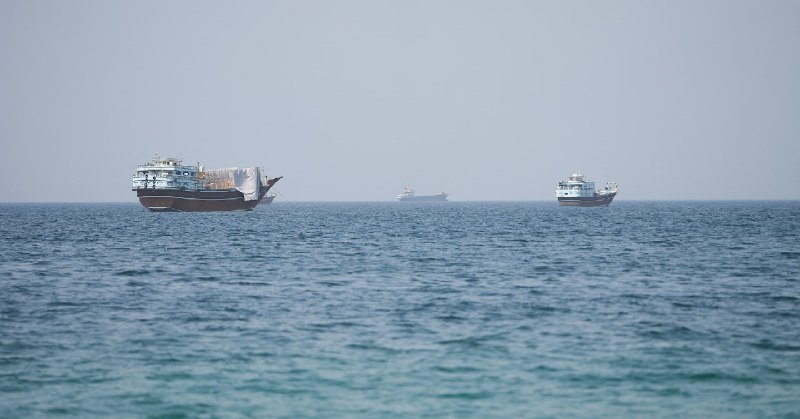
Tehran tests the Strait: Hormuz is now a political question, not a naval one
Iran's deputy foreign minister has publicly declared that Tehran will obstruct any vessel transiting the Strait of Hormuz outside routes it specifies. The statement reframes a chokepoint as a discretionary political lever.

On 29 June 2026, Iran's Deputy Foreign Minister Kazem Gharibabadi said what Iranian officials have long hinted at in private: that Tehran "opposes, and will try to obstruct, any vessels transiting through paths in Hormuz that are not specified by Tehran." The remarks, relayed by the Open Source Intel channel at 18:43 UTC, did not arrive as a leak or a backchannel trial balloon. They were a public restatement of a position the Islamic Republic has been refining for years — one that treats the Strait of Hormuz not as a shared maritime corridor under international law, but as a discretionary lever the regime can pull on a vessel-by-vessel basis.
This is the story the wires have been slow to tell in plain terms. The Strait is a global chokepoint in the textbooks, but in Iranian doctrine it is a domestic asset, governed by a logic in which shipping rights are conditional on political alignment. Gharibabadi's words are not a new posture; they are a more candid articulation of an old one.
The announcement, in context
Gharibabadi's statement came in the same window in which Iranian officials and state-aligned commentators have been sketching the practical mechanics of selective transit. The phrase "paths in Hormuz that are not specified by Tehran" does the rhetorical work. It presumes an authority to specify paths in the first place, and to treat compliance with that specification as the condition for safe passage. The Open Source Intel relay, posted at 18:43 UTC on 29 June 2026, frames this as a continuation of Iranian messaging rather than a rupture — language Tehran has used, in softer form, since at least 2019 when it seized the British-flagged Stena Impero, and again during periods of sanctions escalation.
What is distinctive now is the explicitness. "Will try to obstruct" is not the language of deterrence. It is the language of intent.
The counter-narrative, in the strongest form
Read against the grain, the Iranian position is internally coherent. Iranian strategists argue that the United States and its Gulf allies have, for decades, treated the Persian Gulf as a militarised corridor in which Iranian sovereignty is routinely overwritten — through sanctions enforcement, vessel interdictions, and the persistent presence of the US Fifth Fleet. From Tehran's vantage point, the legal architecture of "freedom of navigation" has functioned less as a neutral principle than as a one-way door: Western warships transit freely while Iranian-aligned shipping is seized, inspected, or held.
There is a real historical record behind that complaint. The 1980s tanker war, the 1988 downing of Iran Air 655 by the USS Vincennes, and the 2019 seizures of tankers in the Gulf by IRGC forces all sit inside a long pattern of tit-for-tat maritime pressure. The Iranian counter-narrative deserves to be taken seriously, not as justification for obstruction, but as a reminder that the present escalation is the product of a long asymmetry — and that the West's preferred vocabulary of "rules-based order" has, for many governments in the region, an unfortunate echo of "rules for thee, discretion for us."
The structural frame, in plain prose
What is changing in 2026 is not the law of the sea. The legal regime — UNCLOS Part III, Articles 37–44, governing transit passage through international straits — is settled. What is changing is the willingness of a regional power to publicly disavow the operational premise that transit passage is, in practice, an open right. That is a different kind of signal than the older routine of veiled threats. It tells shipping insurers, oil traders, and naval planners that the Iranian regime is now prepared to convert a contested legal position into an administrative regime, in which the question "may I pass?" is answered by Tehran rather than by the geometry of the water.
The knock-on effects will be felt first in the Lloyd's-listed insurance market, where war-risk premiums for tankers transiting the Strait are quoted in hours, not weeks. The last comparable spike, in 2019, briefly pushed VLCC insurance surcharges to a documented range of several hundred thousand dollars per voyage. A second-order effect sits in the Asian energy market: roughly 80 percent of crude exported through Hormuz flows to buyers in China, India, Japan, and South Korea, and any move that forces a longer diversion around the Cape of Good Hope will be felt in Asian trade balances before it shows up in Gulf state revenue.
What remains uncertain, and what to watch
The Open Source Intel relay carries Gharibabadi's wording but does not specify whether the policy statement has been operationalised through an order to the IRGC Navy, or whether it remains a diplomatic posture awaiting a triggering event. The sources do not specify the legal mechanism Tehran would invoke to declare specified transit paths, nor whether the regime has coordinated that posture with Gulf neighbours who also border the Strait. Those are the questions that will determine whether 29 June 2026 becomes a date the energy desks remember, or a day of unusually pointed rhetoric that fades by the next news cycle.
What this publication will be watching: any reported boarding, seizure, or warning shot in the next 72 hours; any change in the Joint Maritime Information Centre advisories; and the tone of Chinese, Indian, and Japanese foreign ministry responses — the three capitals most directly exposed to a Hormuz disruption, and the ones least inclined to align reflexively with either Washington or Tehran.
Desk note: Monexus read the Open Source Intel relay of Gharibabadi's 29 June 2026 statement and, in line with the desk's standing approach to Iran coverage, presented both the Iranian framing and the Western-wire concern on their own terms before drawing the structural line. The piece is not an op-ed on the merits of the Iranian position; it is an attempt to read the statement in the legal and commercial context in which it will actually land.
Wire provenance
This editorial synthesis draws on the following public wire/social posts:
- https://t.me/s/Osintlive/thread