Venezuela's Quake and the Limits of Rescue as Politics
A 6.3-magnitude earthquake off western Venezuela has killed at least one person and left tens of thousands unaccounted for. The hard part isn't the tremor — it's who shows up to dig.
Lead
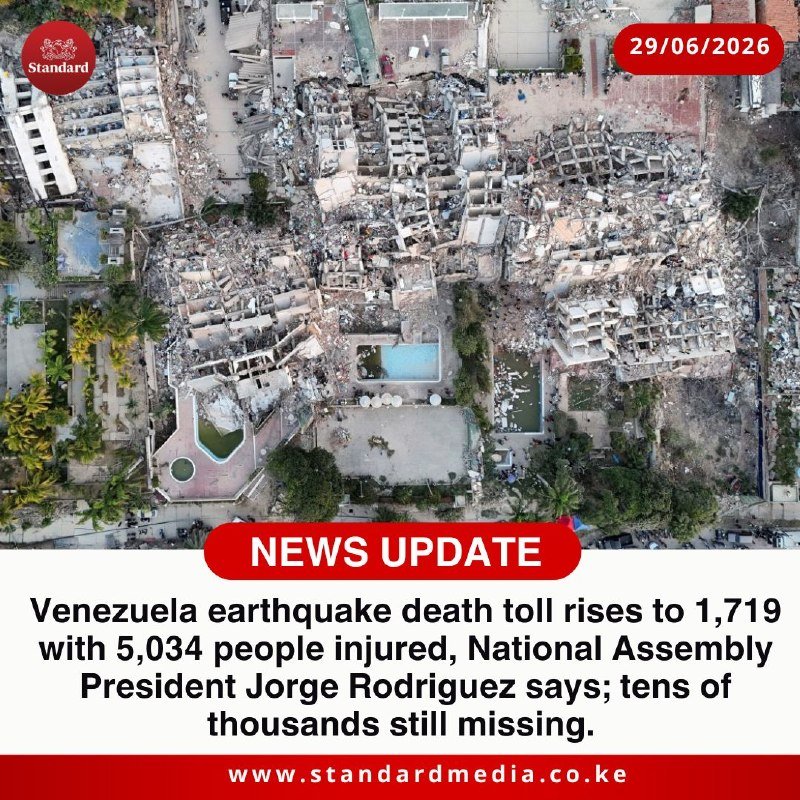
On the morning of 28 June 2026, a 6.3-magnitude earthquake struck off the coast of western Venezuela, toppling buildings in the state of Zulia and leaving an unknown number of residents trapped in the rubble. By 29 June, BBC reporting from the affected zone described rescuers pressed into silence, listening for survivors beneath pancaked concrete, while families waited on pavements with water bottles and photographs of the missing. One newborn, 18-day-old Juan David, was pulled from the debris in what BBC labelled a "miracle" rescue — the child's mother telling the broadcaster that he had, in her words, helped her survive.
The political earthquake under the geological one
The tremor itself is the easy part of the story. A 6.3-magnitude offshore quake in a region with documented seismic risk is, in engineering terms, a solvable problem — given the equipment, the institutional coordination, and the hours after the shaking stops. The harder question is whether Venezuela, after years of economic contraction, sanctions pressure, and a hollowed-out civil-protection apparatus, can run that clock effectively for the tens of thousands its own agencies still consider unaccounted for. BBC's 29 June dispatches describe rescue teams using listening devices, drones, and trained dogs to work through the wreckage — a competent technical inventory. They do not, and cannot, tell a reader how much of that capability is being run by the Venezuelan state, how much by international NGOs, and how much by neighbours with bare hands.
That is the frame. Natural disasters are political at the seams: at the border between a national government and its citizens, between a sovereign and its creditors, and between a state under sanctions and the international agencies whose equipment moves the rubble.
What the wire is and isn't saying
The BBC's four 29 June items are careful. They lead with the human rescue — the agonising silence, the mother, the infant, the listening devices. They avoid naming casualty counts beyond what has been officially confirmed and they do not draw the political line. That restraint is editorially defensible — the wire is reporting the rescue, not the political economy of who funds it. But it leaves a reader with a partial picture. The same outlets covering Venezuela for two decades have produced extensive, well-sourced reporting on the country's crumbling public services, the effects of US sanctions on oil revenue, and the brain drain that has thinned out the engineering corps that would normally manage a disaster of this scale. The disaster and the institutional decay are not separate stories; they are the same story, told at different speeds.
What this publication is watching
Three things will tell us whether the response holds. First, the casualty curve over the next 72 hours — the standard golden window for urban search-and-rescue. The number of live recoveries versus body recoveries is the cleanest measure of institutional capacity. Second, the ingress of international assistance: whether the ICRC, PAHO, and UN-OCHA teams that normally arrive inside 48 hours can clear Venezuelan customs and reach Zulia on schedule. Third, the dollar question — whether humanitarian aid is permitted to flow into a country whose central bank is under heavy US sanction, or whether the same financial architecture that has shaped Venezuelan political life for a decade also shapes how much concrete gets lifted off how many survivors.
The stakes, plainly
A 6.3 quake off a populated coast is a solvable problem. The unsolved problem is whether the country that catches it has the institutional mass to solve it. If the next 72 hours go well, that is a credit to local first responders and the diaspora networks that show up first. If they do not, the cause will be familiar: a state that has lost the capacity to be the first responder, in a region that does not have a reliable second responder waiting in the wings.
Desk note
Monexus framed this story around the political seam between rescue and state capacity, not the seismic event itself. The BBC wire focused on the human rescue; this publication followed the institutional question the wire left open.
Wire provenance
This editorial synthesis draws on the following public wire/social posts:
- https://t.me/s/BBCWorldoffl
- https://t.me/s/BBCWorldoffl
- https://t.me/s/BBCWorldoffl