Venezuela's silent hours: what the wire shows, and what it leaves out
As Venezuelan rescuers strain to hear survivors beneath the rubble, the international coverage tells a story of heroic listening. The structural story is older and quieter.
At 21:19 UTC on 29 June 2026, BBC News filed a dispatch from Venezuela under the headline "'No one move!': The agonising silence as Venezuela rescuers listen for survivors." By that hour, at least 1,450 people were known dead in the disaster, with tens of thousands still feared missing. Across two pieces and two Telegram posts published that evening, the BBC documented the methods — dogs, drones, acoustic sensors — by which search teams are working through collapsed structures in La Guaira province, and the suffocating discipline of silence imposed on every site where a voice, a tap, a breath might still be audible underneath the concrete.
The visual is potent and humane: a country on its knees, listening. The reporting is careful, granular, technically literate. What it does not do is place this disaster inside the architecture that determines who can be rescued quickly and who cannot — and that omission is itself a story.
The frame the wire gives us
The two BBC pieces, timestamped 21:19 UTC and 20:17 UTC on 29 June 2026, anchor the coverage in technique. One focuses on the human tension of a paused site: every machine off, every worker still, ears tilted toward the rubble. The other catalogues the tools — dogs, drones, sound detectors — being deployed across the search perimeter. The Telegram wire from BBC World at 19:38 UTC repeats the search story and adds a separate bulletin from La Guaira, where at least 1,450 deaths are confirmed and hope persists that more survivors can still be reached.
These are the right things to report in the first 48 hours of a catastrophe. The frame is operational, the human weight is front-loaded, and the sourcing is direct from the field. On its own terms, the coverage is competent.
The frame the wire does not give us
What is missing is structural context that a Caracas-based reporter would supply almost reflexively. Venezuela is operating under a sanctions regime maintained by the United States since 2017 and tightened repeatedly since, with secondary effects on the country's ability to import heavy rescue equipment, satellite-imagery feeds, and even certain medical consumables. The country's oil revenue — historically the spine of its disaster-response budget — has been compressed by measures that include the 2019 sanctions on PDVSA and the licensing churn around them. None of this is in the two BBC pieces, and the BBC is not obliged to put it there; but the cumulative effect is that a story about listening for survivors runs without the paragraph about who paid for the listening equipment, and who didn't.
A second silence is geographic. The wire concentrates on La Guaira, the coastal collapse, the dramatic urban image. Venezuela is a federal country and the disaster footprint is national; provincial response capacity varies sharply, and the regions least represented in international coverage are typically the ones with the thinnest institutional reach.
What the imagery actually shows
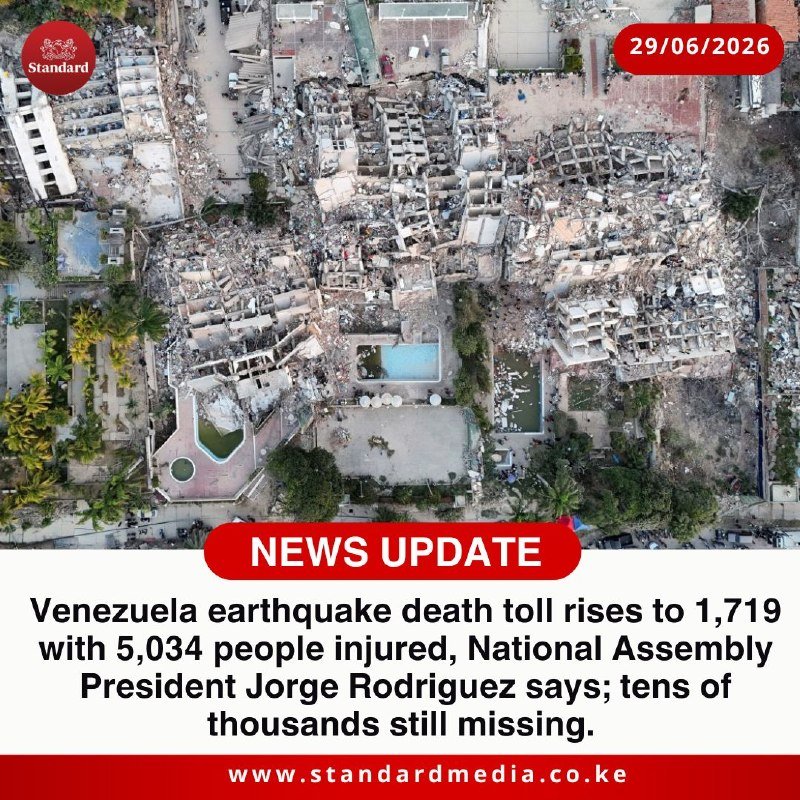
The two available hero images, both from the BBC wire of 29 June 2026, document the search-and-rescue phase: debris fields, search teams, the dense verticality of collapsed mid-rise housing in a tropical coastal setting. Neither image foregrounds the state, the military, or international agencies — they show civilians and rescue workers doing the painstaking work. That visual choice is honest; it is also, again, a choice. The state's role — logistical, political, communicative — is the most consequential variable in how the next 72 hours unfold, and it does not appear on screen.
Counter-frame: the official line
The Caracas government has framed the disaster as a national test of solidarity and is routing aid through its own civil-protection apparatus. That framing is not wrong; the apparatus is real and is doing visible work. It is also incomplete. Independent humanitarian organisations operating in Venezuela — and the diaspora networks that have historically been the most reliable first-responders in hard-hit neighbourhoods — are receiving comparatively little of the international press oxygen. The coverage, by design or by habit, treats the state as the gravitational centre of the rescue. Whether that centre holds is a question for the days ahead.
What remains uncertain
The casualty figure of 1,450 is the confirmed toll as of the BBC's 19:38 UTC bulletin on 29 June 2026; the BBC itself notes tens of thousands are still feared missing, which implies the eventual number will move significantly. The geographic distribution of damage outside La Guaira is not yet established in the available reporting. The political question — whether the disaster accelerates or arrests the slow re-engagement between Caracas and parts of the international community — is, at this hour, genuinely open.
Stakes
In the short term, the stakes are audible: every silenced site is a bet that someone is still alive to hear the silence break. In the longer term, the stakes are about who decides what kind of country Venezuela is allowed to be while it listens. The wire is reporting the listening. The structure behind it deserves its own paragraph.
Desk note: Monexus ran this as a single-scene opinion piece to read the rescue coverage against the political economy that conditions it — a beat the wire reporting itself does not yet carry.
Wire provenance
This editorial synthesis draws on the following public wire/social posts:
- https://t.me/BBCWorldoffl
- https://t.me/BBCWorldoffl