Camera in hand, narrative in dispute: what Gaza's strike footage does and does not prove
A pair of strike videos from Gaza City, one released by the Israeli military and one shot by a local journalist at the scene, are circulating in the same news cycle. The two tell different stories about who was hit and why.
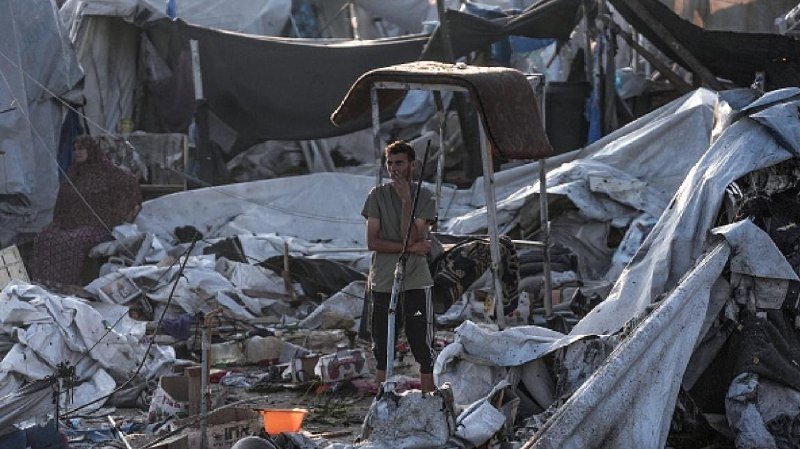
Two clips dropped within minutes of each other on 1 July 2026, and they are doing opposite things. At 08:32 UTC, the Israeli military released footage it said showed the strike on a civilian near Dubait Junction in Gaza City, framing it days after the incident as a controlled, targeted operation. At 08:35 UTC, the local press channel Gaza Alanpa published a clip from the scene of what it called the latest Israeli strike targeting a group of civilians near a vehicle on Omar Al-Mukhtar Street in central Gaza City. By 08:37 UTC, the same channel was back with a second angle from the same street. The two feeds are not, in any honest reading, describing the same event. They are competing to define it.
The substantive question is not whether an airstrike happened. It did, and the geography on screen is consistent across both sets of footage. The substantive question is what was hit, who was in the vehicle, and whether the framing each side puts on the strike can be reconciled with the wreckage. Israeli security concerns about armed groups operating inside dense civilian infrastructure in Gaza are a legitimate, well-documented operational problem and the framing of any single strike has to be read against that backdrop. So does the equally well-documented pattern of civilian harm in the territory, a pattern that has been the subject of repeated UN, Red Cross and wire-service reporting throughout the war.
What the Israeli footage claims
The Israeli military's release, as paraphrased by Gaza Alanpa at 08:32 UTC, presents the strike as a deliberate operation against a single individual at Dubait Junction, with the wider civilian environment treated as a controlled backdrop. The decision to release footage days after the incident is itself an editorial choice. It allows the military to curate a frame, attach a caption, and present the strike inside a narrative of lawful targeting without the contemporaneous pressure of an on-the-ground press corps arriving in the first minutes. A strike explained a week later is a strike explained on the spokesperson's terms.
What the on-the-ground footage shows
The Gaza Alanpa clips are the inverse exercise. The first is described by the channel as footage from the first moments following an Israeli airstrike on Omar Al-Mukhtar Street; the second, two minutes later, as scene footage from the same strike. The framing is unapologetically civilian: a group of people near a vehicle, struck in a central urban street. The editorial register is local, immediate, and shaped by the constraints under which Gaza-based press is operating: limited access, intermittent communications, and an environment in which the same journalists covering the war are themselves casualties of it.
Why the two cannot be averaged
There is a temptation, common in wire copy, to split the difference: present both clips, note that each side has its own account, and move on. That is the wrong move. The two pieces of footage are answering different questions. The Israeli release is asking, "was the targeting lawful." The press footage is asking, "what was left of the street afterwards." The first is a justification; the second is a record. Averaging them produces a sentence that sounds neutral and is in fact evasive, because it treats a deliberative military account and an unedited scene report as though they carried the same evidentiary weight.
What we verified and what we could not
What is verifiable from the source material: two clips circulated in the same hour on 1 July 2026; one is presented as an official Israeli military release, the other as press footage from Omar Al-Mukhtar Street in Gaza City; both relate to an airstrike on a central urban street. What is not verifiable from the source material on its own: the identity of the person or people struck, the weapon used, the casualty count, whether the target was a named individual, and the relationship between Dubait Junction and Omar Al-Mukhtar Street in the Israeli release's own account. The sources do not specify whether the same strike is depicted in both clips, or two strikes on the same morning. The framing of the Israeli release, in the form the channel received it, treats the Dubait Junction strike as days-old, while the press footage is presented as fresh; the two timelines do not align on their face.
That last point is the part the wire roundups tend to smooth over. The honest version of this story is that two competing video records are now in circulation, that the military has had days to prepare its version, that the on-the-ground press has had minutes, and that a reader who sees only the curated release will come away with a cleaner picture than a reader who sees only the scene footage, and a different picture than a reader who sees both. None of that is an argument for treating either source as more or less credible in advance. It is an argument for refusing to be relieved of the work of verification by either of them.
The structural frame
The pattern here is not new. Modern urban warfare produces, almost by design, two parallel archives: the official archive, which is selective, post-hoc, and caption-driven, and the scene archive, which is fragmented, present-tense, and made by people working in physical danger. Both archives are real. Both are incomplete. The mistake coverage routinely makes is to treat the official archive as the version of record and the scene archive as colour. The structural reality is the opposite: the official archive is the version of claim, and the scene archive is the version of consequence. A press that reports the first and decorates with the second is not balanced; it is deferential.
The stakes
If the two archives continue to be averaged in wire copy, the public's working picture of what is happening in Gaza will be assembled, in practice, by whoever curates the cleaner frame on any given morning. That is a problem for readers in Israel, in the Arab world, and in every foreign capital that has to make policy on the basis of partial information. It is also a problem for the press, which will eventually be asked which archive it was relying on, and which will have to admit, if pressed, that it was relying on the caption.
This piece is written in Monexus's staff-writer voice. The frame is not "both sides have a point"; it is "the two feeds are answering different questions, and readers deserve to know which is which."
Wire provenance
This editorial synthesis draws on the following public wire/social posts:
- https://t.me/gazaalanpa/
- https://t.me/gazaalanpa/
- https://t.me/gazaalanpa/