Kyiv's long reach: drones hit 2,000 km inside Russia as Moscow logs 63,933 intercepts
A drone threat declared in Kurgan on 1 July 2026 underscores the geographic stretch of Kyiv's deep-strike campaign, days after Russian-aligned channels logged tens of thousands of intercepts in the first half of the year.
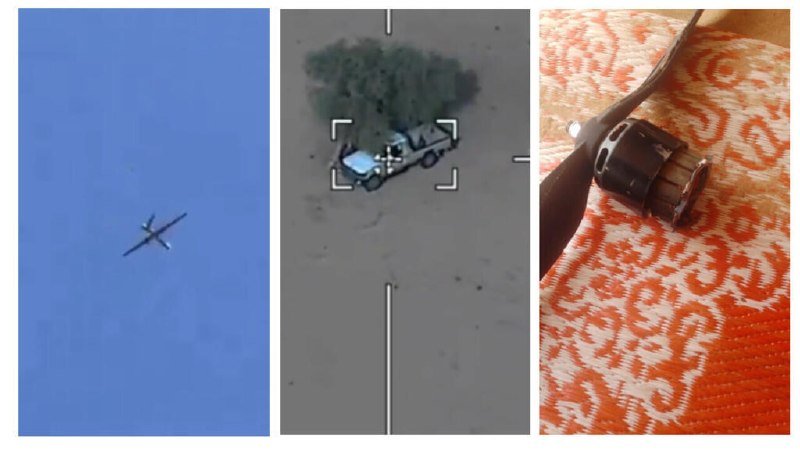
On 1 July 2026 at 09:30 UTC, the Telegram channel noel_reports declared a drone threat over Kurgan, a Siberian city more than 2,000 kilometres from Ukraine's internationally recognised border. Explosions were reported inside the city; the target, the damage, and the casualty picture remain unconfirmed as of publication. The strike, if confirmed, would place Kurgan among the furthest inland Russian cities reached by Kyiv's long-range campaign — a campaign that, by Moscow's own count, is now measured in tens of thousands of intercepts per half-year.
The Kurgan incident is the latest data point in a year-long shift in the geometry of the war. Ukraine's drone programme has moved from tactical use near the front line to a strategic instrument aimed at oil refineries, military-industrial sites and air bases deep inside Russian territory. Moscow, for its part, has begun publishing cumulative intercept tallies that read less like battlefield communiqués and more like air-defence industry reports.
A new range band for the war
Kurgan sits in the southern Urals, near the Kazakh border, more than 2,000 km from Ukrainian airspace by the most direct route and considerably further along the flight paths Kyiv's longer-endurance fixed-wing drones now favour. A strike there implies either a one-way UAV of extended range, a transit through Russian airspace at lower altitude, or a coordination method that has not been disclosed. The Telegram post that flagged the threat — issued at 09:30 UTC on 1 July 2026 — did not specify the launch point, the platform used, or the intended target; it confined itself to the alert, the explosions, and the standing fact that the aftermath was still being clarified.
Deep-strike capability matters for reasons that go beyond any single target. When a city 2,000 km from the border is rendered a credible threat zone, the operating tempo for Russian civil aviation, fuel logistics, and rear-echelon industry changes. The Russian civil-aviation authority has, over the past year, periodically closed airports across European Russia in response to drone alerts; the extension of that pattern into the Urals would push the cost of the air-defence mission onto cities whose populations have, until recently, treated the war as a distant problem.
The intercept tally, and what it does — and does not — prove
On the same morning, at 08:45 UTC, the pro-Russian channel operativnoZSU summarised Russian reporting that anti-aircraft units had shot down at least 63,933 Ukrainian uncrewed aerial vehicles over the regions of Russia and the temporarily occupied territories of Ukraine in the first six months of 2026. The figure is striking for its precision and for its provenance: it is being relayed, not originated, by the channel itself, which frames the upstream source as propagandists.
A figure of this magnitude is useful, but should be read with care. Russian air-defence reporting on UAV intercepts typically counts destroyed drones of every class — from cheap commercial-grade first-person-view craft to longer-range fixed-wing systems — and ranges across the full vertical of Russian air-defence architecture. It does not distinguish between drones that struck their targets and drones intercepted before release, between decoys and warheads, or between losses over the contact line and losses 2,000 km behind it. The number tells the reader that the volume is large; it does not, by itself, tell the reader where on the cost curve each intercept sits.
Reading the air war in plain structural terms
What is unfolding is not a contest of duelling air forces in the conventional sense. It is, instead, a contest of industrial scale, target selection and air-defence economics. Ukraine's drone output — much of it drawn from a domestic ecosystem that grew out of volunteer workshops after 2022 — is producing volumes that strain Russian interception capacity even as Moscow's layered air-defence network, inherited from Soviet doctrine, is being asked to cover a perimeter measured in thousands of kilometres. The result is a long, grinding air-defence bill paid in interceptors, radar time, and command-and-control attention, against a stream of low-cost air vehicles whose individual price tags lie an order of magnitude below the missiles used to bring them down.
That asymmetry has been visible in Western open-source analysis of Russian air-defence expenditure for months. The Kurgan incident, if verified, suggests that the perimeter is now being probed at points where Russian ground-based interception has historically been thinner — the Asian-facing rear, far from the density of assets clustered around Moscow, the Black Sea coast, and the central military districts.
What stays uncertain
Two things remain genuinely unsettled at publication. First, the Kurgan target: noel_reports did not name a site, and the channel's track record is one of early-warning alerts rather than verified post-strike assessment. Second, the 63,933 intercept number: it is presented as a Russian-side running total, transmitted through a channel that openly styles its source as propagandists, and the underlying methodology — counted by whom, with what sensors, against which UAV categories — is not specified. Until an independent wire or OSINT investigator cross-references the figure with its constituent events, the number should be treated as indicative of scale rather than as a confirmed ledger.
The structural direction, however, is plain. Ukraine is operating at distances Moscow's previous defence planning did not centre. Moscow is being forced to defend categories of airspace it had, for most of the post-Soviet era, treated as rear-area. The standoff will, on the evidence so far, continue to push upward in both range and daily volume before either side chooses to negotiate a new ceiling.
Desk note: Monexus has reported the Russian-aligned intercept tally as the channel itself characterised it — propaganda material — and treated the Kurgan alert as an unverified first report, awaiting corroboration from independent wires or OSINT investigators. Both items are recorded with provenance rather than embellished into claims the sources do not support.
Wire provenance
This editorial synthesis draws on the following public wire/social posts:
- https://t.me/noel_reports
- https://t.me/operativnoZSU