Tula burning: a refinery fire the war wants to forget
Two fireballs in Tula within twenty-five minutes — one officially denied, one unconfirmed — show how Russia's war economy is being slowly strangled, one smouldering column at a time.
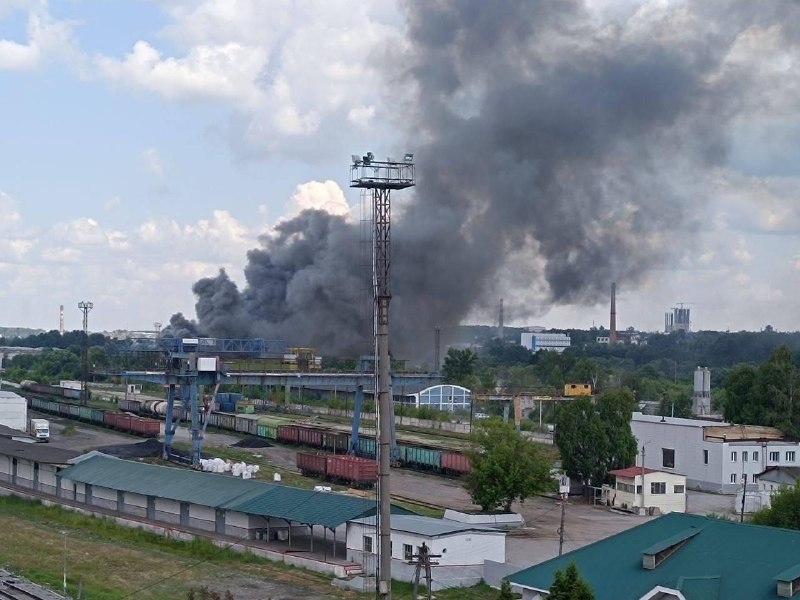
Two fireballs in Tula, twenty-five minutes apart, on the first morning of July. That is the picture that opened the new month: black smoke climbing above the railway district of a city best known for its arms factories and its samovar-makers, while a separate blaze reportedly licked the perimeter of a refinery that Russian officials insisted, before the day was out, was not the work of a drone or a missile.
Read those two items together and the war economy's most under-reported story sits in plain sight. Ukraine's long-range strike campaign against Russian oil infrastructure has been grinding on for years, paused and unpaused, claimed and denied in roughly equal measure. The pattern matters more than any single plume of smoke. On 1 July 2026, that pattern produced an unusually clean illustration: an event that nobody in Moscow wanted attributed, and an event that nobody in Kyiv quite wanted confirmed.
What the wires actually said
At 10:07 UTC, the Telegram channel @noel_reports posted a brief, unverified note: an explosion near Tula's railway station, smoke visible. At 10:32 UTC, the OSINT aggregator @wartranslated carried a follow-up: a fire in the vicinity of the Tula oil refinery, attributed to an unspecified source, with the explicit caveat that it had "not been caused by a drone or missile strike." No casualty figures were given. No Ukrainian claim of responsibility was issued through any official channel before this article went to press. No Russian ministry confirmed the cause, or the cause-of-non-cause, in language the wires would pick up.
The thinness of the reporting is itself the story. Tula, a city of roughly half a million roughly 200 kilometres south of Moscow, hosts the Tula Arms Plant and has long sat on lists of strategically significant defence facilities. It is also home to a working refinery that feeds central Russian fuel markets. Either target, on either day, would be on the menu of a Ukrainian campaign that has, by every available count, been steadily expanding the geography of strikes far from the front line — pushing past the border regions into Leningrad, Tatarstan, Bashkortostan, and points east. That Tula has so far escaped the worst of this campaign is more a function of distance and air-defence density than of innocence.
The art of the non-claim
The Russian side's reflexive denial — "not a drone, not a missile" — is worth dwelling on for a moment, because it has become a genre. Local authorities, when confronted with craters near sensitive sites, increasingly reach for the same script: the fire was caused by fallen debris, a transformer fault, a welding accident, an act of God. The formula is stable enough that it can be parsed. When Russian-aligned sources volunteer the cause of an explosion before any independent investigation, what they are really doing is pre-empting the most damaging interpretation.
It is also worth noting what is not being denied. Neither Tula authorities nor the Russian defence ministry, in the items that surfaced on 1 July, asserted that there had been no explosion at all. The denial is about attribution, not about fact. That linguistic manoeuvre leaves Kyiv room to stay silent — which it has, so far — while letting Moscow's own communicators inadvertently confirm that something, somewhere, burned.
What the strike campaign is actually doing
It is tempting to treat each individual plume as the story. The cumulative effect is the story. Ukraine's domestic refining base was crippled early in the war; the country is now almost entirely dependent on imports for diesel and a substantial share of its gasoline. The asymmetry in fuel flows — Ukraine importing, Russia occasionally burning — has flipped the optics. The same drones and missiles that are reportedly striking Russian oil infrastructure are also, in the parallel economy of the war, the reason Western capitals keep writing cheques for Ukrainian air defence.
The structural effect on Russia is slower and quieter. Refineries take months to bring back to full capacity after a serious fire. Insurance markets have already begun pricing the war risk into Russian energy assets, and several European cargo insurers have, by all available reporting, quietly widened their exclusion clauses for ports on the Baltic and the Black Sea. The strike campaign is not going to collapse the Russian oil economy on its own. It is, however, raising the marginal cost of doing business in that economy one smouldering column at a time.
What remains genuinely uncertain
It is 1 July 2026. The cause of the railway-station explosion is, on the public record, unknown. The cause of the refinery fire is officially "not a drone or missile," which is not the same as a positive identification. There is no casualty count. There is no Ukrainian statement of responsibility. There is no Russian admission of damage. The two Telegram items that anchor this story are, by the standards of any newsroom with a verification desk, low-tier inputs.
What can be said with confidence is narrower, and is what the reader should take away. On 1 July 2026, two fires were reported in Tula within twenty-five minutes. One was near a railway station. One was near a refinery. Russian-aligned channels denied a strike cause for the latter. None of the official channels, on either side, have yet produced a definitive explanation. In a war where attribution is itself a weapon, the absence of a confirmed cause is its own kind of statement.
Monexus is treating the 1 July Tula fires as a single news event held together by geography and timing, and reading the Russian-side "not a drone, not a missile" line at face value while flagging that it is a denial of method, not of incident. We have not attributed the railway explosion to any actor; the source items do not support an attribution.
Wire provenance
This editorial synthesis draws on the following public wire/social posts:
- https://t.me/wartranslated
- https://t.me/noel_reports