The Strait Is Open, the Funeral Looms: Reading Iran's Hormuz Theatre
Vessels are still transiting Hormuz under US escort while Tehran threatens anyone who strays from its prescribed lane. The funeral behind the threats explains more than the threats do.
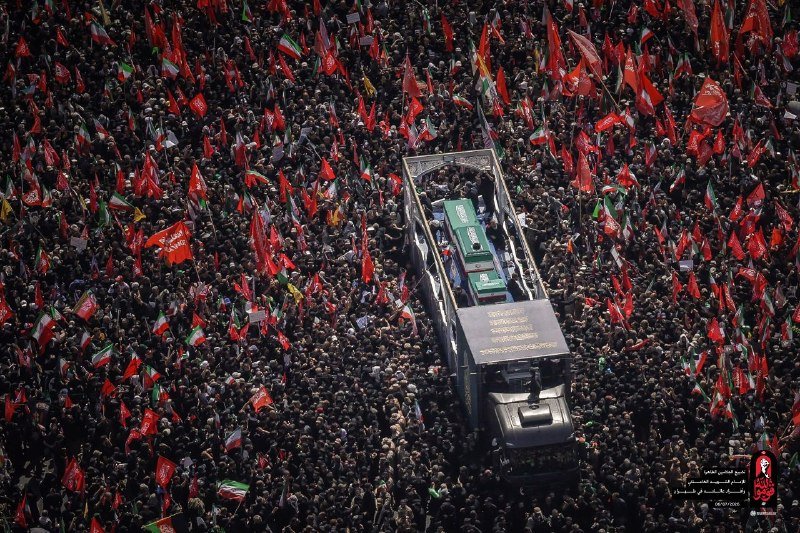
On the morning of 2 July 2026, the world's most consequential shipping lane was, by every visible measure, open. Vessels were passing through the Strait of Hormuz under American escort, including along the Omani coastal route — the same corridor Iran has previously struck — even as Iranian officials spent the hours before midnight raising the volume of their threats, according to a Telegram channel run by Iranian maritime analyst Yahya Abu Ali.
What is unfolding in the Gulf is not a blockade. It is theatre performed on top of a blockade's plausibility. Tehran has threatened to attack any vessel that deviates from a route it has itself prescribed, and warned of a "decisive response" as the date of Ayatollah Ali Khamenei's funeral approaches, per English-language messages on Abu Ali's channel timestamped 10:11 and 10:12 UTC on 2 July 2026. The choreography is unusually explicit: regime grief, naval muscle, and a foreign-flagged escort fleet that refuses to leave.
A lane that is open — for now
The empirical picture matters first. Reporting from the maritime beat at 11:02 UTC on 2 July 2026 describes commercial vessels, including those travelling close to the Omani coast, transiting Hormuz with American naval escort. That is the same coastal stretch where Iran has previously conducted seizures and drone attacks against tankers. The signal from the sea is therefore not "closed." It is "open, but at a price — the price being American hulls in the water and Iranian approval to keep moving."
A serious read of the situation holds both propositions at once: the strait is functioning as a transit corridor on 2 July 2026, and Iranian state behaviour continues to make it the highest-risk chokepoint on the planet for commercial shipping.
What the threats actually say
Read against the grain, the threats Abu Ali published on 2 July 2026 are unusually narrow. They do not announce a closure of the strait. They threaten vessels that deviate from the route Tehran has set and warn of a "decisive response" — language whose ambiguity is the point. Tehran is reserving the right to punish specific targets at chosen moments while keeping the channel open enough that oil markets do not spike out of control.
This is the standard operating procedure of a regional power that depends on the very revenue its threats disrupt. Iran sells oil through the strait; an Iranian attack that deters global transit hurts Iranian state finances first. The threats, in other words, are aimed less at the global tanker fleet than at the specific political moment they accompany.
The funeral is the frame
The revealing detail in Abu Ali's reporting is not the maritime activity at all. It is the parenthetical that the threats are escalating "as the date of Khamenei's funeral approaches." Succession politics inside the Islamic Republic are not normally legible from shipping advisories. When they become legible, it is because the regime wants them to be.
A leadership transition in Tehran is a moment of maximum internal vulnerability. The Strait of Hormuz becomes a stage on which the next generation of the security establishment demonstrates continuity of nerve to domestic audiences, regional clients, and the United States simultaneously. The threats directed at vessels "deviating from the route" serve as a low-cost proof of competence: cheap to issue, plausible to execute, and reversible if the political weather shifts. They also test the new American escort posture in real time — measuring not just the willingness of US destroyers to shadow tankers, but the willingness of the White House to escalate in the middle of a succession crisis in Tehran.
The structural pattern here is older than the current crisis. A regime under internal pressure tends to push risk outward, onto external actors who can absorb it. Iran has done this before: in 2019, when the IRGC seized the Stena Impero weeks after Tehran downplayed the consequences; in 2021 and 2023, when tit-for-tat seizures briefly raised insurance premiums. In every case the pattern is the same — perform control of a chokepoint, then bargain from the demonstration.
What it costs, and who pays
War-risk insurance premiums are the first price gauge. They rose sharply in past Hormuz incidents and would do so again if any vessel on the Omani coastal lane is struck. The indirect cost — slower transit, additional fuel, longer routes around the Cape if any major operator reroutes — falls on importers of Gulf crude: India, China, Japan, South Korea. For Iran itself, the principal cost is credibility; a threat issued and not executed against a single named vessel on the regime's prescribed lane would signal weakness at exactly the moment the successor leadership most needs the opposite signal.
That asymmetry explains the choreography. The threats have to be loud enough to be heard inside Iran during a funeral week, narrow enough that the United States cannot easily escalate into a shooting war in response, and credible enough that at least one operator eventually strays from the prescribed lane and gives Tehran its demonstrative target.
What remains uncertain
The most important caveat is also the simplest: the sources cited here are a single maritime-analyst Telegram channel, and they describe threats, not attacks. Whether Iran executes against any vessel on 2 July 2026 or in the days surrounding the funeral is, at the time of writing, unknown. The threats could be instrumental — a bargaining chip in a quiet channel — or they could be operational, with crews already assigned. The Telegram traffic does not distinguish, and the absence of confirmation from wire services at 11:02 UTC on 2 July 2026 is itself a data point worth weighing: the strait is still functioning as a transit corridor, and the world has not yet been told to treat it otherwise.
A second caveat is that American escort posture is itself a moving target. The presence of US hulls in the strait is reported; the rules of engagement those hulls are operating under, and the political appetite in Washington for a kinetic exchange during a Tehran succession, are not in the public record available here.
The honest read is that Hormuz on 2 July 2026 is not closed, but is being held open under armed supervision on one side and threatened closure on the other, with a funeral in between. That is a stable equilibrium only so long as both sides believe the cost of breaking it is higher than the cost of sustaining it.
This publication treats Iranian maritime threats as reported through the specific channel that published them, not as state-adjacent propaganda — and not as confirmed operational orders. Where wire services eventually corroborate execution, Monexus will update accordingly.
Wire provenance
This editorial synthesis draws on the following public wire/social posts:
- https://t.me/abualiexpress
- https://t.me/englishabuali
- https://t.me/englishabuali