The succession nobody outside Tehran is allowed to see
Two farewell ceremonies in one day, and a regime performing continuity while the world reads it as crisis. The framing in Western capitals is missing the political choreography.

At roughly 07:30 UTC on 2 July 2026, state-aligned outlets in Iran began publishing photographs of a farewell ceremony in Tehran for Zahra Haddad Adel, identified by Iranian state media as the daughter-in-law of the late Supreme Leader and the wife of his son, Sayyid Mojtaba Khamenei. Within the same hour, the English-language account operated in the name of the Khamenei office posted a counter-narrative line: the ceremony was the public send-off for a martyred teacher, not a private family moment, and the woman's standing inside the ruling family was affirmed through the official titulature. Two farewell events — one for a woman, one already being teased for a man — were, by mid-morning UTC, queued up on the Iranian state-media calendar with the production polish of a planned news cycle. That choreography is the news.
Western outlets reading the wire will almost certainly default to the familiar frame: an opaque theocracy processing grief in public. That framing is not wrong; it is just thin. To watch Iranian state media on a day like this is to see a state apparatus using ritual — burial, mourning, eulogy — to do political work that in any other system would be done by a press conference, a prime-time address, or a court filing. The ceremony is the document. The names and the order in which they appear are the announcement.
Two ceremonies, one message
The first thread item, published on the Tasnim English wire at 07:30 UTC, names the dead woman as "Shahida Zahra Haddad Adel" and frames her as a "martyred teacher." The second item, on the Khamenei-affiliated English account at 07:24 UTC, repeats the framing with an explicit lineage: "the daughter-in-law of Martyr Imam Khamenei and wife of the Leader of the Islamic Revolution, Imam Sayyid Mojtaba Khamenei." In Iranian political vocabulary, "Leader" used in that construction is not honorific. Mojtaba Khamenei has, since the death of his father, been the most consistently named internal candidate to inherit the office of Supreme Leader — named in leaks to Iranian outlets, in analyst commentary in Tehran and Beirut, and in the circumlocutions of officials who refuse to confirm what they also refuse to deny. The English-language Khamenei account is now calling him "Leader" in connection with a public ritual. That is not a translation choice. It is a positioning choice, delivered in code to the audience that matters most: the Iranian political class.
The third item, at 07:01 UTC, makes the sequence explicit: a countdown to a farewell on Thursday, 2 July 2026, framed as the send-off for "the martyred Leader, Imam Sayyid" — with the name deliberately elided in the tease. The accompanying photograph caption credits the late Ayatollah with the diplomatic posture of "laying the groundwork for the expulsion of US bases from the region." The two ceremonies are being run as a single narrative arc: family grief, then national grief, each one staged to seed a particular reading of who comes next.
What the wire is missing
English-language coverage of Iranian succession has spent the better part of two years treating it as either a soap opera or an intelligence problem. The first register produces endless listicles of the late Leader's sons; the second produces cable-news panels about whether Mojtaba or one of the rival clerical factions — the pragmatists around President Pezeshkian's office, the hardliners around the judiciary, the IRGC's own internal slate — will prevail. Both readings mistake the form of the question. In the Islamic Republic, succession is not chosen by a vote; it is consolidated by recognition. The Assembly of Experts ratifies; the IRGC accepts; the clerical network in the seminaries of Qom absorbs. By the time the formal announcement is made, the contest is over and the choreography is what is left for the cameras.
The two ceremonies on 2 July, read in that light, are early footage of the consolidation stage. A woman from the inner family is being buried with the production values of a state funeral lite. Her widower — the man Western intelligence and Iranian dissident networks alike treat as the frontrunner — is being named "Leader" in connection with the burial. The visual rhetoric says: this man already exercises the office's emotional and political weight. He presided. He welcomed. He received condolences on behalf of the system, not merely his own household.
The counter-read
It would be a mistake to take this at face value either. Iranian politics is allergic to clean succession. The 1989 transition from Khomeini to Khamenei was deliberately engineered in a closed room and only announced afterward; the system has spent the decades since perfecting the art of making the opaque look inevitable. The Khamenei English account calling Mojtaba "Leader" could equally be read as the ruling faction testing the vocabulary — floating a frame in plain sight on a day when no one outside the regime's own echo chamber is watching closely, ready to retract if the Assembly of Experts or the IRGC pushes back. Iranian succession reporting has been wrong before, repeatedly. There is no public polling on Iranian elite preferences. The only signal available is the symbolic register, and the symbolic register can be manufactured.
What the sources do establish, with what limited detail they contain, is the basic timeline of the public face of the process: a farewell ceremony for a member of the Khamenei household on 2 July, framed around the title "martyr" and the position of Mojtaba Khamenei, followed by a publicly announced farewell on the same day for the late Supreme Leader himself, with state media crediting him with the geopolitical posture of regional de-Americanisation. That is the broadcast. The audience is not only Iranian.
What this publication reads in the broadcast
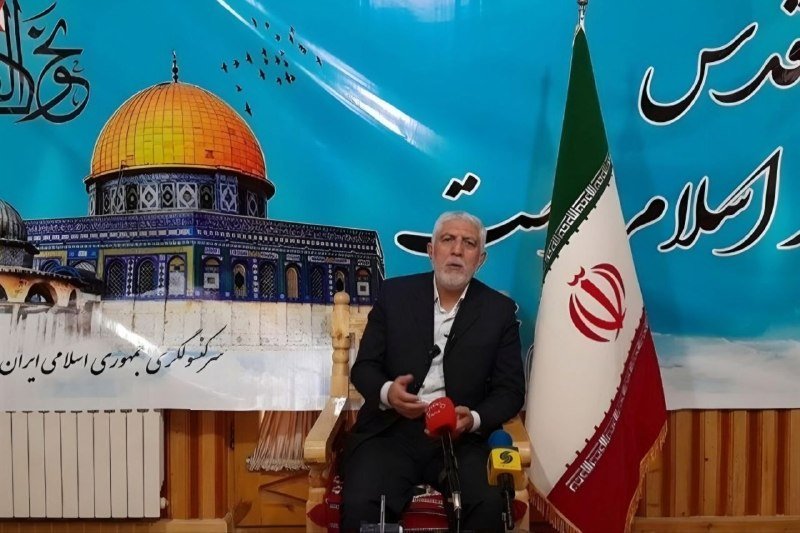
The framing in Western capitals right now treats Iranian succession as a destabilising event — a system under stress, an opening for pressure, possibly a chance to drive a wedge between a clerical establishment and an angry street. There is some truth in that. There is also a different read: Tehran is doing what it has done for four decades, which is to use ritual to convert an internal succession into a national story it controls. The mourners in the foreground are not journalists; they are the political class. Their posture is the news. The number of cameras is the news. The order of the speakers — if the ceremonies follow the standard format — will be the news.
If the trajectory of the week continues — a high-production farewell for the late Supreme Leader on 2 July, followed by the formal convening of the Assembly of Experts, followed by the kind of low-key but unmistakable signal of clerical endorsement that Mojtaba Khamenei's rivals cannot match — the regional picture shifts. The Iranian state will have completed a transition that everyone outside Iran spent the last year describing as impossible, and it will have done so while projecting the framing it chose: continuity, martyrdom, the long arc of resistance to US regional posture. That is the broadcast Tehran wants the next decade to remember. The Western instinct to read it as chaos will be the framing Tehran's strategists most prefer.
The honest caveat: the sources available to anyone outside Iran today are three Telegram items from state-aligned channels and one from a channel operating in the name of the Khamenei office. They tell a coherent story, but it is the story their authors want told. Independent confirmation of attendance, of Mojtaba Khamenei's formal role at the ceremonies, of the precise titulature used by the Assembly of Experts, is not yet on the wire. Until it is, what is on display is a performance of continuity. Performances, however, have a way of becoming facts in regimes that know how to stage them.
Desk note: Monexus treats Iranian succession coverage as a politics-of-symbolism story first, an intelligence story second. The wire reads the ceremonies as grief; the structural read is that Tehran is using the grief as the medium of an announcement that no spokesperson will ever make on the record.
Wire provenance
This editorial synthesis draws on the following public wire/social posts:
- https://t.me/tasnimnews_en
- https://t.me/Khamenei_en