Overnight barrage kills 20 in Kyiv as Zelensky seeks US licence to build Patriot interceptors
A Russian overnight strike combining 74 missiles and 496 drones killed at least 20 people in Kyiv, prompting Volodymyr Zelensky to ask Washington for permission to manufacture Patriot interceptors domestically.
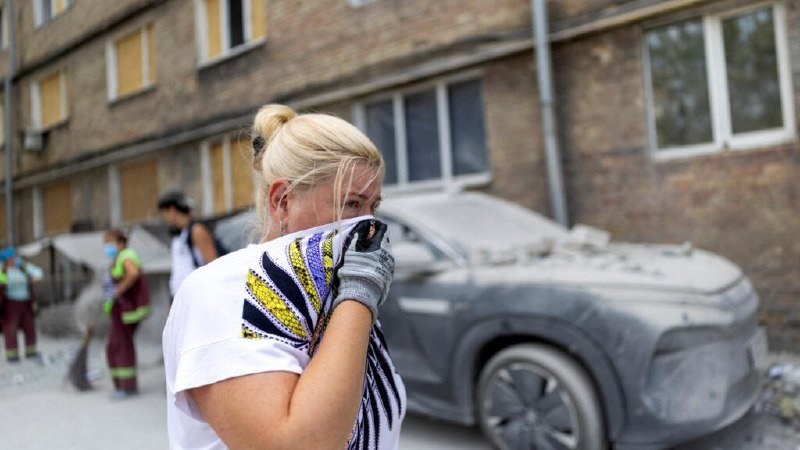
Russia struck Kyiv with a combined salvo of 74 missiles and 496 drones overnight on 2 July 2026, killing at least 20 people and triggering a request from President Volodymyr Zelensky for permission to manufacture Patriot air-defence missiles on Ukrainian soil, according to Ukrainian officials and footage circulated on Telegram on Thursday.
The strike is one of the largest of the war by salvo size and arrives at a moment when Ukraine's interceptor stocks are visibly thin and its industrial partners are wary of escalation. Zelensky's request to Washington — first reported in the immediate aftermath of the barrage — reframes a familiar battlefield shortage as an industrial-policy question, and forces the United States to decide whether shared production of a sensitive Western weapons system is now part of the cost of sustaining Kyiv.
What is known about the strike
According to footage and reporting aggregated on Telegram, Russian forces launched the salvo at Kyiv and surrounding districts. Telegram channel @wfwitness shared additional footage of the attack shortly before midday UTC on 2 July 2026, describing the launch envelope as 74 missiles and 496 drones. Kyiv Post reported at 11:56 UTC that the death toll had risen to 20 according to Ukrainian authorities, with rescue crews still working through the rubble and officials warning the figure was likely to climb. The pattern — a daylight or pre-dawn massed strike aimed at the capital rather than at forward positions — is consistent with Russia's escalating use of long-range precision and decoy munitions against Ukrainian civilian infrastructure, a tactic it has refined across 2025 and into 2026.
The relevant facts as of 12:00 UTC on 2 July: the salvo's combined size, the official Kyiv death toll of at least 20, the still-active search-and-rescue operation, and the as-yet-unconfirmed reports of further casualties in the Kyiv Oblast ring. The sources do not yet specify what fraction of the missiles and drones were intercepted by Ukrainian air defence, nor do they break the munitions count by type.
The Patriot request
Zelensky's request to Washington, picked up by X account @sprinterpress at 11:47 UTC on 2 July and amplified by Iranian state outlets Fars News and its international channel (a coverage pattern that mirrors how Tehran tracks Western arms transfers to Ukraine for its own intelligence purposes), asks the United States to allow Ukraine to manufacture Patriot interceptors domestically.
The request is industrial, not operational. Ukraine is not asking for additional Patriot batteries to be rushed to the front; it is asking for a transfer of production know-how that would let Ukrainian factories build the interceptor rounds under licence. The distinction matters because the bottleneck on Patriot use inside Ukraine has increasingly been interceptor availability rather than launcher availability — batteries can be repositioned, but each engagement consumes a missile that takes months to manufacture in the United States. Domestic production would in principle shorten that cycle, although it would also raise questions about intellectual-property, tooling, warhead integration and the political tolerance of the United States for Ukrainian-fabricated interceptors bearing sensitive guidance components.
There is no public indication from the US side of how it has received the request.
The counter-narrative
The structural counter-narrative — voiced most explicitly in this instance by Iranian state media carrying the request — is that every escalation in Western-supplied Ukrainian capability pulls NATO further into the war and lengthens it. Tehran's interest in propagating the request is itself diagnostic: Iranian outlets covered the Patriot story within hours, framing it as evidence of a US-NATO co-belligerent posture against Russia. That framing aligns with a Russian-state line that the war is being fought by proxy on Ukrainian territory, a reading the Ukrainian government rejects and that this publication does not endorse.
A more textured Western scepticism exists as well. Industrial-policy analysts note that Patriot production cannot meaningfully be transplanted in wartime. The Patriot interceptor supply chain — rocket motors, seeker heads, warhead fuzing, ground-equipment integration — depends on US facilities that took decades to qualify. Standing up a Ukrainian production line inside an active conflict zone, with engineers subject to missile attack, would be slow, expensive and at the margin dilutive of the very stocks it is meant to augment. By that reading, the request is best understood as a negotiating move designed to surface the constraint publicly and to put pressure on Washington and its European partners to expand production in existing facilities in the United States, Germany and Japan.
Structural stakes
The larger pattern is one of industrial-policy rearmament being forced by a grinding war of attrition. Ukraine's Western backers have spent 2025 and 2026 shifting from donating downgraded stockpiles to co-producing new systems — drones, 155mm artillery rounds, air-defence munitions. Each step expands the territorial and legal envelope of the war economy. A licence to build Patriots would be the most consequential of those steps, because the Patriot is the system Western governments have been most reluctant to share at any level beyond operational use.
If the request is granted, Ukraine acquires a sustainable answer to a missile defence problem it currently funds through finite allied stockpiles. If it is refused, Kyiv is dependent on US political will for every reload — a position it has lived with for the past two years and one that becomes more uncomfortable as interceptor consumption rises. Either outcome leaves Russia with an incentive to keep up the pressure on Kyiv's air-defence grid, both to deplete Patriot stocks and to demonstrate that massed salvos retain coercive effect even when a substantial share is intercepted.
What remains uncertain
The sources disagree on framing but not yet on the underlying facts. Telegram footage from Kyiv and the Kyiv Post reporting are consistent on the casualty count and the scale of the salvo. Iranian state outlets are consistent with Western-aligned sources on the substance of Zelensky's request; they diverge sharply on its meaning. The figures most likely to move in the next 24 hours are the Kyiv death toll — search operations are still underway — and any US response from the Pentagon or the State Department. A direct statement from a named US official on whether the Patriot production request is being considered was not available in the materials this publication reviewed at the time of writing.
Desk note: Monexus framed this as a Ukrainian civilian-protection story first and an industrial-policy story second, sourcing casualty and salvo figures to Ukrainian-authority channels and Telegram eyewitness footage rather than to Russian state-aligned sources. The Patriot request is treated as a request, not as an agreement.
Wire provenance
This editorial synthesis draws on the following public wire/social posts:
- https://t.me/wfwitness
- https://t.me/Kyivpost_official
- https://t.me/farsna
- https://t.me/FarsNewsInt