Kyiv wakes to a gutted high-rise: what the casualty count tells us about a city's endurance
An overnight drone strike on Kyiv killed at least 10 and injured dozens, including children. The pattern is familiar, and that is precisely what makes it consequential.
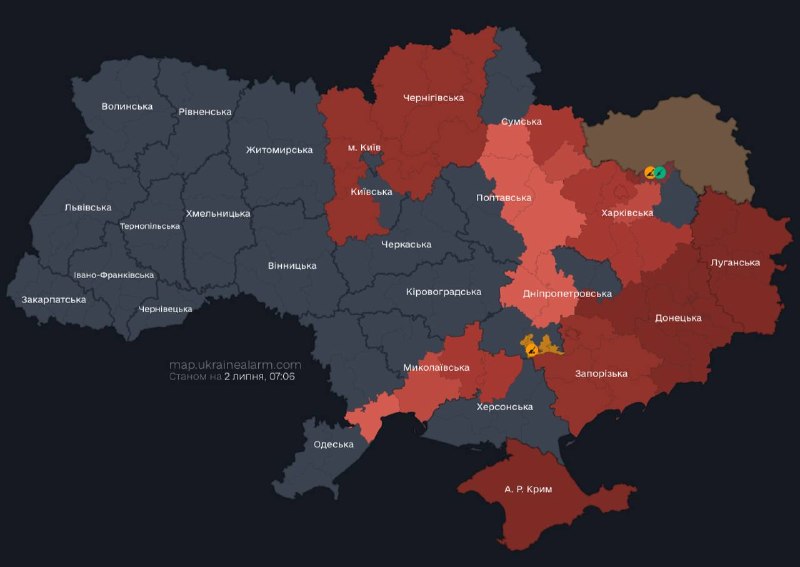
By 04:40 UTC on 2 July 2026, the Kyiv City Military Administration had revised its toll from the night's Russian drone attack three times in roughly an hour. Three dead became ten. Twenty-five injured climbed to 34, then to 56, with two of those injured reportedly children. A residential high-rise in the capital, photographed gutted by Ukrainian journalist Andriy Tsaplienko at 03:44 UTC, stood as the morning's bluntest evidence of what the numbers described.
This is what a full-scale invasion looks like when it has settled into a fourth summer. Not a single cataclysm, but a metronome of intermediate-yield strikes aimed at the place where a country's politics, business and family life concentrate: its capital's residential blocks. The early-July pattern, weeks of nightly Shahed-type UAV barrages punctuated by ballistic barrages on weekends, has become so routine that international desk editors sometimes treat it as weather.
Reading the revisions
The Kyiv City Military Administration's running update matters as a method, not only as a number. Three dead, then ten. Twenty-five injured, then 34, then 56. Each revision reflects debris clearance, hospital admissions from people who self-presented hours after the strike, and the painful work of reconciling missing-persons reports with the bodies recovered from a single ruined staircase. Casualty numbers from any major urban strike move. They almost always move upward. The honest framing is that the figures this publication is reading at 04:40 UTC are the figures available at 04:40 UTC; they will not be the final figures.
What is already firm: at least ten people will not return to flats in a high-rise that, until roughly 03:44 UTC on 2 July 2026, was someone's home. At least two of the injured are children. These are not abstract data points. They are the unit at which this war is being measured by the people absorbing it.
The counter-narrative, briefly
Russian state-adjacent channels have, in past barrages, framed such strikes as retaliation for Ukrainian long-range attacks on Russian territory or for strikes on occupied Crimea. That framing is not without structural logic: the war is reciprocal, and Ukraine has struck inside Russia using domestic long-range drones and Western-supplied missiles. But the framing collapses on contact with the specific facts of this event. A residential high-rise in Kyiv is not a military-industrial site. It is housing. Targeting it is not a measured riposte; it is the doctrine of pressure on civilian morale that Russia has applied, with varying intensity, since at least the autumn 2022 strikes on Kyiv's energy grid. The counter-claim exists; the counter-claim does not absolve.
What the structural pattern is
Strip away the politics for a moment and look at the engineering. UAV swarms launched overnight against a capital city, with ballistic or cruise follow-up strikes designed to catch emergency services at the impact site, are a known Russian playbook. Kyiv's air-defence density is the highest in the country; Patriot and Iris-T batteries, alongside Soviet-era systems and a growing domestic mobile-fire group, intercept a meaningful share of incoming threats. The drones that get through, increasingly, are the ones that catch a gap in radar coverage during crew-change windows, or that arrive in salvos large enough to exhaust interceptor magazines before reload.
The implicit message is not that Kyiv's defences are failing. They are doing remarkable work. The implicit message is that Russia is willing to absorb the cost of expending dozens of long-range strike assets per night, indefinitely, on a single city, to produce a steady drumbeat of damage that the international system cannot respond to fast enough to deter. This is industrial-scale attrition aimed at a domestic audience and at a Ukrainian population, with civilians as the transmission mechanism.
Stakes, and what remains contested
The short-term stakes are concrete and local: trauma capacity at Kyiv's hospitals, displacement from a damaged building, the political pressure on President Volodymyr Zelenskyy's government to demonstrate that the capital is defended. The medium-term stakes sit in Western capitals, where each night of strikes reopens the question of how much air-defence capacity and long-range strike capability Ukraine receives, and on what timetable. The long-term stakes are about whether a war fought by one side primarily through civilian infrastructure damage can be deterred by anything other than a shift in the cost calculus in Moscow.
What remains genuinely contested is whether the July 2026 tempo represents a Russian attempt to break Ukrainian public endurance ahead of a winter campaign, a response to specific Ukrainian strikes, or a routine industrial schedule that has decoupled from battlefield events altogether. The available reporting does not settle the question. What it does establish, with painful clarity at 04:40 UTC on 2 July 2026, is that ten Kyiv residents are dead and the night is not yet over.
This article draws on Kyiv City Military Administration updates relayed through the Ukrainian Telegram channel operativnoZSU between 03:44 UTC and 04:40 UTC on 2 July 2026, and on Andriy Tsaplienko's on-the-ground reporting from the strike site. Wire confirmations of the final casualty toll from Reuters, AP or AFP had not been published as of the time of writing and will be appended when available.
Wire provenance
This editorial synthesis draws on the following public wire/social posts:
- https://t.me/operativnoZSU/45901
- https://t.me/operativnoZSU/45899
- https://t.me/operativnoZSU/45898
- https://t.me/Tsaplienko/21234