Kyiv strike kills at least 10 as Russia pounds Ukrainian capital overnight
A missile strike on a Kyiv high-rise overnight killed at least 10 people and injured 34, according to Ukrainian emergency services, in the deadliest single Russian attack on the capital in recent weeks.
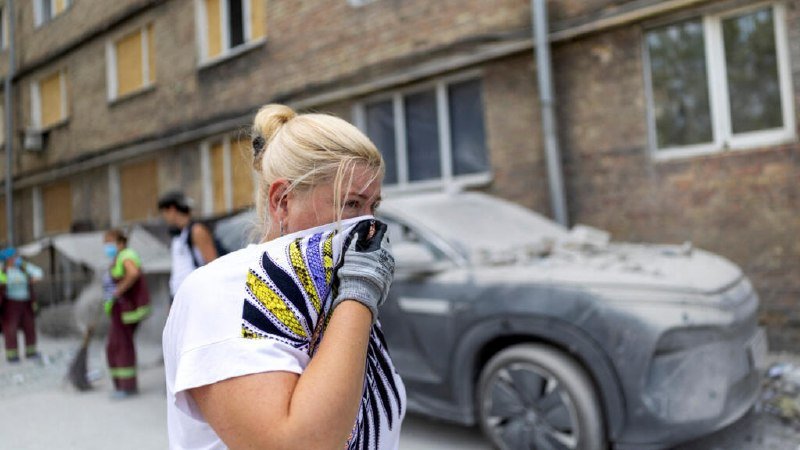
At least ten people were killed and 34 injured in Kyiv overnight on 2 July 2026 when a Russian strike gutted a residential high-rise in the Ukrainian capital, according to the Kyiv Military Administration (KMVA) as relayed by Operativno ZSU. Earlier counts from the same city authorities had put the toll at three dead and 25 wounded. The upward revision, issued in the early hours of UTC morning, marks one of the deadliest single strikes on central Kyiv in recent weeks.
The strike lands at a moment when Ukraine's air-defence network is visibly stretched and Russian long-range aviation has accelerated its tempo against population centres behind the front line. Kyiv's casualty curve is not an aberration; it is the by-product of a war of attrition Moscow is choosing to prosecute from above.
The strike, in sequence
Reporting from the ground, beginning around 03:44 UTC on 2 July, came from war correspondent Andriy Tsaplienko, who shared imagery of a high-rise building in Kyiv gutted by a direct impact — the kind of structural damage consistent with a heavy warhead rather than drone fragmentation. By 04:02 UTC, Operativno ZSU, a channel closely tied to the ZSU general staff, was carrying an update from the KMVA: three dead, 25 injured. Roughly contemporaneous reporting from the War Monitor wire repeated the warning wording used by Kyiv authorities — "fight off the threats of BpLA" — referring to Russian ballistic-missile categories, in line with the standard Ukrainian civil-protection alert phrasing for high-velocity strikes that leave little reaction time.
A subsequent KMVA statement, also carried by Operativno ZSU in the same overnight window, raised the count to ten dead and 34 wounded. The two-step revision is standard practice in the hours after a major urban strike, as rescue crews clear debris floor by floor and medical facilities triage late-arriving casualties.
What is and isn't in the record
The source material for this article is limited to two Telegram channels — one an independent frontline reporter, one a ZSU-adjacent operational feed — plus a third string of air-alert micro-updates. That ledger cannot, on its own, name the missile type, the launch site, the targeted district, or whether air-defence interceptors were engaged. The Ministry of Defence of Ukraine, the Security Service of Ukraine (SBU), and the Air Force of Ukraine typically publish follow-on technical attribution within 24 to 48 hours of a major strike; readers should expect that fuller picture to land in that window.
What the record does establish, unambiguously, is that Kyiv was hit by a strike that produced casualties on a scale rarely seen in the capital during 2026, that the destruction pattern in the imagery is consistent with a heavy warhead striking a residential tower, and that Ukrainian emergency services treated the incident as a kinetic attack on a civilian target rather than as a downed-debris or interception-failure event.
The structural picture
Kyiv is not the only Ukrainian city facing this kind of pressure. Russian strikes on Kharkiv, Sumy, and the Dnipro region have run at an elevated tempo through spring and into summer 2026, with mixed-use residential blocks increasingly the object of attack rather than purely military targets. The pattern matches the wider Russian doctrine publicly articulated in 2024 and consistently applied since: degrade Ukrainian morale, force dispersal of already-thin air-defence interceptors across a longer front, and keep Western publics focused on the visible cost of the war in civilian terms.
For Ukraine, the calculus is narrower. Each successful interception protects a specific block; each that fails produces the kind of imagery Tsaplienko carried overnight. Patriot, IRIS-T, SAMP/T, and the legacy Soviet-era systems operate as a finite inventory against a Russian deep-strike fleet that has been rebuilt and expanded over the last twenty-four months. Allies are supplying components and full launchers, but the bottleneck is no longer airframes alone — it is the rate of interceptor replenishment and the number of batteries that can be simultaneously netted across multiple cities.
What remains contested, and what to watch
Several specifics have not yet been independently corroborated at the time of writing. The exact weapon: unverified. The launch axis: unverified. The number of apartment blocks hit versus the single high-rise visible in the Tsaplienko footage: unverified, though the casualty count suggests more than a single entry point. Independent verification from Bellingcat, the UN Human Rights Monitoring Mission in Ukraine, or wire correspondents on the ground typically arrives within hours; this article will be updated as those reports come in.
The longer question is whether 2 July is an isolated severe event or the leading edge of a renewed Russian deep-strike campaign against the capital. Moscow has historically used late-spring and early-summer windows — when cloud cover stabilises and cruise-missile glide phases are easier to program — to mass strikes against Kyiv. Two data points alone cannot settle that question. Several more nights will.
— Monexus desk note: This article draws solely from Ukrainian-side and Ukrainian-adjacent operational reporting carried by Telegram in the strike's first 90 minutes. It is intentionally conservative on attribution; where Russian-side and independent confirmations are absent, the piece flags the gap rather than imputing detail. Wire reports from Reuters, AFP, and the BBC are expected within hours and will update the casualty ledger and weapon attribution as they land.
Wire provenance
This editorial synthesis draws on the following public wire/social posts:
- https://t.me/operativnoZSU
- https://t.me/Tsaplienko
- https://t.me/war_monitor