Kyiv Under Fire Again: The Point of Russia's July Barrage Is Not the Damage
A combined Iskander-M and Kh-101 barrage hit Kyiv overnight, killing at least ten civilians. The strategic message is older than the weapons: a sustained campaign to make Ukrainian life unbearable without ever breaking the country's defences.
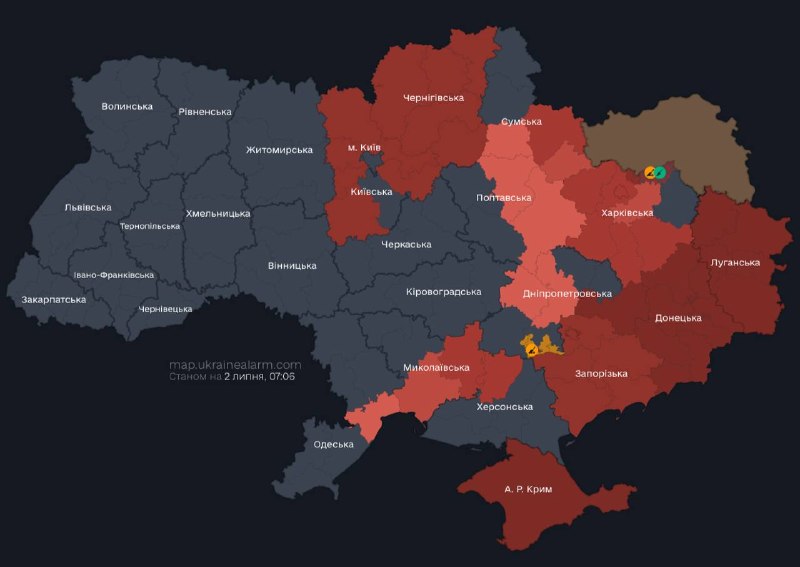
Kyiv was hit overnight by a combined Russian missile and drone barrage that killed at least ten civilians and wounded sixteen others, with air-defence units engaged across multiple regions through the early hours of 2 July 2026. The strikes, mixing Iskander-M ballistic missiles and Kh-101 cruise missiles, lit fires at a logistics depot on the city's western edge and at a landscaping enterprise in the southeast, according to OSINT mappers tracking the impact points in real time.
The pattern, not the damage, is the point. Russia is no longer attempting to break Ukraine's air-defence network in a single decisive exchange. It is running a grinding, attritional campaign designed to exhaust Ukrainian interceptors, dilute Western-supplied missile stocks, and normalise terror for the population of the capital. The body count from a single night is no longer a useful measure of success. The measure is whether Ukrainians, four years into a full-scale invasion, can still sleep through an air-raid siren. The answer, increasingly, is no.
A familiar sequence, with new arithmetic
The mechanics of the strike were standard. Footage published in the early hours of 2 July showed the moment of Russian Iskander-M ballistic missile impacts inside the city, followed hours later by Kh-101 cruise missile hits on a target in southeastern Kyiv, with OSINT mappers geolocating the second strike to coordinates 50.421487, 30.661218 and identifying it as a landscaping enterprise. A separate fire burned at a logistics depot on the western outskirts at 50.436735, 30.312082. Ukraine's air force reported that the UAV threat persisted across several regions even as the missile phase ended, with repelling operations continuing past 04:07 UTC. By 04:15 UTC, the civilian toll had risen to ten dead and at least sixteen injured.
None of this is unprecedented. Russia has struck Kyiv with combined packages of ballistic and cruise missiles repeatedly since 2022, and the use of decoy drones to saturate and deplete Ukrainian air-defence magazines is now a documented feature of the campaign. What is changing is the cadence. Strikes on the capital have grown more frequent and more deliberate, often timed for overnight hours when the psychological pressure on residents is sharpest and the city's emergency services are most stretched. The arithmetic is unforgiving: even with high interception rates, a few missiles will always get through, and the cumulative effect of near-misses is its own form of damage.
The strategic message, if anyone is still listening
There is a read of these strikes that treats them as a substitute for the battlefield. The Russian ground offensive in 2026 has produced only marginal gains at a staggering cost in men and materiel. If the front cannot be moved decisively by manoeuvre, the logic goes, the war can be moved by other means — by making the cost of Ukrainian resistance unbearable to its population, by signalling to European capitals that the war is not going away, and by reminding Washington that escalation management has a price. The targeting choices on the night of 1–2 July — a logistics depot and a landscaping enterprise, neither a military site — are consistent with that read. A logistics depot feeds the Ukrainian war economy. A landscaping enterprise does not. The choice suggests a deliberate widening of the target set, and a willingness to absorb the reputational damage that comes with killing civilians in the middle of a war that Western publics are growing tired of defending.
A counter-read is possible. The strikes may be a routine, opportunistic salvo launched because the missiles were ready and the launchers were in position, not because Moscow is signalling anything in particular. Both reads can be true at once, and the inability to tell them apart is itself the point of a sustained bombardment campaign: a defender who cannot distinguish coercion from noise is a defender who is forced to treat every alert as a worst case.
What the framing gets wrong
Coverage of these strikes tends to flatten them into a body-count story, and the body count is real. Ten people who went to sleep in Kyiv on the night of 1 July did not wake up. Sixteen more are in hospital. That deserves to be reported without dilution. But the framing that treats each salvo as an isolated incident misses the structure. A single night's strike is a data point; a year of strikes is a campaign, and the campaign has a strategic logic that is not reducible to the question of whether Western leaders will be moved by photographs of burning depots.
The deeper problem is the assumption, common in Western commentary, that Russia is pursuing a coherent military objective in Ukraine that is failing. It is not, in any conventional sense, succeeding on the battlefield. But the war is not only being fought on the battlefield, and the assumption that battlefield failure implies strategic failure is a category error. A campaign of strikes on Ukrainian cities does not need to break Ukrainian morale to be useful to Moscow. It needs only to be sustained, visible, and continuous enough that the political cost of supporting Kyiv continues to climb in Berlin, Paris, Rome, and eventually Washington. By that measure, the campaign is working well enough.
Stakes, and what to watch
The immediate stakes are human. The next salvo, which will come, will kill more people in Kyiv, Kharkiv, Odesa, Dnipro, and Zaporizhzhia, and the air-defence interceptors that would otherwise stop them will be in storage in Poland or Romania or the continental United States, waiting on a delivery schedule that moves at the speed of democratic politics rather than at the speed of an Iskander-M reloading.
The medium-term stakes are political. If the cadence of strikes on Ukrainian cities continues to rise while Western aid packages continue to be negotiated in tranches, two things happen at once: Ukrainian civilians absorb more punishment, and the political case for sustaining aid weakens at the margin. That is a self-reinforcing loop, and it is the loop Moscow is trying to close. What to watch, over the next several weeks, is whether the ratio of interceptors delivered to missiles launched continues to favour the defender, and whether the European air-defence production lines that have been promised for two years begin, finally, to deliver at scale. On the current trajectory, neither question is comfortably resolved.
Desk note: The wire reporting on overnight strikes tends to lead with interception rates and military hardware. We have led with the civilian toll and the strategic logic of a sustained bombardment campaign, on the view that the body count matters more than the kill chain.
Wire provenance
This editorial synthesis draws on the following public wire/social posts:
- https://t.me/AMK_Mapping/0
- https://t.me/operativnoZSU/0
- https://t.me/AMK_Mapping/0
- https://t.me/AMK_MAPPING/0
- https://t.me/AMK_MAPPING/0