Steely USA shrug off Balogun red to reach World Cup last 16
The co-hosts down a man for the entire second half after Folarin Balogun's straight red, yet beat Bosnia and Herzegovina 2-0 to book a knockout slot.
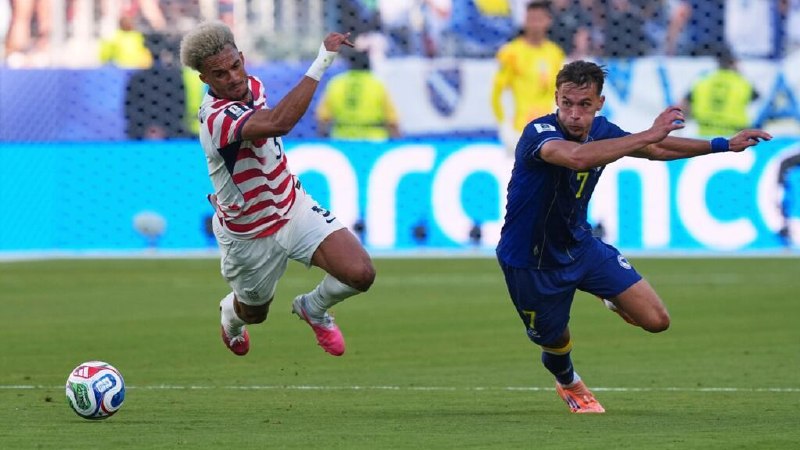
The United States absorbed a straight red card and 45 minutes of second-half pressure to defeat Bosnia and Herzegovina 2-0 at the San Francisco Bay Area Stadium on Wednesday, becoming the first of the co-hosts to book a place in the World Cup knockout rounds. Folarin Balogun's opening goal on the stroke of half-time was followed moments later by a dismissal that, on most nights, would have flipped the game. Instead, the Americans held their line and finished the job.
The result is less a tactical story than a temperament one. Pochettino's side is young, multi-club, and still finding its identity a year after the Argentine took charge. Bosnia and Herzegovina, by contrast, arrived with nothing to lose and a structure that has repeatedly troubled bigger nations. The Americans' response to a moment that could have unravelled their tournament is the first genuinely reassuring signal of this World Cup for the home support.
A goal, a red, and a half to forget
The 38th minute settled the first question. Balogun, born in New York and raised through Arsenal's academy, finished a move that broke Bosnia's pressing lines and gave the co-hosts a lead they would not relinquish. The stadium, announced as full for the round-of-32 fixture, exhaled. Then the match tilted on its axis.
In first-half stoppage time, Balogun was shown a straight red by the referee for a challenge on Bosnia and Herzegovina defender Tarik Muharemovic. The France 24 wire described the dismissal as cutting the United States' advantage in half before the break; the BBC's running account simply recorded the colour of the card and the player it was shown to. Either way, the arithmetic of the match changed overnight. Pochettino waved towards the sky; McKennie's face, as captured pitchside, was a study in disbelief.
Playing the entirety of the second half a man down at a World Cup knockout game is the kind of problem that ends campaigns. The Americans, to their credit, did not let it.
How Bosnia failed to land the punch
Bosnia and Herzegovina's task was straightforward in shape and brutal in execution: find an equaliser before the American shape cracked, then press for a winner. They had the ball, the territory, and the noise of a stadium that, after the red, briefly turned uncertain. They did not have the goal.
The structural problem for the Balkans was the United States' defensive block. With a man down, Pochettino's side dropped into a mid-to-low block, narrowed the central channels, and invited Bosnia to circulate wide. Wide circulation against a disciplined American back line, with the goalkeeper's starting position pushed up to compress the space in front of the box, produced territory without threat. Bosnia's half-chances were almost all from distance or from set-pieces where the Americans' aerial numbers, even reduced by the red, were enough.
A second goal, scored against the run of play on the counter, killed the contest and confirmed the scoreline that the wire services had already filed. From that point the question was no longer whether the United States would advance, but how much the second-half ordeal would cost them going into the round of 16.
The Pochettino project, one game older
The head coach's fingerprints were on the response as much as on the team sheet. Pochettino has spent the past year assembling a squad from the broadest possible pool: dual-nationals reclaimed from European academies, MLS mainstays given a stage they had not previously been trusted with, and a handful of Premier League starters whose club seasons ended in fatigue. The tactical flexibility he has asked of them, press-to-block transitions within a single half, has been the talk of the tournament's technical observers.
A red card is the ultimate stress test of that flexibility. The team passed it without conceding, which is the kind of result that buys a coach a year of trust. It does not buy him a place in the quarter-finals on its own. The round of 16, against an opponent to be confirmed after the rest of the bracket settles, will tell us whether this is a team that has learned to win ugly or a team that has merely learned to survive ugly.
What remains unresolved
The dismissal itself will dominate the post-match debate. Straight reds for challenges that draw blood but contain no malice are the most argued-about decisions in football, and Bosnia's bench is certain to argue that the punishment fit the crime. The available reporting does not record a VAR overturn; it records only that the card was shown and that the United States played on. The Disciplinary Committee's view, if the case is referred, is the next subplot worth watching.
There is also the question of squad cost. Losing Balogun, presumably for the next match at minimum, narrows an attacking group that was already thin on out-and-out centre-forwards. Pochettino will need a plan that does not depend on the man who broke this game open before he left it.
The United States has reached the last 16 of a World Cup it is hosting. The manner of the reaching, rather than the fact of it, is what will be remembered.
This publication framed the result through the lens of squad temperament rather than tactical novelty, on the view that a one-man disadvantage in a knockout match tests character more reliably than it tests system.
Wire provenance
This editorial synthesis draws on the following public wire/social posts:
- https://t.me/france24_en