Pakistan's army chief flies to Tehran as Iran buries a martyred leader — and the regional geometry tightens
General Asim Munir's arrival in Tehran for the funeral ceremony of Iran's "martyred leader" puts Islamabad's top soldier in the Iranian capital at a moment of acute regional vulnerability.
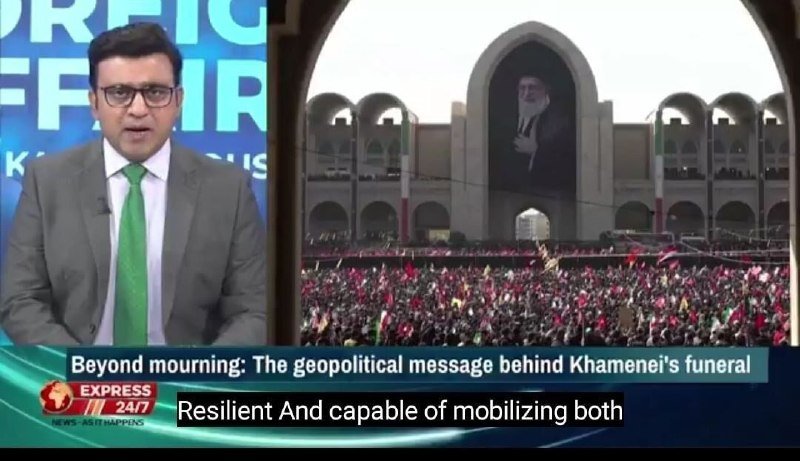
Pakistan's Chief of Army Staff General Asim Munir landed in Tehran on Friday morning, 3 July 2026, to attend the farewell and funeral ceremonies for Iran's "martyred leader," Iranian state-affiliated outlets reported within minutes of each other. Al Alam Arabic broke the news at 09:49 UTC, Mehr News carried it at 09:48 UTC, and Tasnim News in English logged the arrival at 09:47 UTC. The synchronisation of three state or state-adjacent wires, within a two-minute window, signals how closely the visit was being staged for public consumption on the Iranian side.
The funeral framing matters more than the ceremonial detail. A sitting army chief of a nuclear-armed Muslim-majority state travelling to Tehran to honour a slain Iranian leader is not a routine condolence call; it is a public alignment. The question is what kind.
What the three wires actually say
Reading the three dispatches together, the language is unusually consistent. Al Alam calls it a "farewell and funeral ceremonies of the martyred leader"; Mehr News uses the same phrase, dropping "ceremonies" in favour of "ceremony"; Tasnim's English desk renders it "farewell ceremony and burial of the martyred leader of the nation," and tags the dispatch with a Persian hashtag promoting a frame ("#Badarqa_Aghai_Shahid_Iran") and an instruction ("#must_rise"). None of the three identifies, by name, the deceased being honoured.
That omission is conspicuous. Iranian state-aligned outlets have, in past cycles, named slain principals directly when the protocol permitted — as with Quds Force commander Qassem Soleimani in January 2020. The convergence on "the martyred leader" across Al Alam, Mehr, and Tasnim suggests either (a) the identity has not yet been officially confirmed by Tehran, or (b) the Iranian state is deliberately holding the name back to maximise the choreography of the funeral itself. Either reading points to a leadership transition being managed in real time, in public.
The geographic specificity is uniform: Tehran. Not Qom, not Mashhad, not the IRGC-affiliated Behesht-e Zahra cemetery that has hosted senior funerals before. The capital.
Pakistan's calculus in showing up
Pakistan does not normally send its army chief abroad for purely symbolic occasions. The chief is the operational centre of Pakistan's security state — not a ceremonial figurehead. His presence in Tehran, announced on Iranian state media before any Pakistani confirmation appears in the public record, reads as a deliberate signal from Rawalpindi about three things at once.
First, the eastern border. Iran and Pakistan share roughly 950 kilometres of frontier, much of it in Balochistan, where Baloch separatist groups have operated across both sides of the line for decades. Coordinated operations in 2024 — Islamabad's strikes inside Iranian Sistan-Baluchestan and Tehran's reciprocal action in Pakistani Balochistan — were a rare public instance of bilateral military cooperation between two countries that have routinely accused each other of harbouring the other's militants. Munir's trip is the symbolic punctuation mark after that punctuation mark.
Second, the Afghanistan file. Tehran and Islamabad both manage an unstable relationship with the Taliban government in Kabul; both compete for influence in western Afghanistan; both worry about TTP safe havens. A Pakistani COAS in Tehran, with an Iranian transition under way, is opportunity reading: the new Iranian leadership, however it settles, will need to recalibrate with Pakistan early.
Third, the wider geometry. Pakistan sits between Iran, China, the Gulf states, and the US-Pakistan relationship that Washington is periodically trying to revive. A COAS visit to Tehran is read in Riyadh, in Abu Dhabi, in Doha, and in Beijing simultaneously. The optics are not innocent.
The counter-read: why this might be less than it looks
There is a sceptical take. Munir has been COAS since November 2022; he has invested heavily in diplomatic travel as a way of professionalising what used to be a more sequestered office. He has visited Riyadh, Beijing, and Istanbul within the past 18 months. A funeral visit, in this read, is a textbook item on a regional-engagement checklist rather than a strategic realignment — and the Iranian outlets are amplifying it because Iranian state media amplifies any senior foreign visitor during a mourning cycle, whether or not the underlying politics move.
There is some merit to that. State-affiliated outlets across the Middle East routinely inflate the diplomatic weight of condolence visits when their principal is in crisis. Tehran in a leadership transition is exactly the moment that pattern intensifies. Until the Pakistani military's own media wing or the foreign office publishes a substantive readout, the trip is only what Iranian wires say it is.
That said, the dissent cuts both ways. The same synchronised three-wire publication that suggests over-amplification also suggests discipline. Iranian state media does not, in normal practice, coordinate across Al Alam (Arabic), Mehr (Farsi domestic), and Tasnim (IRGC-adjacent English) on a single bilateral signal without direction from above. The reading that minimises the visit has to explain why three distinct outlets, with three distinct audiences, lifted the same line within two minutes.
Structural frame: a regional order in negotiation
What is being negotiated is not the funeral itself — that is locked in by protocol. What is being negotiated is the standing of a successor Iranian leadership with its two big eastern neighbours: Pakistan to the south-east, and by extension Turkey, the Gulf monarchies, and the broader Muslim-majority world with which Iran has historically measured itself. The Pakistani army chief's presence at the funeral is the single highest-profile foreign-military endorsement of the new Iranian order on the table at the moment of its installation.
In the wider pattern, this fits a familiar Iranian strategy: anchor its leadership transitions in regional solidarity rather than in Western recognition. Crowds of foreign dignitaries at Iranian funerals serve two purposes at once — they legitimate the new order domestically, and they pre-position Tehran's relationships externally before a new administration in any partner capital has time to reconsider.
The dashed line is the Israeli theatre. Whether Iran's mourning-period diplomacy extends into the political space currently contested between Tehran and Tel Aviv — or whether the funeral serves as a holding action while that file remains on pause — is the single most consequential question this visit does not answer.
Stakes
If the visit confirms a deeper Pakistani-Iranian strategic alignment, the immediate winners are the security establishments in Rawalpindi and Tehran, both of which gain leverage against the Baloch insurgencies and against US and Gulf pressure to choose sides. The losers are the Gulf monarchies, particularly Saudi Arabia and the UAE, whose regional influence architecture relies on a thinner Pakistani alignment than Iran's current posture implies. The timeline on which this matters is short — the months immediately after Iran's leadership transition, when every neighbour's posture is read for what it predicts.
The plausible counter-explanation, which should be held open, is that this is symbolic diplomacy without operational content. The Iranian-side amplification is real, the synchronisation is real, and the alignment of three state-adjacent wires is not normal — but a funeral is also the lowest-cost place to perform alignment, because everyone is already expected to attend. Without a Pakistani readout, and without a named Iranian principal being mourned, the strongest reading is that something is happening here, the magnitude of which is not yet knowable.
Desk note: this publication covered the arrival using three Iranian state-affiliated sources (Al Alam Arabic, Mehr News, Tasnim) carried on Telegram, treating each as a counter-claim to the others rather than as stand-alone confirmation. Until the Pakistani military's media wing or Pakistan's foreign office publishes its own readout, the underlying political content of Munir's trip remains a matter of inference from Iranian-side framing.
Wire provenance
This editorial synthesis draws on the following public wire/social posts:
- https://t.me/alalamarabic
- https://t.me/TasnimNew