Tehran on high alert as Iran lays Ali Khamenei to rest
Iran opens days of public mourning for Ayatollah Ali Khamenei, with helicopter activity over Tehran and foreign delegations streaming in ahead of a state funeral that doubles as a managed display of unity.
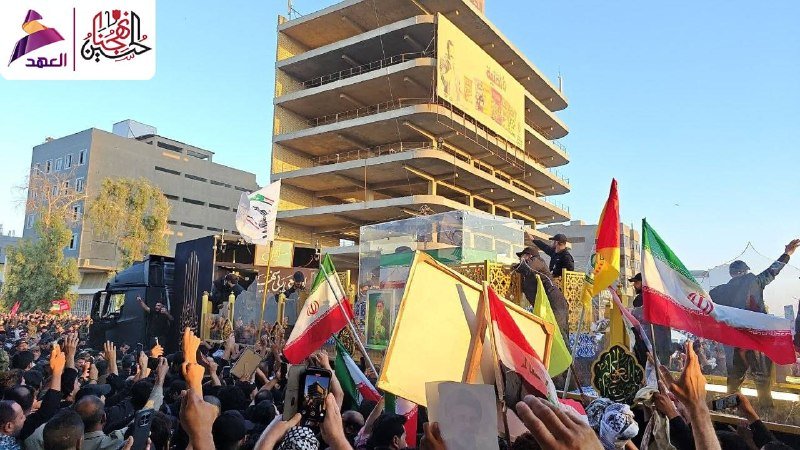
Iran opened days of public mourning for Ayatollah Ali Khamenei on Friday, 3 July 2026, transforming the capital into a fortified stage for one of the most consequential state funerals the Islamic Republic has staged. Helicopters circled over central Tehran from the early hours, eyewitness traffic on the open-source channel @Osint61 reported at 09:33 UTC, as security services locked down the route between the Grand Mosalla mosque and Enghelab Square. By mid-morning, state-linked outlets were billing the event as a national-unity ceremony, with foreign delegations arriving in waves.
The funeral matters less for its liturgy than for what it reveals about the post-Khamenei settlement. A succession choreographed in the open, with the security services visibly in command of the airspace and the street, signals an establishment that intends to manage the transition rather than be carried by it. The choreography — mourning extended across several days, foreign guests brought in as witnesses, the corpse placed in state at the Grand Mosalla before burial — is designed to do political work the Supreme Leader himself can no longer do.
What is actually happening in Tehran
According to BBC reporting on 3 July, Khamenei's body will lie in state at Tehran's Grand Mosalla mosque from Friday, with funeral events stretching across several days. The open-source account circulating via Telegram channels in the morning described helicopter activity overhead as the capital moved to high alert ahead of the burial; the Palestine Chronicle frame, published at 08:54 UTC the same day, characterised the ceremony as a "powerful display of national unity" engineered around the arrival of foreign delegations.
Read together, those two signals describe the same event from different vantage points. The open-source traffic captures the coercive apparatus — rotorcraft, road closures, alert posture. The state-aligned coverage captures the intended meaning: a unified Iran receiving the world. Both are accurate; neither is complete without the other.
The framing contest
Western wire reporting on Iranian state funerals has historically leaned on two tropes: a managed personality cult, and a brittle regime papering over cracks. Both contain truth and both conceal as much as they reveal. The funeral is unmistakably managed. But the scale of the mobilisation — millions expected in central Tehran by state-aligned accounts, delegations from allied and non-aligned capitals landing in sequence — is also a real metric of diplomatic weight.
For Tehran's regional partners, attendance is a billable signal. For rivals, the gathering is a target-rich environment and a stress test of Iranian internal security. The helicopter activity reported over the capital is consistent with both readings — protective posture and surveillance posture are the same flight pattern at this altitude.
The structural picture
A succession of this magnitude in a theocratic republic does not happen in a vacuum. It happens inside a country that has spent four decades fusing clerical authority with the Islamic Revolutionary Guard Corps, the regular military, and a network of bonyad foundations that control vast economic assets. Khamenei did not personalise the system so much as he became its most recognisable face; that face is now being carried through the streets of the capital one last time before it is interred.
What replaces the face is the question every regional foreign ministry is trying to answer. The days-long format of the funeral buys the establishment time to choreograph that answer publicly. State media is already framing the procession as continuity rather than rupture. The security footprint says the same thing in a different vocabulary: the perimeter is sealed because the script is not yet finished.
Stakes and forward view
The immediate stakes are operational. A sealed capital with millions on the streets and dozens of foreign delegations in town is a high-value target for adversaries and a high-stress test for the security services. The longer stakes are geopolitical. Iran enters its post-Khamenei phase with deepened ties to China and Russia, an unresolved nuclear file, and an active conflict footprint through Hezbollah-aligned and proxy networks across the region. The funeral is the moment that file gets a new signature at the top.
Three things to watch in the days ahead: first, which clerical and military figures appear together on the funeral platform and in what order; second, the official communiqués issued to foreign dignitaries, which often preview the new doctrine; third, the security posture in border provinces, which is where stress in a managed transition tends to surface first.
What remains uncertain
The sources available in the open record do not specify the precise sequence of mourners, the names of all attending foreign delegations, or the burial date beyond the days-long framing. Open-source traffic captured helicopter movement over the capital; state-aligned coverage characterised the mood as unified. Those two readings are not in flat contradiction, but neither alone tells a reader what the post-Khamenei balance of power inside the establishment will look like. The next forty-eight hours of state-media framing, combined with the order of appearances at the Grand Mosalla, will narrow that uncertainty considerably — or, if the security perimeter stays unusually tight for unusually long, will signal that the script is still being negotiated in private.
— Desk note: Monexus frames this as a managed succession event under high-security conditions, reading open-source traffic on rotorcraft and state-aligned coverage on unity as complementary data points rather than competing narratives. Wire services will lead on the ceremony itself; we are watching what the choreography reveals about the settlement that follows.