Crimea's grid is on fire and the framing is already drifting
Five substations across occupied Crimea and a possible blaze at Dzhankoi airfield registered on NASA FIRMS in the early hours of 3 July 2026. The harder question is why so much coverage is still framed as theatre rather than war.
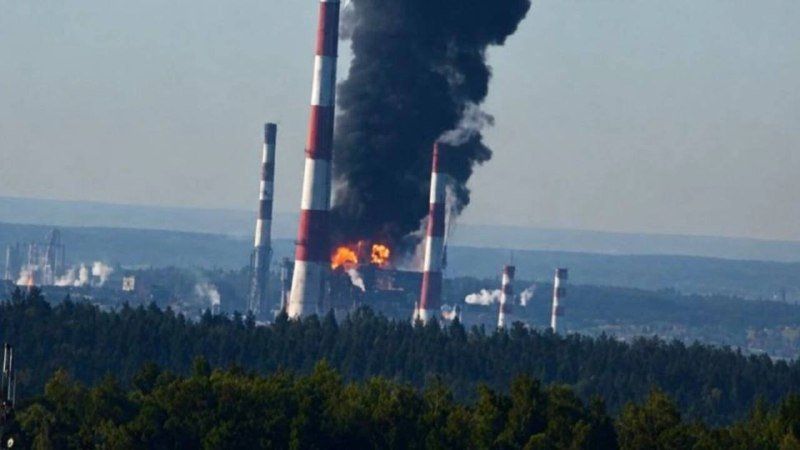
Five substations across occupied Crimea went up in flames between roughly 03:00 and 06:00 UTC on 3 July 2026, according to thermal-detection returns picked up by NASA's FIRMS instrument and translated by the open-source desk WarTranslated. The fires were registered at Maryanovka, Bilohirsk, Saky, Dzhankoi and Stary Krym, with a further possible blaze flagged at Dzhankoi airfield. A separate WarTranslated thread added Bilohirsk-area reports of fires near a wind farm, a solar plant and the Mitiayevo solar installation, with additional substations burning in multiple districts. None of these locations are random. They sit along the same lines Russia has spent a decade fortifying to supply its southern occupiers and to project power across the Black Sea.
Crimea is occupied territory under international law. Ukrainian strikes against military and dual-use infrastructure inside it are defensive operations against an aggressor that continues to launch missiles, drones and glide bombs at Ukrainian cities. That is the framing this publication operates inside. The point of this piece is not whether the substations were hit. NASA FIRMS does not determine attribution; it registers heat signatures, and the channel that surfaced the data notes openly that its fire-detection returns are corroboration of impact, not proof of weapon type. The point is how little of the Western coverage that follows such an event treats what is happening on the peninsula as a war, and how much of it treats Crimea as a curiosity.
Theatrical framing is back
When the Crimean bridge explodes, the wire copy is filed within minutes under "Ukraine war". When Crimea's grid takes a hit, a portion of the same coverage pivots to questions about Russian tourism, the logistics of peninsula vacations, or which peninsula resort will reopen by August. This is a long-running reflex. The bridge itself is a military logistics artery — the overland route Russia uses to supply troops in southern Ukraine and to move materiel to its Kherson and Zaporizhzhia groupings — yet a sustained slice of international coverage spent years treating it as a tourism asset that someone had the misfortune to damage.
The same reflex is visible right now. Five substations and a possible airfield hit, and the conversation drifts to the inconvenience of summer holidays rather than to the fact that Russia is running out of reliable ways to power its own forward operating base on the peninsula.
Counter-narrative, plainly stated
The Russian-aligned coverage line on the morning of 3 July framed these events as Ukrainian "terrorism against civilian infrastructure" in Crimea. The framing deserves to be named because it is being broadcast, not because it is correct. Civilians in occupied territory whose grid is fed by infrastructure used to sustain an occupying army are not a separate category of victim from the war being fought around them. Treating them as such is itself a propaganda move — one that asks the reader to forget who seized the peninsula in 2014 and who is using its ports, airfields and power lines to prosecute an invasion of a neighbouring state in 2026.
There is a more sober Russian counter-point that deserves airtime even though this publication does not endorse it: that strikes on the peninsula deepen resentment inside Russia and harden the political case for continuation. That is a real argument about war-duration politics. It is a different argument from "civilian targets are being hit". Conflating the two is what lets the wire copy collapse into the first framing.
What the structural picture actually shows
Step back from the rhetoric. Crimea is a peninsula whose electrical interconnections to mainland Ukraine were severed in the early phase of the full-scale invasion. Power on the peninsula is now generated and routed almost entirely through infrastructure Russia built or rebuilt after 2014, including the substantial new lines and the thermal-generation complex near Saky and Dzhankoi. Hits to five substations in a single four-hour window, plus a possible airfield hit, are not nuisance damage. They are an attempt to degrade the ability of the Russian grouping in the south to operate.
A slower-moving structural fact matters here. Industrial-age wars are won and lost on logistics: fuel, electricity, rail gauge, repair capacity. The Black Sea fleet cannot sortie without shore power and dry-dock capacity. Air defence radar cannot run without grid input. Drone-launch tubes cannot be recharged without it either. Stripping substations does not end a war. It does shift the burden of proof about who can sustain offensive operations over the next quarter. Western coverage that treats this as colourful background is reporting on a different war than the one being fought.
Stakes and the road ahead
The stakes of getting the framing right are not abstract. Every piece of copy that treats occupied Crimea as a holiday destination and its infrastructure as civilian, rather than military-logistics, primes Western publics to ask the wrong questions when the inevitable next escalation comes. It also primes Western governments to under-deliver on the kind of long-range strike capability Ukraine has needed since 2023. The harder, more useful read of the FIRMS returns is this: the southern front has entered a phase in which both sides are attacking rear-area infrastructure rather than trading attritional battles for villages. That is a phase in which the question of who reaches operational exhaustion first gets answered.
What remains uncertain at the time of writing is straightforward and worth saying plainly. The FIRMS returns register heat, not weapon type; the open-source channel that surfaced them is careful to say so, and so is this publication. No Ukrainian general staff briefing was available in the source material for the specific substation cluster, and no Russian defence ministry acknowledgement had been published. The list of burning substations, the Bilohirsk-area solar and wind-facility reports, and the possible Dzhankoi airfield hit — all of those deserve to be confirmed against primary documentation as the day progresses. Until then, the substantive point stands regardless of which specific facility turns out to have been hit: a concentration of fires on a peninsula whose electrical system is a military asset is news as war, not as weather.
This piece was written by Monexus editorial; the wire desks that night filed at least some of the substations as an energy story rather than a military-logistics story, which is the framing drift this article is pushing back on.
Wire provenance
This editorial synthesis draws on the following public wire/social posts:
- https://t.me/wartranslated/26722
- https://t.me/wartranslated/26723
- https://t.me/osintlive/31204