Egypt edge Australia on penalties to reach World Cup Round of 16, as Gaza watches from the stands
Egypt advanced past Australia 4-2 on penalties after a 1-1 draw through extra time on 3 July 2026, sealing a Round of 16 berth in a match Palestinians in Gaza watched and cheered as a rare public moment of collective joy.
Egypt booked its place in the Round of 16 of the 2026 FIFA World Cup on Friday, 3 July 2026, dispatching Australia 4-2 on penalties after 120 minutes of football failed to separate the sides. The match finished 1-1 in regulation and extra time. Australia's exit was confirmed at roughly 20:56 UTC, with both Cairo-aligned and Australia-focused wires posting the result within minutes of the final spot-kick.
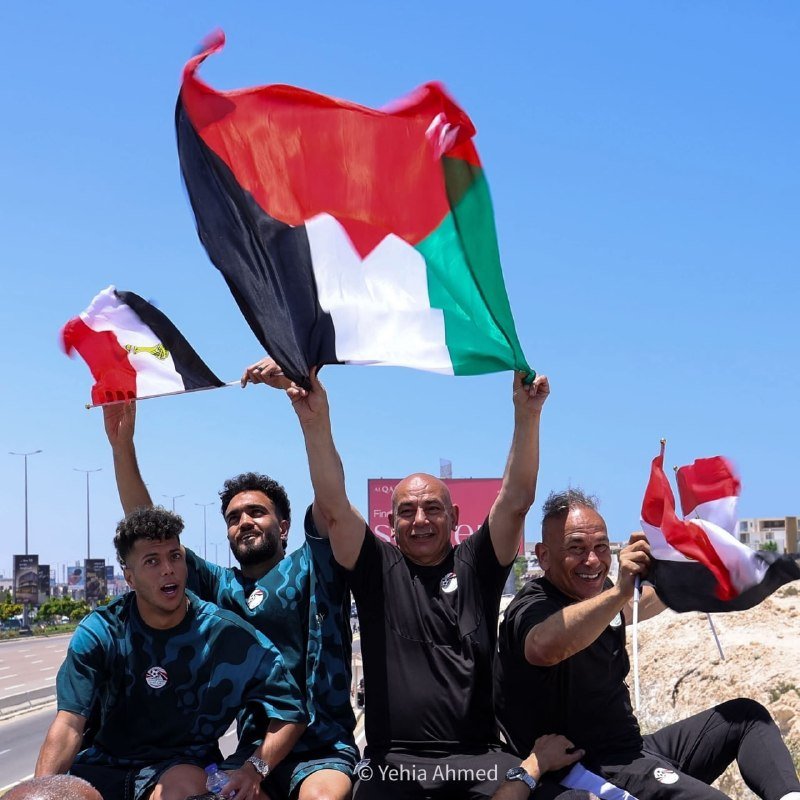
The result carries weight beyond the bracket. In Gaza, where the war has thinned the routines of daily life for nearly two years, Palestinians gathered in front of screens to cheer the Egyptian goals — including the opener that briefly put the Pharaohs ahead in normal time. The Middle East Eye correspondent on the ground reported fans celebrating in the streets when the ball went in, a small, vivid counter-image to a strip otherwise defined by rubble and displacement. Football, in other words, briefly re-inserted itself as a civic event in a place that has lost most of its public ones.
What the 120 minutes actually said
Egypt arrived as the established side of the bracket, carrying the expectation of a region. Australia arrived as the stubborn underdog, the kind of team that has spent a generation making knockout football harder than its talent pool should allow. The match, by all accounts, matched the billing: tight, tactical, and decided less by flair than by nerve.
The scoreline stayed level after 90 minutes and through both halves of extra time, forcing a penalty shootout that Australia lost 4-2. The Standard Kenya wire posted the confirmed result at 21:13 UTC; Iran's Tasnim news agency confirmed the same scoreline from its own angle at 20:58 UTC. Both outlets, with no obvious reason to coordinate, framed the match identically: a 1-1 draw through extra time, a 4-2 penalty win for Egypt. That convergence, across two sources on opposite ends of the geopolitical map, is the cleanest signal of what actually happened on the pitch.
The Gaza lens the Western wires will not run
What makes this Round of 32 tie more than a sporting footnote is the crowd Monexus could not see on television. In Gaza, where public gathering spaces have been systematically narrowed by bombardment and displacement, the match functioned as one of the few remaining occasions on which a community could assemble around a common cause that was not grief. Fans cheered when Egypt scored the opener, and the celebration spilled into the street.
That angle is worth pausing on. The Palestinian relationship with Egyptian football is not incidental; the national team is the closest large Arab footballing institution most Gazans can claim without the politics getting in the way. There is a long history here — shared jersey colours, shared broadcaster, shared border — that gives Egyptian goals an outsized emotional register in Palestinian public life even on a normal day. On a day like this, after the cumulative damage of a war that has destroyed most of the strip's sporting infrastructure, the resonance is harder to overstate.
The Western wire coverage of Egypt's qualification will, in Monexus's read, frame this as a sporting story: an African giant through, an Oceanian side out. The Gaza dimension will appear, if at all, as a sidebar. The structural read is the inverse. Football's actual content on Friday was the 120 minutes in the stadium; football's actual meaning was the living rooms and alleyways where the goals were watched.
Structural context: a World Cup staged across a wider Middle East
The 2026 tournament's Round of 32 produced a fixture list dense with political undertones, and Egypt-Australia is one of the cleaner examples. Egypt is the highest-ranked Arab side left in the field and is carrying an expectation that extends well beyond Cairo's airport. A run to the quarter-finals would be the country's deepest in the post-1990 era and would land at a moment when Cairo is investing in soft-power projection through sport at a scale not seen since the 2019 Africa Cup of Nations.
Australia, meanwhile, is the standard-bearer of the Asian confederation's Pacific flank, and the loss ends a tournament in which the Socceroos had hoped to demonstrate that the 2022 run to the last 16 was the floor rather than the ceiling. The structural read here is straightforward: the global football economy is shifting toward multi-confederation depth, and Australia-versus-Egypt is the kind of fixture that, ten years ago, would have been a curiosity and is now a coin-flip.
Stakes and what comes next
For Egypt, the win earns a Round of 16 tie against a yet-to-be-confirmed opponent and, more importantly, extends the tournament presence of the only Arab side still standing. The bracket matters: a deep Egyptian run would put Arab audiences in front of their televisions at a scale no commercial broadcaster can replicate, and Cairo will treat the next match accordingly. For Australia, the exit means a review cycle that will likely centre on the team's inability to convert set-piece and counter-attacking phases into goals against organised mid-tier opposition — a familiar critique, and one that the Socceroos have not yet answered structurally.
The Gaza dimension will continue to hover around the result regardless of how Egypt fares from here. Monexus's reporting finds that the emotional weight of the win on Friday — confirmed by the on-the-ground cheering that accompanied Egypt's first goal — will outlast the tactical post-mortems. That is a fact the score sheet does not capture, and one the Western wire cycle is unlikely to dwell on.
What remains uncertain
The source material Monexus has reviewed does not specify the identity of Egypt's goalscorer or the order in which the penalties were taken, nor does it name the Australian side that will now begin its post-tournament review. The wire reports converge on the scoreline and the timing but thin out on detail. Readers wanting a full tactical read will need to wait for federation statements and the post-match press conference. The Gaza-celebration angle, meanwhile, is captured in a single on-the-ground dispatch and one aggregator post; its broader scale — how many gatherings, how sustained the celebration, whether it persisted into the night — is not yet documented. Monexus will update this article as those details are confirmed.
Desk note: Monexus framed this match around the result on the pitch and the public reaction in Gaza, rather than treating it as a routine wire-cycle elimination. The structural argument is that major tournaments in 2026 carry political weight well beyond the bracket, and the Egyptian national team's run is the most legible case in point.
Wire provenance
This editorial synthesis draws on the following public wire/social posts:
- https://t.me/StandardKenya/
- https://t.me/tasnimnews_en/
- https://t.me/bricsnews/
- https://t.me/wfwitness/
- https://x.com/middleeasteye/status/