Germany's Nagelsmann era ends in Paraguay — and the reckoning is just beginning
Julian Nagelsmann is gone after a last-32 penalty loss to Paraguay. The question now is what Germany's football establishment actually learned — and whether the next coach inherits a federation willing to change.
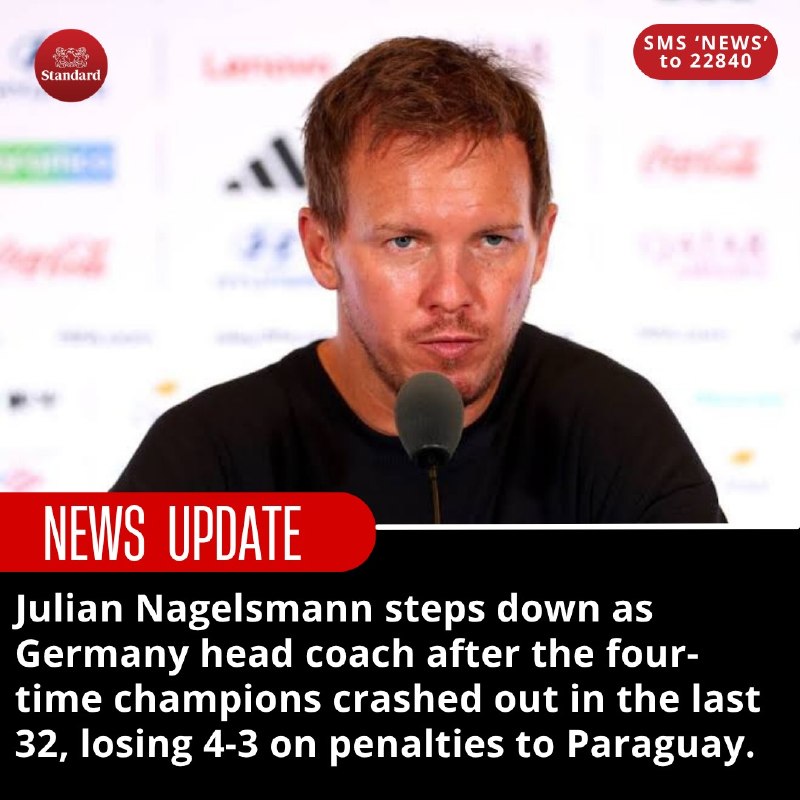
Germany's 2026 World Cup is over before the second week begins. On 3 July 2026, the German Football Association (DFB) and national team coach Julian Nagelsmann parted ways, hours after the four-time champions were knocked out in the round of 32 by Paraguay, 4–3 on penalties following a goalless draw in regular and extra time. The federation confirmed the split in a statement carried by Deutsche Welle the same morning, ending a tenure that began in 2023 and that the DFB had publicly extended with confidence less than twelve months ago.
The exit is not really about a single shoot-out. It is about what the shoot-out revealed: a squad built on the Bundesliga's midfield conveyor belt that, against a CONMEBOL opponent organised into two disciplined banks of four, ran out of ideas, then of legs, then of nerve. Germany's failure in the United States mirrors the same pattern that undid them at the 2022 World Cup in Qatar — control of possession, vulnerability in transition, and an inability to convert territorial dominance into goals against a deep block.
A federation that keeps recruiting the same profile
Nagelsmann's appointment was framed, at the time, as a generational gamble: a 36-year-old coach with a track record of aggressive pressing and positional play, parachuted into a job that has historically rewarded experience and political patience. The gamble did not pay off in tournament football. The DFB's structural problem is older than Nagelsmann. Germany continues to produce technically excellent midfielders and ball-playing centre-backs, and continues to struggle for strikers capable of playing through the middle of a low block. Paraguay did not need to be brilliant; they needed to be compact, and they were. Germany's xG-heavy, shot-shy performance against that shape is now a recurring feature of major tournaments.
There is also the question of identity. The 2026 squad was the second consecutive Germany World Cup party built around Bayern Munich and Bayer Leverkusen starters, supplemented by a thin layer of Bundesliga midfielders and a handful of Premier League players on the margins of their clubs. The Bundesliga, for all its financial muscle, is no longer producing the variety of forward profiles that the national team needs. The federation knew this. They appointed Nagelsmann anyway.
The counter-narrative: it is not just the coach
The German sporting press will spend the next ten days debating whether the successor should be an internal promotion — Hansi Flick remains the obvious sentimental choice despite his own 2022 exit, while youth coach Antonio Di Salvo and the available pool of club managers are thinner than they look. There is a louder critique gathering in the studio segments: that the DFB's problem is structural, not coaching. That a federation which continues to outsource its sporting direction to Bayern's preferences, which has not produced a world-class No. 9 since Miroslav Klose's prime, and which rotates sporting directors more frequently than it rotates captains, will find a way to lose to a disciplined South American side regardless of who is on the touchline.
The counter-view — and it is not without merit — is that elite tournament football is decided by moments, and that Nagelsmann lost the decisive one by failing to alter his team's shape after the first twenty minutes, when it became obvious Paraguay had no intention of pressing. A coach with his tactical reputation should have diagnosed that earlier. He did not. That failure sits with him, not with the federation's talent pipeline.
What this looks like inside a wider shift
Germany's exit is one of three things happening at once. The first is a clear pattern at major tournaments: the gap between European possession football and South American defensive organisation is, if anything, widening rather than narrowing. Brazil, Argentina and now Paraguay have shown that disciplined low blocks plus clinical penalty technique will continue to punish teams that cannot break them down over 120 minutes. The second is a structural one — the Bundesliga's status as the world's second-richest league is no longer translating into national-team outcomes, and the political economy of German football is starting to look like the political economy of Italian football a decade ago: domestic prosperity, international irrelevance.
The third is a quieter story about how federations absorb failure. The DFB is unlikely to undergo the kind of root-and-branch review that Spain did in the 1990s or that the Netherlands has undergone twice in twenty years. The political incentives inside German football reward continuity of message and personnel. That is precisely why the next appointment matters more than the Nagelsmann dismissal.
Stakes: what the next coach inherits
Whoever takes the job inherits a federation that has now lost three of its last four major tournaments before the quarter-finals (Euro 2020 round of 16, 2022 World Cup group stage, 2026 World Cup round of 32). That is not a record any German coach will want sitting in their in-tray. It is also, paradoxically, an opening: the appetite for genuinely radical change — a coaching staff from outside the Bayern-Leverkusen axis, a deliberate shift to a counter-attacking identity, a longer-term project that accepts short-term results — has probably never been higher among the German public.
The risk is that the DFB reaches for the familiar. The opportunity is that this is the first moment in a decade where the federation's institutional inertia might actually give way to a serious rethink. Whether the German FA reads 3 July 2026 as a warning or as an aberration will define the next cycle of European international football.
This article was filed by Monexus on 3 July 2026. Wire reporting on the DFB–Nagelsmann split was carried by Deutsche Welle; the result and the coach's departure were confirmed via the Standard Kenya newsroom on Telegram the same morning.
Wire provenance
This editorial synthesis draws on the following public wire/social posts:
- https://t.me/standardkenya