Iran's Strait of Hormuz warning lands as Tehran buries Khamenei — and the timing is the message
With Ayatollah Khamenei's body arriving in Tehran on 3 July 2026 and a fresh warning to shipping in the Strait of Hormuz issued hours earlier, Iran is signalling that grief and leverage will travel together.
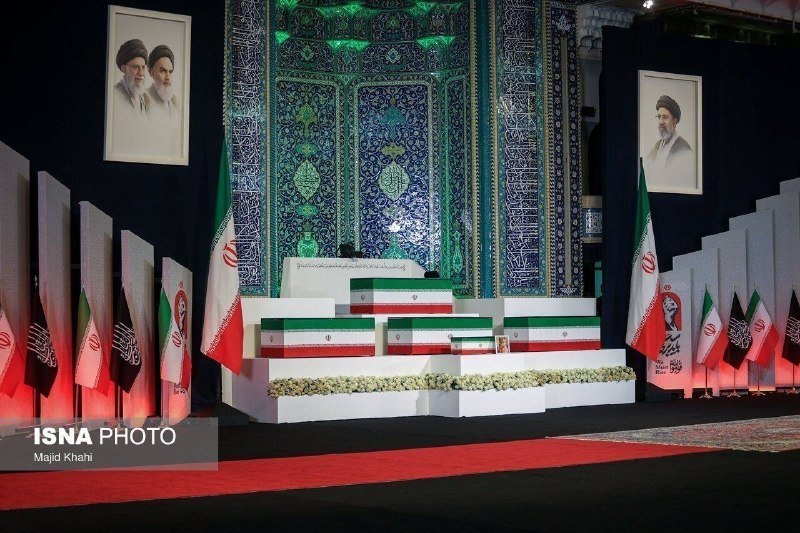
The bodies, the banners, and the broadcast loop all arrived on the same morning. At 06:19 UTC on 3 July 2026, the body of Ayatollah Ali Khamenei was carried into the Imam Khomeini Grand Mosalla in central Tehran for funeral ceremonies, according to Middle East Eye. Less than half an hour later, Al Jazeera English was reporting that Iran had warned ships against using unapproved routes in the Strait of Hormuz. By 06:42 UTC, a Tehran funeral cortege and a Hormuz navigation order had been placed on the same global news cycle, sequenced to the hour.
The point of the choreography is the choreography. Iran is not separately mourning a leader and policing a chokepoint; it is performing both at once, in full view of an audience that includes Washington, the Gulf monarchies, and every underwriter of global energy supply. Grief and leverage, broadcast in parallel, are themselves the message.
What Iran actually said to shipowners
Al Jazeera English reported on 3 July that Iranian authorities had warned vessels against transiting the Strait of Hormuz via routes not approved by Tehran — a reminder, not a novelty, but delivered with unusual timing. The strait is the maritime pinch-point through which a significant share of seaborne oil moves; any official Iranian communication about routing is read in trading rooms and operations centres as a precursor to selective inspection, detention, or harassment. The directive came as a live funeral broadcast and US-Iran recriminations were dominating the regional headlines, with Al Jazeera reporting Tehran had used the preceding hours to publicly slam the United States ahead of the Khamenei ceremonies.
In practice, the warning means three things at once. First, that Iran reserves the right to determine which tankers may pass under which conditions. Second, that any operator who chooses a non-Iranian-approved route is volunteering for the consequences. Third, that the rules of passage — long assumed by most commercial operators to be governed only by international maritime law and the customary right of transit — are now being openly contested in a single sentence of official communication.
The funeral is a foreign-policy instrument
Khamenei's body arriving at the Grand Mosalla is not just a domestic ritual. State funerals of this scale function as a foreign-policy instrument in the Islamic Republic: a moment at which internal factions are forced into visible unity, foreign missions are obliged to send envoys or conspicuously decline, and the successor order is implicitly previewed. The optics that matter are who stands where on the dais, which armed-services banners line the cortege, and which messages are printed on the placards held by the disciplined crowds.
Middle East Eye's live coverage placed the body in the Mosalla on 3 July. Al Jazeera's morning live blog layered that visual onto a separate track of anti-US rhetoric from Tehran officials. The effect is a doubled signal: to a domestic audience, Khamenei's legacy is being consecrated as the spine of the republic; to an external audience, the republic is reminding them that its strategic geography — the strait, the coastline, the missile inventory that protects it — has not softened with the change at the top.
What the counter-narrative gets right
A reading from outside the region would stress that Iran is posturing, that its navy cannot physically police every unauthorised transit, and that an outright closure of the strait would inflict more pain on Iran itself than on its adversaries. That reading is not wrong; it is just incomplete. The warning does not require total compliance to be effective. It requires only that enough commercial operators reroute, re-insure, or pause voyages to push freight rates higher and political attention sharper. Iran's demonstrated playbook in the strait over the past decade has been incremental: selective seizures, captor crews, legal theatrics, then quiet releases. The point is friction, not blockade.
A second counter-reading, from inside the Gulf, would frame any Iranian directive as a violation of the customary freedom of navigation and a provocation that the United States Fifth Fleet is explicitly tasked to counter. That, too, is not wrong. But it leaves out the asymmetry that matters: the strait is flanked on its northern shore by Iranian territory, with the kind of coastal anti-ship missile and fast-boat density that no escort fleet can fully neutralise without an escalation neither Washington nor the Gulf monarchies are currently willing to sign off on.
Stakes — and what remains uncertain
If the trajectory holds, the next seventy-two hours will set the price. Insurers repricing war-risk premia in the Gulf, refiners quietly securing alternative barrels, and diplomatic back-channels in Oman and Qatar will tell us whether the morning's dual broadcast was a controlled message or the prelude to something less controlled. What the public sources do not yet specify is which Iranian authority issued the routing warning, whether the directive has been formalised in writing to commercial operators, or how it lines up with the succession arrangements being choreographed alongside the funeral rites. The sources disagree, if at all, on emphasis rather than fact: Al Jazeera foregrounds the geopolitical friction; Middle East Eye foregrounds the ritual. Both are accurate. Neither is the whole picture.
For the moment, the safest read is the one Iran is offering in plain sight: that a leadership transition and a strategic choke-point are being managed as a single event, and that anyone reading only one of the two threads is reading the wrong document.
Desk note: Monexus frames the 3 July 2026 Hormuz warning and the Khamenei funeral as a single coordinated signal — grief broadcast as leverage — rather than treating them as separate news items, the way wire desks are currently parsing them.
Wire provenance
This editorial synthesis draws on the following public wire/social posts:
- https://t.me/aljazeeraglobal
- https://t.me/aljazeeraglobal