In mourning and menace, Iran's IRGC projects continuity after Mojtaba Khamenei's killing
With the Islamic Republic's wartime leadership buried, the IRGC Aerospace commander has gone public with vows of continuing 'unexpected blows' against the unnamed enemy — a message both doctrinal and operational.
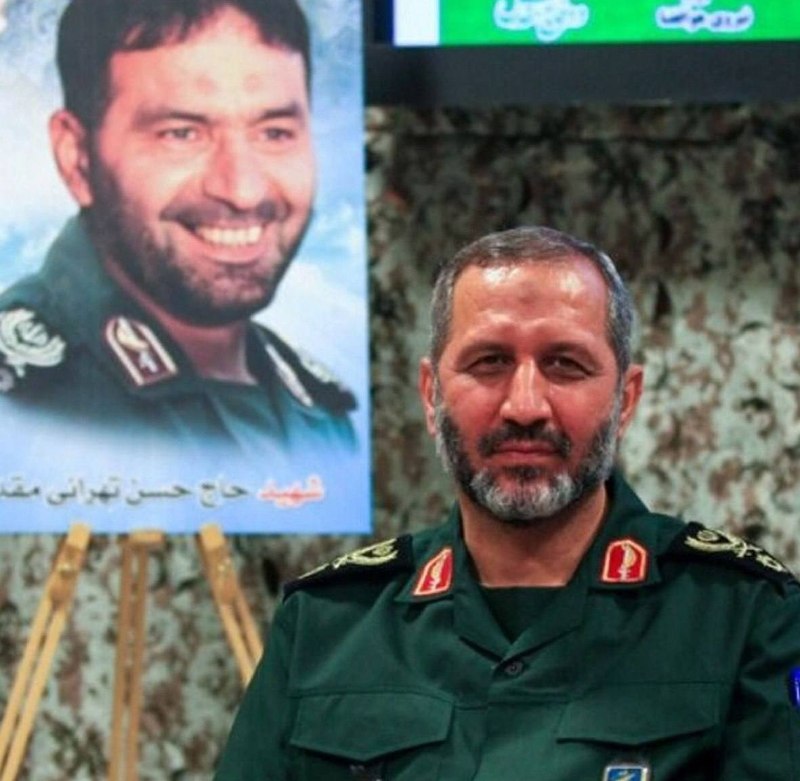
On 3 July 2026, at 13:10 UTC, the Telegram channel Fotros Resistancee circulated a written message from IRGC Aerospace commander Seyyed Majid Mousavi, who did not appear publicly that day. The text, repeated almost word-for-word by Iran's state Tasnim News Agency thirteen minutes later, declared that there is "no end to the hard and unexpected slaps that the enemy received," and pledged loyalty to "the martyred leader." The phrasing matters less as poetry than as a flag-plant: the Islamic Republic's most operational military arm is publicly asserting that the campaign that killed the Supreme Leader's designated heir continues, with no pause for mourning and no visible recalibration.
What the messages tell us, and what they don't
The Mousavi statement sits inside a tightly choreographed sequence of public acts by the Islamic Republic's senior figures. According to IRNA's English wire at 11:49 UTC, the heads of Iran's three branches of power — the executive, the legislature, and the judiciary — accompanied by the chairman of the Expediency Discernment Council, paid their respects at the ceremony for Ayatollah Seyyed Ali Khamenei's designated successor. The phrase "martyred Leader of the Islamic Revolution" in the IRNA English text is the operative clue: succession has not been quietly absorbed; the framing is martyrdom, and martyrdom, in the Republic's grammar, is a debit to be settled.
Tasnim's 12:58 UTC version of the same Mousavi statement, attributed to the "IRGC Air Force Commander," adds a telling cadence: "Now, with a heavy heart and a sad heart, we are escorting our martyred leader." The repeated "heavy/sad" is not filler in a press agency accustomed to writing for effect; it signals that the Aerospace Force, which runs Iran's missile and satellite-launch programmes, is publicly internalising the loss as a wound to its own institution, not as an abstraction handled by clergy. The "enemy" in both statements remains unnamed in the excerpts circulated — a deliberate choice that allows the message to refer, depending on audience, to either Israel or the United States, or both.
The operational implication is straightforward: the Aerospace Force is signalling that any expectation of an Iranian pause — for funeral protocol, for a conclave to choose a new Supreme Leader, for back-channel nuclear diplomacy — has been priced out of the picture. The "slaps" and "blows" language is continuity rhetoric, not escalation rhetoric.
Where this leaves the succession fight
Iran's wartime command structure has, in public at least, closed ranks faster than outsiders expected. Three branches of state plus the Expediency Discernment Council appearing together is the standard choreography of an institution under stress; it is also the choreography that, historically, the Islamic Republic deploys when it wants to pre-empt any reading that the system is fractured. The IRGC's parallel move — broadcasting from the Aerospace commander rather than the chief of staff — is the tell. The chief of staff handles routine command; the Aerospace commander handles the missiles and the space programme. Choosing that voice is a signal to foreign intelligence services that the deterrent instrument is being held up for viewing, not shelved.
The alternative reading is that the Republic's leaders are buying time. Public unity statements in the first seventy-two hours after an assassination rarely predict the institutional shape six months later. The successor-designate is dead; the Assembly of Experts has not, in any wire that has reached English-language audiences, announced a meeting to ratify a new Supreme Leader. That vacuum, rather than the IRGC's bluster, is the more durable variable. Iran's near adversaries do not need to guess what the "martyred leader's" successor will look like; they need to wait for one to be named. Until then, the IRGC's statements function as a placeholder for a decision the clerical system has not yet made public.
What sits underneath the language
The repeated "unexpected" framing in both the Fotros Resistancee and Tasnim versions is worth reading as political-economic positioning, not just battlefield confidence. "Unexpected" is the country's word for what it claims its June strikes and any follow-on operations delivered: a payload that the adversary's air defence was not calibrated to handle. Internally, that word does double work — it is the marketing of an asymmetric missile and drone complex to a domestic audience that has lost a figure it was taught to venerate. Externally, the same word is intended to deter by suggesting that even the recent losses have not degraded the technical edge.
A more sober calculation coexists with that messaging. The Islamic Republic's missile inventories have absorbed an Israeli strike cycle measured in days, with public casualty and equipment figures that the Iranian government has not disclosed in English-language outlets. The IRGC's instinct, visible across the three Telegram items on 3 July, is to deny damage rather than enumerate it. A military organisation that is genuinely shattered does not write poetry about its own strength; it keeps quiet. The choice to publish — twice, through two channels within fifteen minutes — argues against a leadership that believes it has lost the capacity to act. It does not, on its own, prove that the capacity has been preserved.
What to watch next
Three concrete signals will tell observers whether the IRGC's continuity message is operational reality or managed perception. First, the timing and content of any further Aerospace Force statements; silence, after this volume of public messaging, would itself be a revelation. Second, the public schedule of the Assembly of Experts; a convened meeting is the most decisive counter to the "fractured system" reading. Third, the trajectory of the nuclear file — not the public rhetoric, but any IAEA inspector movement, any satellite-imagery change at Natanz or Fordow, and any change in the cadence of IAEA board meetings. The Islamic Republic's missile complex and its centrifuge complex are different instruments; both are now being managed under the same stress test, but they answer to different chains of command. The next seventy-two hours will tell observers whether the IRGC's confidence, expressed publicly at 12:58 and 13:10 UTC on 3 July, reflects an intact chain or a chain that is performing intactness while a clerical succession, somewhere in Qom, has not yet been settled.
This article is built on three Telegram dispatches circulated within fifteen minutes on 3 July 2026. Two are Iranian-state or state-adjacent channels (Tasnim English, IRNA English); the third is an Iranian opposition-aligned account (Fotros Resistancee). Where the wording is identical across channels, Monexus treats it as signalling rather than as independent corroboration.
Wire provenance
This editorial synthesis draws on the following public wire/social posts:
- https://t.me/FotrosResistancee
- https://t.me/tasnimnews_en
- https://t.me/Irna_en