The ritual choreography of martyrdom: how Iran's state media builds a funeral into foreign policy
Bulgarian officials, Pakistani Shia leaders and a deputy foreign minister converge on Tehran inside 48 hours — and Iranian state television broadcasts every handshake as scripture.
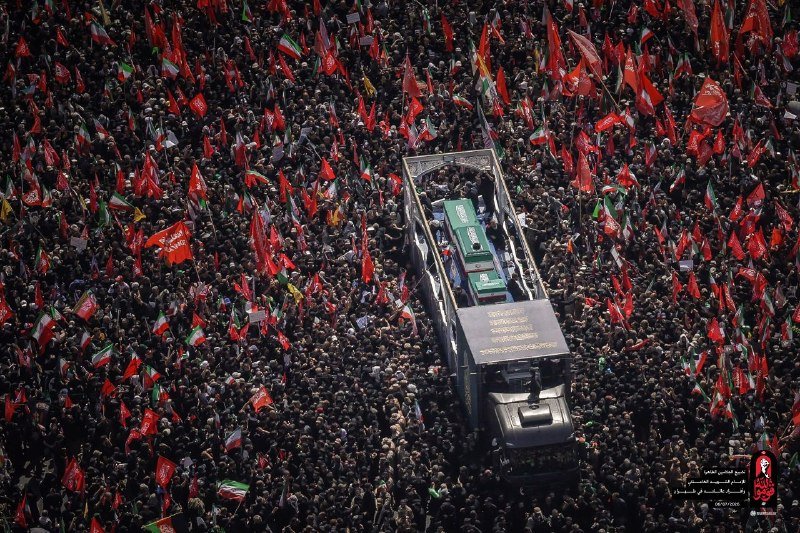
Between 07:20 and 07:40 UTC on 3 July 2026, Iranian state television PressTV ran three near-identical dispatches inside twenty minutes. A Russian delegation paid tribute. Pakistani Shia leaders paid tribute. Iran's deputy foreign minister Gharibabadi used the moment to describe the killing of Ayatollah Seyyed Ali Khamenei as "the symbol of the United States' persistent and profound animosity toward the Iranian nation." The choreography is worth watching on its own terms: a continuous funeral has become a working foreign-policy instrument, and the cameras are no longer documenting mourning so much as broadcasting alignment.
The reporting comes exclusively from PressTV. That is a limitation, not a footnote. The thread context contains three Telegram posts from that single channel, timestamped within a twenty-minute window on the morning of 3 July, and no Western wire confirmation is in the pipeline. Any judgment made here therefore proceeds from the framing that Iran itself is choosing to project, plus the structural pattern that framing sits inside — not from independent corroboration, of which none is yet available.
What the camera is actually doing
PressTV's three items are stylistically near-identical: a foreign actor pays tribute; the channel relays it; the masthead ties the act to the death of Khamenei. The Bulgarian dispatch carries the hashtag #MartyrKhamenei; the Pakistani dispatch reuses it. Gharibabadi's line, broadcast at 07:20 UTC, is the only one of the three that frames the killing as an external act — "the symbol of the United States' persistent and profound animosity" — converting an obituary into an indictment of Washington without naming an operation, a weapon, or a date.
The sequencing is the story. Twenty minutes of airtime given to allied visitors gives Tehran a way to make the death legible as a transnational event before any independent outlet can verify the circumstances of how Khamenei died. The deputy foreign minister's commentary, arriving first, sets the interpretive frame; the dignitaries who follow ratify it. This is not journalism. It is state-sanctioned grief processed through a broadcast schedule.
Why Bulgaria and Pakistan, and why now
The choice of mourners is calibrated. Bulgaria, an EU and NATO member, is an unusual presence at an Iranian state funeral — its inclusion signals that Tehran wants to broadcast an audience wider than its usual partners. Pakistan, with its large Shia population and historically close relations with Iran, offers the parallel signal of solidarity from a neighbouring Muslim-majority state. Together they let PressTV argue, without saying so, that the death commands respect from both a Western-aligned capital and a regional heavyweight.
PressTV does not name the Bulgarian officials or the Pakistani Shia leaders, nor does it specify which deputy foreign minister Gharibabadi is — the source items identify him only by name and title. A reader cannot independently verify the rank-and-file composition of either delegation from what is in the pipeline. That gap matters: the broadcast is asserting a coalition; it is not, on present evidence, naming one.
The structural frame, in plain prose
State funerals have always been diplomatic instruments — Wellington's, De Gaulle's, Khomeini's all functioned as messaging windows. What distinguishes Iran's current production is the speed and the symmetry. Visitors arrive; PressTV films them; the foreign ministry narrates the symbolism; the cycle repeats within hours. Western wire reporting on Iranian leadership transitions typically lags by days; here, the framing is set before the cycle of independent reporting has begun. The result is that any subsequent correction, or any fuller account of how Khamenei died, will arrive into an interpretive space already structured by Tehran.
This is not unique to Iran. Any state with a captive broadcaster can run a similar operation. But Iran has spent two decades building PressTV's multilingual capacity specifically for moments like this — when the gap between event and interpretation is the policy. The PressTV output on 3 July shows that gap being filled in real time.
Stakes and what we cannot yet verify
The proximate stakes are narrative. If Western outlets report Khamenei's death using PressTV's vocabulary — "martyrdom," "US animosity" — the diplomatic cost of any future investigation into the killing rises. If they do not, Tehran loses the framing race but still controls the visual archive: the photographs and footage of Bulgarian and Pakistani visitors at the bier will circulate regardless of how the story is later told.
Three things the sources do not establish: the precise manner and date of Khamenei's death; the identity of the named Bulgarian officials or Pakistani Shia leaders shown paying tribute; and whether Gharibabadi's "assassination" framing reflects an official Iranian government position or a PressTV editorial choice. The thread context is a single channel's output, repeated three times in twenty minutes. It is a place to begin, not a place to finish.
This publication notes that the wire provenance for this article is narrow — one channel, one morning — and treats it accordingly. Where PressTV frames events as foreign policy, Monexus reports that PressTV is framing events as foreign policy.
Wire provenance
This editorial synthesis draws on the following public wire/social posts:
- https://t.me/presstv/
- https://t.me/presstv/
- https://t.me/presstv/