The Custodians of a Martyred Office: How Tehran Stages a Funeral for the Living Order
Bangladeshi Islamists, Hezbollah commanders, Iraqi Kurdish parties and Russian Muslim scholars queued in Tehran this week to honour the martyred Supreme Leader. The choreography is the point.
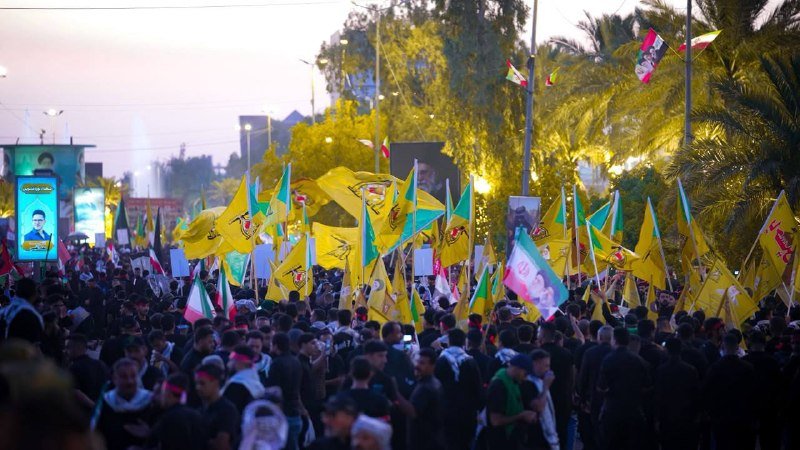
Between roughly 06:43 and 07:57 UTC on 3 July 2026, four separate delegations filed past the same bier in Tehran. Shia leaders from Pakistan arrived first. Russian Muslim scholars followed. Then came a delegation of Kurdish tribal sheikhs, Iraqi Islamic-party representatives and members of the Iraqi parliament. Then Hezbollah commanders and the families of Hassan Nasrallah and Imad Mughniyeh. Last in the queue: representatives of Jamaat-e-Islami Bangladesh, alongside members of the Bangladeshi parliament. Each visit was published, in real time, on the official Khamenei Telegram channel under the hashtags #WeMustRise and #MartyrKhamenei.
This is not diplomacy. It is liturgy. And the liturgy has a single, deliberate message: that the martyred Supreme Leader's office is not a national institution but a transnational one, and that the queue of mourners is itself the proof.
Reading the queue
Start with what the official channel chose to publish. The delegations are not random. Pakistan supplies Iran its eastern Shia flank. Russia's Muslim scholars formalise a Moscow-Tehran entente that has hardened since 2022. Iraqi Kurdish parties are the cross-sectarian hinge of Baghdad's political class. Hezbollah's presence, and specifically the families of Nasrallah and Mughniyeh, signals continuity of the "Axis of Resistance" command structure. And Bangladesh — through Jamaat-e-Islami, the country's principal Islamist opposition movement — extends the ritual into South Asia, where Iran has spent a decade courting Deobandi and Shia constituencies against Gulf and Saudi influence.
The staging is therefore a map. It tells the reader, in the visual grammar of a Telegram photo set, which relationships the Islamic Republic considers load-bearing in 2026. Pakistan, Russia, Iraq, Lebanon, Bangladesh. Five countries, four theatres, one choreography.
What the choreography is buying
Theatre of this kind performs a function that is older than the Islamic Republic itself: it converts a moment of acute vulnerability — the loss of the founder-leader — into a demonstration of embeddedness. A line of foreign mourners says, in plain image-language, that the regime is not isolated even if the men at the centre of it have changed. That matters because Iran's posture across all five theatres is, at this writing, defensive. Hezbollah is reconstituting after the killing of its senior cadre. Iraqi Shia militias operate under sustained US and Israeli pressure. Pakistan's borderlands remain contested. Bangladesh's political space for Islamist mobilisation is constrained by a quasi-secular state establishment. Russia's Muslim scholars are useful but their presence costs Moscow little and tells us mostly about Russian foreign-policy signalling.
The funeral theatre therefore does not paper over these vulnerabilities. It reframes them. Vulnerability is recast as martyrdom; isolation as solidarity; command decapitation as a recruitment opportunity. The hashtag #WeMustRise is doing the work of a policy paper.
The Western read, and the rebuttal
Western wire commentary on this kind of staging tends to flatten it into a propaganda display — visual filler for an otherwise diminished regime. That read is not wrong, exactly, but it is incomplete. It treats the funeral as a performance for domestic Iranian consumption and leaves it there. The Telegram record shows the opposite. The audiences named in each caption are foreign. They are intended to be read, photographed, and re-broadcast by the foreign press arms, partisan outlets and diaspora networks that the Islamic Republic has spent forty years building.
The counter-frame — that this is a coercive religious-political mobilisation against Sunni-majority populations and against Iran's actual neighbours — also has weight. Jamaat-e-Islami in Bangladesh is a movement with a documented record of sectarian agitation. Hezbollah's continued veneration of its dead commanders is not neutral diplomacy; it is the public face of an armed non-state apparatus. Kurdish-Iraqi Islamic parties sit inside a fractured Iraqi political system that has periodically leaned into sectarian mobilisation. The honest reading is not that one frame cancels the other, but that both are present, on purpose, and that the funeral is the moment when the regime chooses to display them together.
What remains uncertain
Three things the published record does not settle. First, the diplomatic status of the delegations: appearing at a religious mourning rite is not the same as recognising the office or the successor. Some of the figures named — Iraqi parliamentarians in particular — operate in personal capacities that the Iraqi state has not endorsed. Second, the successor question itself. The Telegram channel frames the late leader as "Martyr Imam Sayyid Ali Hosseini Khamenei," which presupposes a martyrdom that the Iranian state has formally declared, but which has not been independently corroborated by any source in this thread. Third, the operational continuity that the staging implies. Showing the families of Nasrallah and Mughniyeh in the queue is a message of command survival; whether the underlying structure can absorb a successor Supreme Leader at the same scale of authority remains the open question of the year.
The funeral is therefore best read as a claim, not a fact. The Islamic Republic is telling its rivals, its allies and its own population that the office has not been decapitated by the killing of its holder. Whether the office survives intact is a question the next twelve months will answer, not the next twelve hours of Telegram posts.
— Monexus Staff Writer
Desk note: Wire reporting on this story will lead with the official Iranian framing of martyrdom and the named foreign delegations. Monexus has instead treated the funeral as a piece of diplomatic theatre and read the published delegation list as a map of which relationships Tehran intends to signal as load-bearing in 2026. The Western "propaganda display" frame is noted; it is not adopted as the headline.
Wire provenance
This editorial synthesis draws on the following public wire/social posts:
- https://t.me/Khamenei_en
- https://t.me/Khamenei_en
- https://t.me/Khamenei_en
- https://t.me/Khamenei_en
- https://t.me/Khamenei_en