The farewell in Tehran and the architecture of regional mourning
A martyred leader's farewell draws the Iraqi parliament speaker and Turkmenistan's national leader to Tehran — and exposes the choreography of regional alignment around a politically charged mourning ritual.
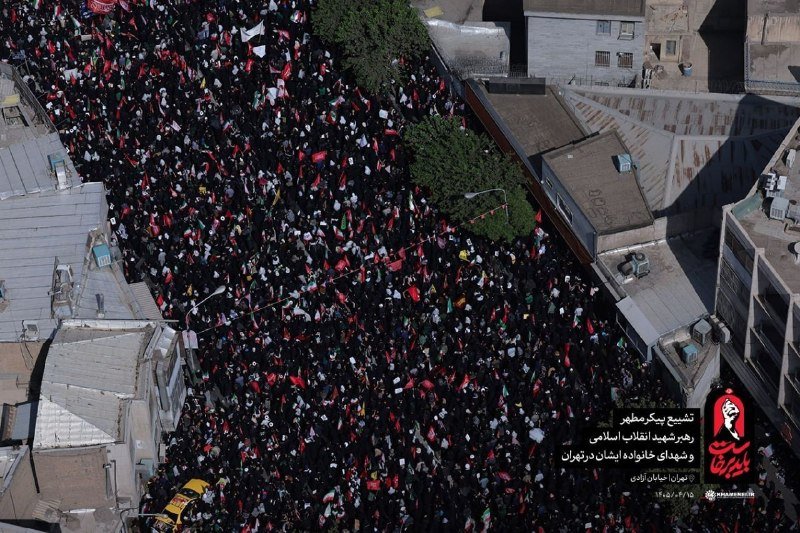
On the morning of 3 July 2026, an English-language channel tied to the office of Ayatollah Sayyid Ali Hosseini Khamenei published a steady, almost liturgical drumbeat of tributes. By 11:02 UTC, Gurbanguly Berdimuhamedov — National Leader of the Turkmen People and Chairman of the Halk Maslahaty — had formally paid his respects at the bier of a figure the channel refers to only as "the martyred Leader of the Islamic Revolution." By 11:22 UTC, Mohammed al-Halbousi, Speaker of the Iraqi Parliament, had done the same. By 11:30 UTC, the channel was already running a countdown — phrased in deliberately eschatological register — to a "final farewell" with "the man who… walked the path of God until his very last breath, and in doing so, opened the way for the seekers of truth across the world."
The choreography is the story. Funerary politics in the Iranian orbit are never private; they are a stage-managed assertion of who stands inside the regional order and who is being shown, in real time, where the lines now run. The two visitors named within a half-hour window — the parliamentary speaker of Iraq, and the chairman of Turkmenistan's supreme representative body — are not incidental dignitaries. They are the political faces of two of Iran's most consequential neighbours: one sharing a long, contested land border and a deeply entangled Shia political establishment, the other sitting on a critical stretch of Central Asian gas pipeline and a Turkmen–Iranian frontier that has historically been one of the quieter stretches of the Islamic Republic's perimeter.
What the wires actually show
The three messages posted to the Khamenei office channel between 11:02 and 11:30 UTC are short, formal, and interchangeable in structure. Each frames the deceased as a "Leader of the Islamic Revolution," each invokes a register of martyrdom and religious struggle, and each is paired with a photograph of a coffin draped in the Iranian flag. The names that appear — al-Halbousi and Berdimuhamedov — are not low-level functionaries; al-Halbousi has led Iraq's Council of Representatives, and Berdimuhamedov remains the senior power-broker in Ashgabat, having handed the presidency to his son Serdar in 2022 while retaining chairmanship of the Halk Maslahaty. Their presence in Tehran on the same morning is itself a signal.
The framing on the channel is unambiguous about what is being staged. The 11:30 UTC countdown post is not framed as a domestic burial. It is framed as a global send-off, addressed to "the seekers of truth across the world." That is regime language, not private language — and the choice of platform (an English-language Telegram channel rather than the Persian-language official outlets) tells you who the intended audience is meant to be.
The counter-read: what the visit does not prove
A sceptic reading the same thread will reasonably ask whether a funeral circuit is a meaningful geopolitical act or merely a choreographed one. Two Iraqi speakers have come and gone in recent years; the Iraqi parliament has on several occasions produced sharply different signals on Iranian influence depending on who is in the chair and who is in the courtyard. Al-Halbousi's presence is significant — but in a system where a condolence visit costs the visitor little and buys the host a photograph, the evidentiary yield is modest.
Turkmenistan is the more interesting case. Ashgabat has spent the post-2009 gas-dispute decade studiously balancing Tehran, Moscow, and Beijing. Berdimuhamedov's appearance in Tehran does not tell us whether Turkmenistan has recalibrated; it tells us only that Turkmenistan has shown up. The structural position — pipelines, neutral-status diplomacy, dependency on Chinese offtake — has not changed because of a single day's mourning visit. A serious reading treats the funeral circuit as evidence of legibility, not evidence of alignment.
The architecture underneath the ritual
Underneath the ceremonial surface sits a recognisable pattern. When a central figure in the Iranian political-religious order is mourned publicly, regional states with a stake in the Islamic Republic's posture — Shia-majority Iraq on the western flank, Turkmenistan on the eastern gas-and-border flank — perform a careful visible deference. The performance has three functions.
First, it confirms to internal Iranian audiences that the deceased's coalition still has external standing. Second, it positions the visiting dignitary inside the regional bloc that Iran's state media is trying to assemble around its narrative of the moment. Third, and most quietly, it pre-positions the visitor for whatever comes after — succession, succession politics, reorganisation of the regional axis around the figure of the Islamic Republic's next senior clerical establishment. Visitors at a funeral are not just paying respects; they are taking notes on who else showed up, who was seated where, and what the next prayer will sound like.
The English-language channel is doing additional work that Persian-language channels do not need to do. It is broadcasting outward, not inward. The Telegram thread is an exercise in telling non-Iranian, non-Arabic, non-Turkish-reading audiences that this is a moment with global reach. That is a frame, not a fact — but it is a frame with operational consequences, because the same readers are the ones whose governments will, over the coming weeks, have to decide how loudly to acknowledge the transition.
Stakes and what to watch next
The stakes of the next seventy-two hours are concrete. Iraq's caretaker political calendar has been unstable since the 2021 elections produced no clean majority, and the country's internal Shia coalitions have reorganised repeatedly since. Turkmenistan's gas export economics remain hostage to a Chinese offtake structure that pays below European spot prices and offers no upside in a sanctions-tightened environment. Both states have reasons to be visible in Tehran right now, and both have reasons to keep the visit calibrated — close enough to be photographed, far enough not to commit.
What the sources do not yet tell us — and what this publication will not speculate about — is the substantive content of any bilateral conversation that may be taking place behind the closed doors. The Telegram channel is a one-way broadcast of arrival and condolence; it is not a readout. Until a wire with verifiable bilateral sourcing confirms what was actually discussed, the visit should be read as choreography with an open script.
Desk note: Monexus has framed this dispatch as a reading of regional choreography around a high-profile mourning, anchored only in the English-language Telegram channel of the office of Ayatollah Khamenei. Wire-service verification of bilateral content has not yet been published; this publication will update as it appears.
Wire provenance
This editorial synthesis draws on the following public wire/social posts:
- https://t.me/Khamenei_en
- https://t.me/Khamenei_en
- https://t.me/Khamenei_en