Tehran's funeral choreography and the meaning being staged for the cameras
Delegations from Hezbollah, the Amal Movement, Pakistani and Gulf Shia networks, and Russian Muslim scholars have converged on the Imam Khomeini Mosalla in Tehran. The choreography of condolence is also a public ledger of who still answers the call.
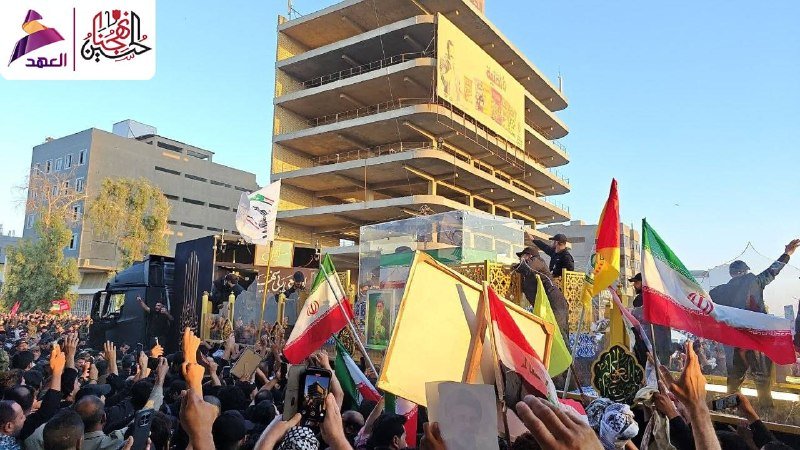
The procession files past the bier in ordered waves, and the order itself is the news. On 3 July 2026, between roughly 06:16 and 07:40 UTC, the official channels associated with the office of Ayatollah Khamenei released a rolling sequence of arrivals at the Imam Khomeani Mosalla in Tehran: Lebanon's Amal Movement first, then Shia Muslims from the Persian Gulf states, then a delegation of Pakistani Shia leaders, then Russian Muslim scholars, then a Palestinian scholars' and sheikhs' delegation, and finally — in the most heavily signalled dispatch of the morning — Hezbollah commanders accompanied by the families of the organisation's two most mythologised dead, Sayyid Hassan Nasrallah and Haj Imad Mughniyeh. The choreography reads less as grief than as a demonstration of which foreign constituencies still answer the call when Tehran asks.
The substantive question is not who died. It is what is being staged, and for whom. A funeral at this scale is a piece of regional signalling dressed in mourning dress. It inventories the surviving clients of the Islamic Republic at the precise moment the Iranian-led axis is being asked, by events in Gaza, in south Lebanon, and in the Iranian interior itself, to demonstrate that its command architecture still coheres. That demonstration is aimed outward — at Gulf and Western intelligence services reading the footage — and inward, at Iran's own street, which has been restive and grieving in equal measure.
The roll call, decoded
The order is not random. Amal Movement first, on the morning of 3 July, is the polite diplomatic register; the speaker Nabih Berri's party is the Iranian axis's Lebanese ballast, but it is a Shia Lebanese party with state-facing pretensions, and it travels first for that reason. The Gulf Shia delegations that follow carry a different register entirely — citizens of states that publicly balance against Iran and privately tolerate the visit. Their presence is the single most informative item in the sequence, because the Persian Gulf monarchies have spent two decades publicly distancing themselves from the Islamic Republic's foreign policy while tolerating quiet confessional traffic across their own borders. Funerals make the quiet visible.
The Pakistani and Palestinian delegations rehearse a second theme: the Shia-Muslim world's reach beyond the Arab state system. The Russian Muslim scholars complete the message. Moscow does not run a Shia foreign policy. But the Russian Federation has rebuilt its Middle East posture on plausible deniability, energy interdependence, and a willingness to host the clerical services of clients other capitals will not. A Muslim-Russian presence at a Tehran funeral reads as a credential: we have friends where you do not.
Who is centre, who is margin
The Hezbollah visit, with the Nasrallah and Mughniyeh families, is the camera shot that matters. Sayyid Hassan Nasrallah was the Secretary-General of Hezbollah killed in the 2024 Israeli campaign against the organisation's senior leadership in Beirut's southern suburbs. Haj Imad Mughniyeh was the long-time head of Hezbollah's external operations directorate, killed by a car bomb in Damascus in 2008. Their families at the bier is not sentimental; it is a claim that the institution which produced them remains politically continuous across two decades and at least one existential military blow.
The framing of the morning is therefore not just about the deceased. It is a public register of which parties in the region still treat Tehran as a gravitational centre, in what order they are processed, and which absences are most conspicuous. Gulf Shia Muslims attend; Sunni Arab state delegations do not. Russian Muslim scholars attend; the Russian Orthodox Church, which carries weight in Moscow's actual decision-making, is not on the list. Lebanese Shia delegations attend; the Druze and Maronite leaderships who have positioned themselves as post-Iranian alternatives in Lebanese politics do not feature in the sequence. The negative space of the photographs is as loud as the arrivals.
What the choreography does not prove
The reading above is the conventional one and it is largely correct, but it should be hedged. Funerals are an exceptionally weak signal for an exceptionally strong claim. They tell you who feels obliged to send a representative; they do not tell you what that representative carries — a condolence letter, an intelligence channel, a payment, a private warning. The region has a long history of diplomatic courtesies running directly against strategic intent. Saudi, Emirati, and Egyptian intelligence services have attended or sent messages at Iranian events they publicly condemned. Conversely, no-shows can be logistical as easily as political; the Amal Movement delegation has been a fixed feature of such visits for years, but individuals within it are not necessarily the political centre of the party.
It is also worth saying plainly that the source material for this article is limited to the official channels of the office of the Supreme Leader and its Arabic-language mirror, plus the Russian and Palestinian arrivals recorded on the same feed. That is a deliberate platform. It tells Tehran's story of the day, not the stories of the recipients, and it does not include the reactions of Western or Arab governments. The funereal choreography is, in other words, public relations that should be read as such — neither dismissed nor taken at face value.
The stakes, plainly
What is genuinely at stake is the question of whether the Iranian-led axis can still produce a coherent public face under sustained military and economic pressure. A funeral is the softest possible test of that capacity — sorrow is a free good, attendance costs little, and the cameras are obliging. The harder tests lie ahead: whether the delegations photographed today translate into operational cooperation in the next crisis, whether Gulf Shia traffic holds up under renewed GCC counter-intelligence scrutiny, and whether the Hezbollah families at the bier are followed by a credible successor narrative for the organisation's leadership. The performance this morning suggests the answer to the first question is yes, at the cost of revealing how much the second and third still worry Tehran.
Desk note: Monexus reads the morning's official-channel footage as a public register of the Islamic Republic's external relationships under stress, not as an independent report on the substance of those relationships. Where the official version and independent reporting diverge — and on the long-run political weight of these visits they typically do — both frames have been named, and the conventional reading hedged accordingly.
Wire provenance
This editorial synthesis draws on the following public wire/social posts:
- https://t.me/Khamenei_en/11362
- https://t.me/Khamenei_en/11363
- https://t.me/Khamenei_en/11364
- https://t.me/Khamenei_en/11365
- https://t.me/Khamenei_en/11366
- https://t.me/Khamenei_en/11367
- https://t.me/Khamenei_arabi/11369