Tehran's funeral diplomacy, and the bloc it assembles
Heads of state are converging on Tehran for the funeral of a senior Iranian figure. The guest list says as much about regional alignment as the ceremony itself.
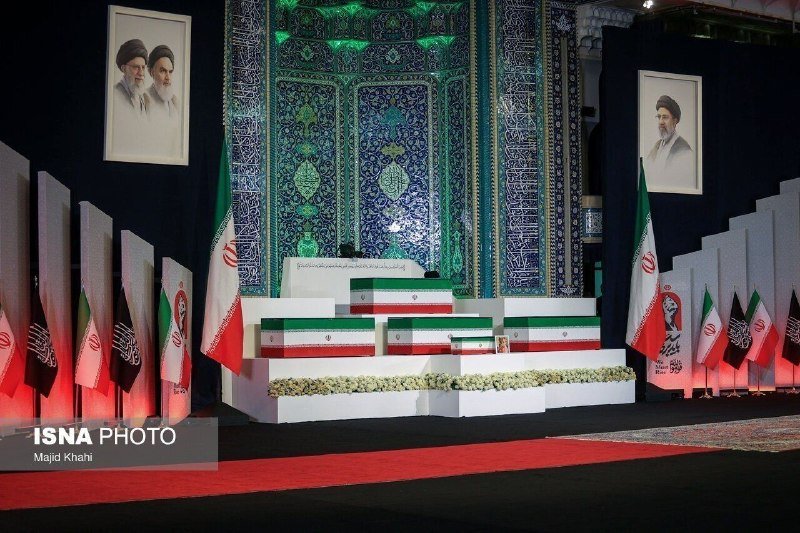
The procession is the message. On 3 July 2026, both the Iraqi president and the Tajik president landed in Tehran to attend the funeral of a senior Iranian figure whom state outlets describe as the "martyred leader of the revolution," according to Fars and Tasnim wire dispatches. The Iraqi delegation, per Fars, includes "political leaders, members of parliament and commanders," a guest list that reads less like a condolence call and more like a coordinated diplomatic statement. A Tajik presidential visit, on the same day and for the same ceremony, broadens the geography still further.
Funerals in Tehran have long served as convening moments for the axis of political and security relationships that runs through the Islamic Republic. The composition of the mourners, more than the eulogies, is the news.
The guest list as foreign policy
The presence of an Iraqi head of state is the least surprising entry on the manifest. Baghdad sits inside Iran's deepest institutional neighbourhood: shared border, integrated electricity grids, Shia-majority political culture, and an Iraqi political class whose leading factions were forged in the post-2003 order that Iran shaped. Tasnim, the outlet closest to the Islamic Revolutionary Guard Corps, named the visiting Iraqi president as Nazar Omidi in its 06:12 UTC dispatch and again on his arrival in Tehran at 07:01 UTC via the Fars wire. The pairing of an Iraqi presidential flight with a wider parliamentary and military delegation, per Fars, suggests the visit is being framed in Tehran as a regional affirmation rather than a perfunctory attendance.
The Tajik arrival, reported by Tasnim's English service at 06:25 UTC on 3 July, is the more telling data point. Tajikistan is the only former Soviet republic in Central Asia whose official political and cultural vocabulary leans heavily toward Persian-language identity. A Tajik presidential visit to an Iranian state funeral places Dushanbe inside a diplomatic ring that already includes Baghdad, Damascus, Beirut, Sanaa and, intermittently, Moscow. The geography is wide; the political signal is narrow.
What the ceremonies obscure
Iranian state media tends to use such occasions to consolidate a single authorised narrative of who stands with whom. Coverage in Tasnim and Fars frames the arriving dignitaries as participants in a shared cause, not as heads of sovereign states with their own internal balances. Readers outside the region should note that the framing is a projection as much as a description. Iraq's government is a coalition in which Iranian-aligned factions are powerful but not exclusive; Tajikistan's president maintains working relationships with both Tehran and Ankara, and navigates a security architecture dominated by Moscow and Beijing. The funeral photograph is real; the diplomatic monobloc it implies is partly editorial.
That caveat does not undo the underlying signal. Iraqi and Tajik presidents do not fly to Tehran for routine protocol. The travel itself, irrespective of the camera angles, commits the visitors to standing visibly inside a particular diplomatic geometry for the duration of the visit.
The structure underneath
What the wires describe, stripped of the religious register, is a transactional security community in formation. Iran's regional relationships have always blended ideological language with concrete material exchange: oil and gas supply, electricity provision, arms and training flows, and political protection for Shia-majority or Shia-led armed actors from Beirut through Baghdad to Sanaa. A funeral is precisely the kind of event at which that community renews its optics.
The wider context matters. Iran in 2026 is operating under sustained Western sanctions pressure and in the shadow of recurring confrontation with Israel and the United States. In that environment, visible alignment with Tehran is not costless for any neighbouring head of state. That Iraqi and Tajik presidents travelled anyway is itself the data point: their domestic political calculations, for this week at least, are not blocking the trip.
Stakes and what to watch next
If the funeral produces a joint statement, communique, or even a coordinated media readout, the next beats to watch are concrete and verifiable: any movement on Iraqi gas-import contracts, any Tajik announcement on transport corridors through Iran, and the public posture of the Iraqi Shia factions most closely tied to Tehran once the visitors return to Baghdad. Conversely, if the ceremony closes with no readout beyond mutual condolences, the trip should be read as consolidation rather than expansion: an existing alignment performing itself for an internal audience.
What the sources do not specify is the identity of the senior Iranian figure being mourned. Fars and Tasnim both refer to the deceased as the "martyred leader of the revolution" without naming the individual in the English-language dispatches carried in the thread; until that identification is confirmed from primary Iranian state-media output, the diplomatic choreography around the funeral should be reported as significant in pattern but provisional in specific motive.
For now, the wires converge on a single legible fact: on 3 July 2026, before 07:00 UTC, two heads of state and an Iraqi parliamentary-military delegation were on the ground in Tehran, in the same place, for the same reason, and on camera. That is enough to anchor a story. The interpretation will sharpen once the name and the readouts are confirmed.
— Monexus framed this around the diplomatic signal rather than the ceremonial imagery, since the guest list carries more verifiable weight than the rites themselves.
Wire provenance
This editorial synthesis draws on the following public wire/social posts:
- https://t.me/farsna
- https://t.me/tasnimnews_en
- https://t.me/tasnimnews_en
- https://t.me/FarsNewsInt