Tehran Turns a Funeral into a Diplomatic Fair: Why Iran's Regional Audition Is Now Out in the Open
A stream of foreign delegations paying respects in Tehran signals Iran's success in using grief as convening power — but the gathering also illuminates how isolated the Islamic Republic still is from the Western-led order.
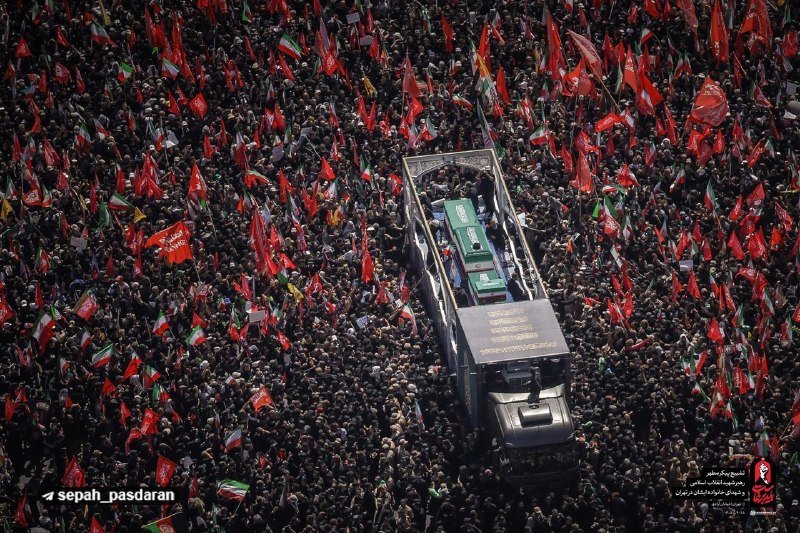
LEAD. On the morning of 3 July 2026, a delegation from the Islamic and Parliamentary Jamaat of Bangladesh arrived at a mosque in central Tehran to pay its respects to the body of what Iranian state-aligned media described as a "martyred leader of the Islamic Revolution." Within the next hour, Iraqi President Nizar Omidi landed in the Iranian capital, followed shortly afterward by a delegation described as comprising Hindu, Shia Thai and German religious leaders — all converging on the same site of mourning. The choreography was unmistakably choreographed, and unmistakably diplomatic. Three separate arrivals from three continents in the space of ninety minutes, all routed through the same state-aligned channel of record: Al-Alam's Persian-language Telegram feed, mirrored on its X account.
NUT GRAF. Iran's clerical establishment has spent four decades converting ceremonies into convening moments. This one — a funeral rendered as a pilgrimage, and a pilgrimage rendered as a press operation — exposes both the durability and the limits of that craft. The delegations are real, the travel is verifiable, and the symbolic signalling is plain. What is also plain is the guest list: the dignitaries travelling to Tehran are drawn almost entirely from a non-Western diplomatic map. The choreography cannot mask that arithmetic.
Funerals as statecraft
Iran's theocracy has long understood that calibrated grief is a currency. Senior foreign visitors rising from one-week domestic crises have, on past occasions, used Tehran's mourning halls to take the temperature of the Islamic Republic from the inside. The pattern is not new. What is new in this 3 July window is the mix of delegations signalling at once: a parliamentary bloc from Dhaka, a head of state from Baghdad, and a religiously plural delegation stitched together from South Asia, Southeast Asia and Europe. Iranian state media has, predictably, leaned into the optics. The framing positions the Islamic Republic as a destination for a politics that runs on Islamic and anti-imperialist solidarity rather than G7 communiqués.
There is a real read of the choreography here. Iran is, by several independent measures, the most diplomatically isolated major state in the Middle East — under broad Western sanctions, with its banking sector effectively cut off from the dollar system, and with a rolling confrontation with Israel and intermittent confrontation with the United States that has produced discrete military exchanges within the past year. The willingness of an Iraqi head of state, an active parliamentary party from Bangladesh, and visiting European and Asian religious figures to step into a mourning ritual in central Tehran is, on its face, a rebuff to the assumption that isolation equals silence.
What the delegations actually signal
Read each arrival on its own terms. Iraq: President Nizar Omidi's visit comes against a backdrop of long-running political tension between Baghdad and Tehran over the file of Iranian-aligned armed factions inside Iraq, and a US–Iraq security relationship that remains operationally significant. A presidential visit during a high-profile funeral in Iran is a public gesture of relationship-management. Bangladesh: the arrival of the Islamic and Parliamentary Jamaat — a faction with formal representation in the Bangladeshi parliament — is the kind of visit that signals intra-Islamic parliamentary networking rather than state-to-state alignment. Dhaka's official foreign policy remains calibrated between India, China and the Gulf; a party delegation to Tehran does not equal Bangladesh's endorsement of the Iranian system. Germany and Thailand, via religious leaders: the description of a Hindu, Shia Thai and German religious delegation offers no names, no institutional anchors, and no evidence of state sponsorship. Religious diplomacy travels on different rails than state diplomacy, and cannot be read as an act of official alignment with Tehran.
What unites these arrivals is not an embrace of the Iranian state, but the use of a mourning ritual as a public stage. Each guest holds a press moment by being physically present in Tehran. Each guest takes home a photograph. The Iranian state-aligned channel publishes, and Western desks pick up or ignore.
The structural frame
There is a broader pattern here, plain-spoken. Across the past three years, the spaces where non-Western states congregate visibly — emergency summits in Beijing, expanded BRICS+ gatherings, recurring Arab–Islamic coordination meetings — have thickened into routine architecture for a diplomacy that does not move on US State Department press cycles. Iran's use of funeral diplomacy belongs inside that thickening. It is the same mechanism by which Caracas hosts, by which Khartoum once hosted, by which Pyongyang still tries to host: a non-Western capital opening its doors to friends, partners and curious outsiders at moments when Western cameras are elsewhere.
The convergence of Iranian and post-hegemonic institutional building is, for Tehran, the most consequential political story of the decade. The arithmetic is straightforward. Sanctions-regime durability depends on dollar-clearing access and on the willingness of major counterparties to keep underwriting the US-led financial perimeter. Every visible act of outward Iranian diplomacy is, whether Tehran intends it or not, an argument that the perimeter is porous. That argument is the structural prize on offer here.
Counter-narrative and stakes
The dominant Western framing of the 3 July arrivals will be straightforward: delegations paying respects to a leadership that the United States, the United Kingdom, Canada and parts of the European Union have designated as a sponsor of regional armed activity. That framing is not wrong, but it is incomplete. It treats Iran's only available diplomatic currency as the absence of other currencies. It also treats attendance at a funeral as endorsement of the regime. Neither is accurate to the underlying political economy. Visitors — including senior ones — go to foreign capitals for reasons that mix protocol, factional positioning, contingency management, and audience-building. Reducing the choreography to endorsement collapses real diplomatic texture into a simpler picture than the evidence supports.
What is genuinely uncertain is whether the choreography converts into deliverables. Iran under sanctions is structurally obligated to convert every visible foreign arrival into something — a credit line, a sanctions workaround, an arms purchase, a polling-station moment inside a host country's diaspora. The delegations listed on the morning of 3 July do not, on the public record available, carry that kind of weight. They are signalling visits, not transactional visits. The probability that Iran's most exposed financial counters will read the funeral programme as a dealbook is, frankly, low. The probability that Western sanctions desks will read the same programme as evidence of escalating Iranian influence is, just as frankly, a managed expectation inside Tehran. Both reads will be made; both will be partial.
The serious paragraph
There is also a quieter story under the choreography. Iran, whatever its diplomatic isolation, retains a real constituency in the Islamic world — parliamentary allies, religious networks, and aligned armed factions across four contiguous countries — and that constituency travels. It travels visibly when funerals open the door. The presence of an Iraqi president in Tehran three days after a regional security flare-up, and the presence of an organised Bangladeshi party delegation with parliamentary standing, are the kinds of arrivals that look, in retrospect, like the connective tissue of a foreign policy whose centre of gravity has shifted decisively toward the South and the East. That is not a triumphalist claim on Iran's behalf. It is a fair description of who shows up.
KICKER. The delegations will leave. The photographs will linger. What lasts longer is the precedent: that a non-Western capital, in a non-Western format, can on a single morning draw a Bangladeshi party, an Iraqi head of state, and a religiously plural guest list from three continents — and that the Western-led order's only available response is to keep reading the room carefully and to hope that the visitors' shopping list stays empty. On present form, that hope is the operative variable in the room.
Desk note: Monexus treats the ceremonial choreography documented in Iranian state media as a primary signal of where non-Western diplomacy is currently convening. Coverage prioritises verified arrivals and named counterparts over speculation about undisclosed agreements.
Wire provenance
This editorial synthesis draws on the following public wire/social posts:
- https://t.me/s/alalamfa/398
- https://t.me/s/alalamfa/396
- https://t.me/s/alalamfa/395