A funeral in Tehran and the architecture of the "Resistance Front"
Senior Iraqi Kurdish and allied figures converged on the Imam Khomeini prayer hall on 3 July. The choreography matters more than the ceremony.
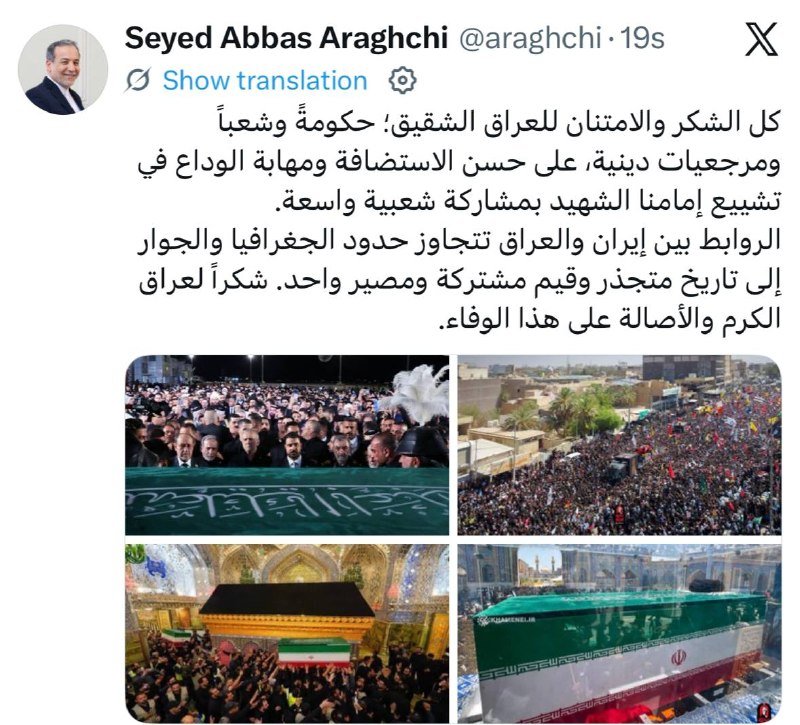
At 03:28 UTC on 3 July 2026, representatives of several religious communities gathered at the Imam Khomeini prayer hall in central Tehran for a ceremony of respect around the body of a senior Iranian leader, according to Al-Alam Arabic's breaking-news feed. By 03:54 UTC, what the Iranian state broadcaster described as "Resistance Front" representatives had arrived to pay their respects. Two hours later, Nechirvan Barzani, president of the Kurdistan Region of Iraq, landed in Tehran to take part in the funeral. The sequence, broadcast almost in real time on a state-aligned channel, is the news.
What the wire footage actually shows is the choreography of a political coalition in public mourning. The "Resistance Front" is not a single party or a treaty organisation. It is a working label for the loose, Iran-anchored axis that has survived the assassinations and reverses of the past two years — Hezbollah, the Iraqi Shia paramilitary coalitions, the Houthi movement in Yemen, and a constellation of smaller Palestinian and Syrian armed factions. Putting its envoys in the same hall as a visiting Kurdish head of state from Erbil is the part that should preoccupy analysts. It signals that Tehran is still willing, on the days that matter, to host figures who are not formally inside that coalition but who share a strategic horizon with it.
Who came, and what that tells us
Al-Alam's dispatches are sparse on names beyond Barzani. The channel identified the incoming delegations as "representatives of the Resistance Front" and "representatives of various religions" performing a ceremony of respect. Barzani's office has not, in the materials available to Monexus at the time of writing, released a public readout of his Tehran meetings, but his presence at a funeral for an Iranian leader is itself a foreign-policy signal. The Kurdistan Region sits inside Iraq, a state with the world's largest embassy of the Iranian foreign-policy project next door. Erbil's working relationship with Tehran has deepened as Baghdad's has frayed, and a presidential visit to a funeral is the kind of low-cost, high-visibility gesture that costs nothing and buys a great deal of goodwill.
For the Palestinian, Yemeni and Lebanese factions whose banners usually show up at these ceremonies, attendance is obligatory. Skip it once and you are read as having defected; attend it visibly and you are photographed inside the Iranian state's frame of legitimacy. The religious-diversity framing — Christian, Jewish, Zoroastrian and Muslim representatives at the prayer hall — is a deliberate piece of domestic Iranian optics, aimed at a global audience that has spent two years hearing the opposite story about the Islamic Republic.
The counter-narrative
Western wire coverage of Iranian-led funerals tends to read them as theatre, and not without reason. The language Al-Alam uses — "martyred leader," "Resistance Front," the prayer-hall framing — is the canonical vocabulary of the Iranian state and its partners. A reader trained on Reuters or the BBC is entitled to discount it. The counter-frame is straightforward: this is a regime that has spent four decades exporting a security doctrine, and the funeral is the moment that doctrine is performed most openly.
But the visitor list complicates that reading. Nechirvan Barzani is not a client of the IRGC in any conventional sense. He leads a Kurdish administration that is economically integrated with Turkey, hosts a US consulate in Erbil, and sits inside a federal Iraqi system whose Shia political class has deep, and deeply contested, ties to Tehran. His presence in Tehran suggests that even actors whose strategic centre of gravity lies outside the "Resistance" label calculate that the cost of absence exceeds the cost of attendance.
What the architecture looks like
The pattern on display is older than any single leader's death. For two decades, the practical machinery of Iran's regional influence has run through three channels: the IRGC Quds Force and its proxy commanders; a network of Shia political parties embedded inside the Iraqi state; and a set of soft-power and diaspora institutions that operate across the Gulf and South Asia. Funerals consolidate all three. They remind the proxy commanders whose authority they ultimately serve; they let the Iraqi partners be seen inside the Iranian state's house; and they give the soft-power institutions a media product they can re-broadcast to their own audiences.
What is new in 2026 is the speed at which the symbolism has to move. With several senior figures of the "axis" killed in the past eighteen months, succession is no longer theoretical, and funerals have become the public-facing instrument by which the succession is narrated. The choice to broadcast in near-real time, in Arabic, on a state channel, is itself a strategic decision: it is aimed at the audiences of the partner movements first, and at the Iranian domestic public second. Western coverage, when it picks the footage up, is almost an afterthought.
Stakes and what to watch
The practical question is whether this choreography translates into operational coordination in the period ahead — whether the leaders photographed today in Tehran are in a position to authorise, finance or supply the movements that will matter in the next crisis in Gaza, Lebanon, Iraq or Yemen. The ceremonial record cannot answer that. Only the operational one will, and that record is opaque by design.
Two things are worth watching in the days ahead. First, whether any of the partner movements names a successor figure at the funeral in a way that goes beyond condolence — that would be the signal that a transition is being legitimised in real time. Second, whether Barzani's office publishes a substantive readout of his Tehran meetings; silence, after a presidential visit of this kind, is itself a statement. Until either happens, the Tehran prayer hall is the news, and the diplomatic weather it implies is the story.
Desk note: Where mainstream Western wires treat the funeral as a closing chapter, the regional frame reads it as an opening one — the public consolidation of an axis that has absorbed two years of losses and is now visibly choosing to mourn in the open.
Wire provenance
This editorial synthesis draws on the following public wire/social posts:
- https://t.me/alalamarabic/
- https://t.me/alalamarabic/
- https://t.me/alalamarabic/
- https://t.me/alalamarabic/