The Funeral That Pulled a Militant Chief Into the Light
Ziad al-Nakhla surfaced in Tehran on 3 July 2026 to mourn Ali Khamenei — a rare public appearance that says as much about the Iranian succession crisis as it does about the Palestinian militant leader.
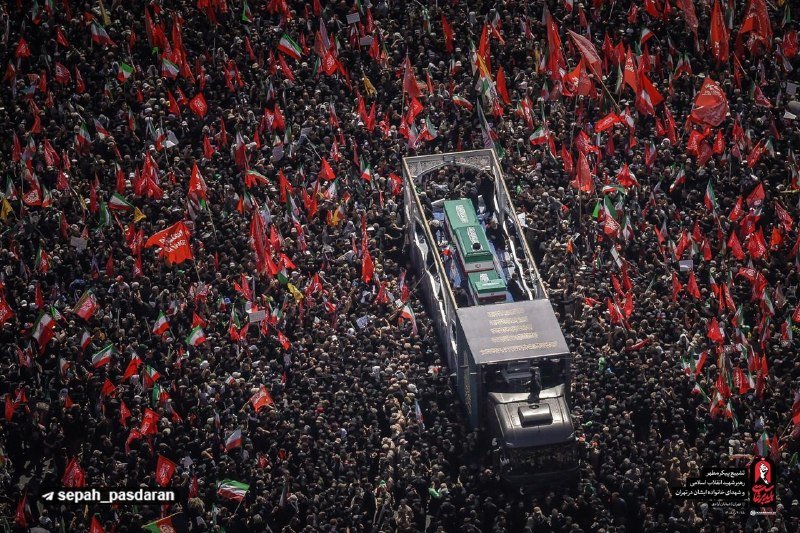
Ziad al-Nakhla, the Secretary General of the Palestinian Islamic Jihad, surfaced in Tehran on 3 July 2026 after months out of public view, leading his movement's delegation at the funeral of Iranian Supreme Leader Ali Khamenei. Two Telegram channels — abualiexpress and FotrosResistancee — carried images of al-Nakhla paying his respects in the Iranian capital, marking one of the more striking visual records of the day. That a reclusive militant leader felt obliged to break cover, fly to Tehran, and stand in the funeral cortege is a small piece of theatre with outsized consequences for the so-called "axis of resistance."
Al-Nakhla has not been a peripheral figure. Islamic Jihad is a smaller, more Iran-aligned counterpart to Hamas, and its chief answers, in operational terms, to a chain of patronage that runs through Tehran, Beirut and Damascus. His appearance at Khamenei's bier is therefore not a courtesy call. It is a statement of organisational continuity at a moment when the patronage structure that has sustained the group is visibly in flux.
A succession, not a funeral
The framing of these ceremonies matters. Iranian state-aligned outlets have presented the funeral as a national rite of passage — a moment in which the Islamic Republic demonstrates that institutional succession is orderly and the revolutionary project continues unbroken. Foreign delegations, particularly those drawn from the network of Iranian-aligned armed movements and political parties, function in that frame as evidence that the post-Khamenei order retains external backing. Al-Nakhla's presence is being read in that light: Islamic Jihad standing publicly with the new leadership.
The structural reality is more complicated. The loss of a patron who personally approved cross-border operations, weapons pipelines and financial transfers does not get papered over by a row of black banners in Tehran. What al-Nakhla can plausibly extract from the new Iranian leadership — and what the new leadership is willing, or able, to deliver — is the open question that will define the next phase of the relationship.
Reading the room
Two readings of al-Nakhla's appearance are plausible, and both should be on the table.
The first is the continuity reading: Islamic Jihad is signalling that it expects its privileged access to Iranian funding, training and logistical support to survive the transition. By turning up in person, al-Nakhla is performing loyalty to the institution of the Supreme Leader's office, not to the individual who last occupied it. That is the kind of message Tehran rewards.
The second is the uncertainty reading: al-Nakhla broke cover because the situation is precarious. Months of absence from public view, followed by a high-risk flight to Tehran at a moment when Israeli airstrikes have repeatedly targeted PIJ figures in Lebanon and Syria, suggests a leader who needs to be seen pressing the flesh at the centre of his supply chain. The funeral was a defensible pretext for a meeting he could not afford to skip.
The available reporting — two Telegram channels, both with a clearly sympathetic editorial line toward the Iranian axis — does not allow a clean adjudication between these readings. What can be said is that al-Nakhla judged the political cost of non-attendance higher than the security cost of attendance, and that judgment is itself a data point.
What the camera caught
The visual record is modest but specific. Al-Nakhla, in footage circulated by abualiexpress and FotrosResistancee on 3 July 2026, is shown among the foreign delegations paying respects in Tehran. The framing by both channels emphasises the Palestinian flag and the Iranian flag side by side, an editorial choice that doubles as a diplomatic signal: this is a bilateral relationship, not a tributary one.
That framing is itself worth scrutiny. The relationship between Islamic Jihad and Tehran has historically been described as one of the more hierarchical within the "axis" — closer to client than to partner. The Telegram channels pushing this footage have a stake in presenting it as a relationship of equals. Monexus treats the imagery as evidence that the meeting happened; we treat the framing as advocacy for how the relationship should be read.
Stakes for the next phase
If the continuity reading holds, the post-Khamenei order in Tehran will continue to underwrite Islamic Jihad's rocket and rocket-adjacent capabilities in Gaza and the West Bank, with logistics routed as before through Lebanese and Syrian territory. Al-Nakhla's public standing will rise in inverse proportion to Israeli confidence that decapitation strikes can degrade the group's command.
If the uncertainty reading holds, the more relevant question is who absorbs the cost of any cutback in Iranian sponsorship. Gaza-based cadres, already operating under severe physical constraint, are the obvious first loser. So is Hezbollah, which has historically passed on a slice of its own Iranian-supplied capability to Islamic Jihad and now has its own exposure to manage.
The honest summary: a secretive militant leader surfaced in Tehran on 3 July 2026 to mourn a dead patron. The two Telegram channels that covered it told us what was visible. They did not — and could not — tell us what was negotiated in the rooms behind the cameras. The next weeks of reporting from the region will determine which of the two readings above becomes the working assumption of Western and Israeli intelligence services, and that assumption will shape operational decisions with direct consequences for civilians on both sides of the border.
Monexus framed this as an axis-of-resistance story about patronage and survival, not as a stand-alone obituary for a foreign leader — the wire photostream of the funeral provided the visual hook, but the analytical weight sits on what al-Nakhla's appearance says about the network he depends on.
Wire provenance
This editorial synthesis draws on the following public wire/social posts:
- https://t.me/abualiexpress
- https://t.me/FotrosResistancee
- https://t.me/abualiexpress/13131
- https://t.me/FotrosResistancee/42218