A Bahraini cleric's eulogy, and the limits of reading Iran's clerical bench by obituary
Sheikh Isa Qassem's tribute to a fallen Supreme Leader reads as theology. The Western wire will read it as a political signal. Both readings miss what succession actually changes inside the Islamic Republic.
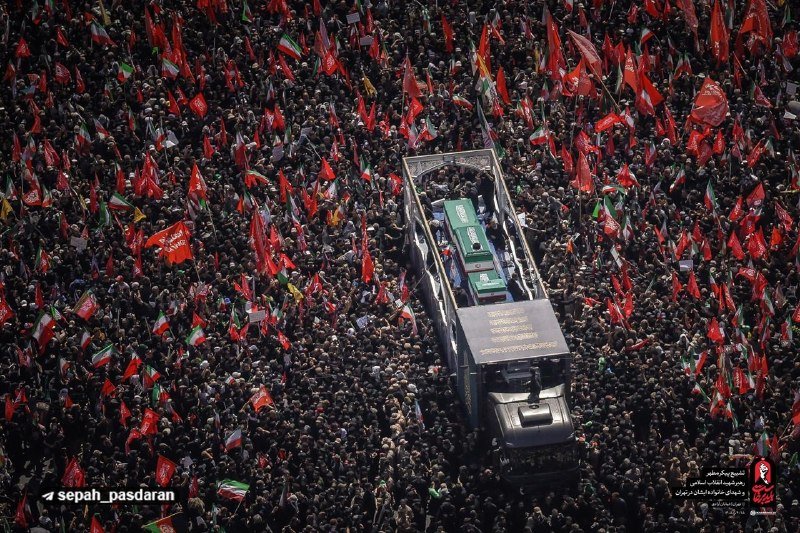
A statement issued by Bahrain's Ayatollah Sheikh Isa Qassem on Friday 4 July 2026 — surfaced first by Iranian state outlets Press TV and Al-Alam — reads as the kind of formal clerical tribute that begins circulating inside the Shia political sphere within hours of a senior figure's death. Qassem, the spiritual leader of Bahrain's Shia community, saluted the deceased as "a great jurist, a true revolutionary on the right path," and pledged that "the path of Imam Khomeini" and the martyred leader "will continue with strength." The language is theological. The subtext is political. Both are doing work the moment they cross a wire.
The temptation, in Western newsrooms that have spent fifteen years reading every Shia clerical utterance for a hint of operational direction from Tehran, is to treat a Bahraini sheikh's condolence as a kind of proxy fax from the Islamic Republic's highest office. That is the wrong frame. The Islamic Republic does not speak through Manama. It does, however, fund, broadcast to, and politically orient a broad Shia clerical ecosystem that runs from Bahrain's marginalized community through Iraq's Hashd-aligned pulpits and into Lebanon's south — and the choreography of a death inside that system is itself the story.
What Qassem actually said
The two statements, picked up by Press TV at 21:50 UTC and Al-Alam at 21:40 UTC on 4 July 2026, are unusual less for what they contain than for what they omit. There is no mention of continuity of command, no reference to the Assembly of Experts that under Iranian law ratifies a new Supreme Leader, no quote from Qom, no instruction to the Bahraini street. There is eulogy, and a lineage claim — Khomeini, then the dead leader, then the path — that locates the departed inside an established clerical canon rather than a contingent office. The careful absence of operational content is itself a signal: Bahrain's most senior Shia voice is observing a mourning protocol, not issuing a political directive. Manama's intelligence apparatus, which stripped Qassem of his citizenship in 2016 over what it called incitement, will read it that way too.
Why the Western wire will over-read
Coverage of clerical Iran in Western outlets tends to flatten a deliberative, factional institution into a one-line slogan machine. Every obituary, every commemoration, every pulpit reference is treated as a communiqué from a central committee. There is a reason that habit formed: the Iranian state has, at points, deliberately used affiliated clerics abroad to carry messages it did not want to attach to the Supreme Leader's office directly. But the same institutional reflex has produced three decades of confident miscalls — from apocalyptic reads of Ahmadinejad-era Friday sermons to breathless coverage of Quds Force speeches that turned out to be performances for internal factional rivals rather than cables to Western capitals. The Bahraini clergy in particular has been cast, repeatedly, as a node in a Tehran-controlled network when most of the actual evidence points to a much looser arrangement: shared clerical training in Najaf and Qom, parallel political grievance against Sunni-majority rule in Bahrain, and a steady pressure from Iranian state media that shapes but does not command the Bahraini Shia public sphere.
The structural frame
What we are watching is the choreography of a clerical succession at the head of an institution that has spent four decades exporting political weight through affiliated preachers, allied militias, and a Persian-language satellite ecosystem. When the senior post is vacant — by death, illness, or protracted internal arbitration — the silence and the eulogies are both loud. Affiliated clerics in Bahrain, Iraq, and Lebanon do not become more obedient; they become more legible, because they have to perform loyalty to an institution whose head is missing. That is why a Bahraini sheikh's statement on the evening of a Tehran death matters: not because Manama has been deputized to speak for Qom, but because the act of speaking, in this register, at this moment, is itself a positioning inside a system that will, within days, have to decide who sits at the top.
Stakes and what remains uncertain
The hard question — who succeeds, by what mechanism, and on what factional terms — is not in these statements and will not be settled by reading them. Bahraini clerical commentary will tell us something about whether the new Supreme Leader inherits the quiet Arab Shia periphery intact or whether that periphery fractures between factions. That is a story worth following. The wrong way to follow it is to read every Bahraini eulogy as a Qom-issued dispatch. The right way is to treat the eulogies as position-takes inside a regional clerical field whose centre of gravity is, for the moment, absent — and to wait for the institutional answer from inside the Islamic Republic itself before assigning meaning to the sympathy notes that arrive from its outskirts.
What we verified and what we could not
The text of Qassem's two statements, the timing of their release (21:50 UTC and 21:40 UTC on 4 July 2026), and the framing — Khomeini, martyrdom, continuity — are taken directly from the Press TV and Al-Alam Telegram posts. The institutional background — that Qassem heads the Bahraini Shia spiritual authority, that Manama revoked his citizenship in 2016 — is well-attested in prior reporting and consistent with public record. The succession mechanism inside Iran (the Assembly of Experts, the Guardian Council's vetting, the role of the Assembly of Experts' standing committee) is a stable constitutional fact. What no source in this thread confirms is the identity of any successor, the timetable for a formal transition, or any operational instruction issued from Qom in connection with the present moment — and Monexus will not speculate on those gaps.
Across the Gulf desk, this publication treats regional clerical commentary as position-taking inside a factional system, not as communiqué issuing from a unitary command. The obituary frame — what the dead leader built, who the heirs are, which rivalries survive — is the story; the eulogies are the chorus, not the script.
Wire provenance
This editorial synthesis draws on the following public wire/social posts:
- https://t.me/presstv/176245
- https://t.me/presstv/176244
- https://t.me/alalamfa/189012