Doha hosts Syria's foreign minister as Gulf states test the post-Assad diplomatic lane
A Doha meeting between Syria's Asaad al-Shaibani and Qatar's prime minister signals how Gulf monarchies are positioning themselves in the diplomatic space left by Assad's fall.
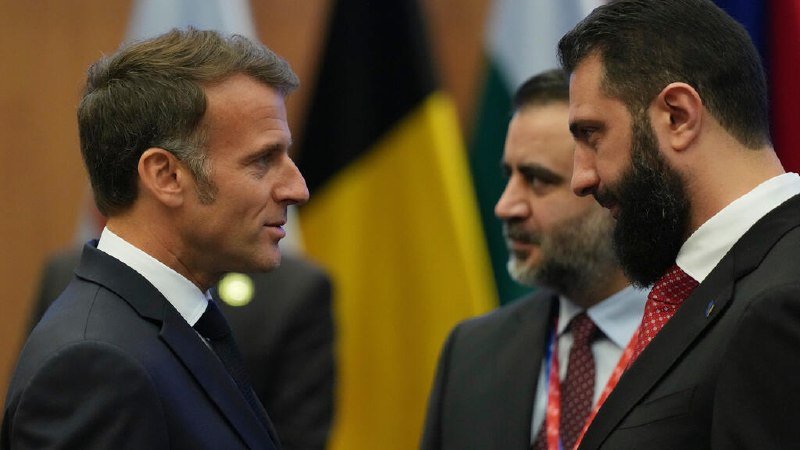
Syria's foreign minister, Asaad al-Shaibani, landed in Doha on 4 July 2026 for a meeting with Qatar's prime minister and foreign minister, Mohammed bin Abdulrahman Al Thani. The talks, confirmed by both the Telegram channel GeoPWatch and Warfield Witness coverage of the same arrival, are the latest in a sequence of Gulf-hosted contacts with Damascus since the Assad government's fall.
The Doha meeting is small in scale — two foreign ministers, a bilateral working agenda — but it is doing real diplomatic work. It is establishing the routine by which a transitional Syria is being reintroduced to the Arab diplomatic circuit, and it is doing so on Gulf-monarchy terms.
Who is in the room, and who is not
The Syrian side is led by al-Shaibani, the foreign minister of the transitional government that took power after the Assad regime collapsed. Doha is sending Mohammed bin Abdulrahman Al Thani, who holds both the prime ministership and the foreign affairs portfolio. The agenda, per the readouts circulating on regional monitoring channels, covers bilateral cooperation and unspecified "latest developments" — the standard formulation for diplomatic contacts that have not yet produced a communiqué.
What is conspicuous is the institutional frame. The Syrian side is meeting with a Gulf prime minister, not with a Western foreign minister. Western governments — including the United States and the European Union — continue to maintain formal distance from Damascus pending progress on transitional governance benchmarks, even as regional actors move to normalise. The meeting therefore doubles as a quiet signal: Damascus's re-entry to international politics is being chaperoned, for now, by Arab capitals rather than Atlantic ones.
The Gulf lane since Assad
Qatar's diplomatic footprint inside Syria predates 2024, but the post-Assad environment has accelerated the work. Doha was among the first Arab capitals to receive Syrian transitional envoys after the regime change and has hosted several rounds of talks on reconstruction financing, refugee return logistics, and the integration of Syrian factions into regional security frameworks. The 4 July meeting fits that pattern.
The framing matters. Gulf monarchies are not framing the relationship in human-rights conditionality language — the dominant Western register. They are framing it in trade, investment, and stabilisation language: roads, ports, electricity, the predictable menu of post-conflict economic statecraft. That is a different operating theory of engagement, and it comes with different priorities. Refugee returns and reconstruction contracts move faster in this register than in a register anchored to transitional-justice benchmarks.
There is a counter-narrative worth naming. Western diplomats privately argue that the Gulf approach, by de-linking engagement from governance reform, risks entrenching the most retrograde factions inside the transitional order. Gulf officials counter — and they say this publicly — that sequencing conditionality ahead of basic state functionality produces a failed-state equilibrium in which the conditionality is never met and the population pays the price. Both arguments are coherent. Which one proves out is a function of facts on the ground that the meeting in Doha is, in part, designed to shape.
What the diplomatic choreography tells us
The choice of Doha as the venue is not incidental. Qatar has invested in being the neutral-ground mediator of Middle Eastern disputes from Lebanon to Afghanistan to the Palestinian file. Hosting the Syrian foreign minister reinforces that brand and, more importantly, inserts Qatar into a Syrian reconstruction conversation that will involve tens of billions of dollars over the next decade. Reconstruction contracts — port management at Latakia or Tartus, airport modernisation, telecom licensing — will be awarded. The capitals that position themselves earliest in the diplomatic queue tend to capture the early-mover advantage on the commercial queue that follows.
That is the structural pattern: diplomatic normalisation, then trade normalisation, then capital flow. Gulf monarchies understand the sequence because they have run it themselves, with their own Gulf Cooperation Council partners and, more recently, with previously estranged Arab states. Syria is the latest iteration.
Stakes and what remains unclear
The immediate winners, if the trajectory holds, are the Gulf monarchies positioning for Syrian reconstruction contracts, and the Syrian transitional government securing external engagement without Western preconditions. The immediate losers are the Western donors who want a slower, conditionality-anchored process, and Syrian civil-society groups who fear that an Arab-capital-led stabilisation will dilute the political accountability built into the transition.
What remains genuinely unclear from the 4 July meeting — the sources do not specify — is whether any of the announced cooperation will translate into concrete financial commitments, and on what timeline. Diplomatic meetings of this kind produce communiqués and sometimes memoranda of understanding; whether this one will is an open question. The two channels that carried the arrival reporting — GeoPWatch and Warfield Witness — gave no readout of deliverables.
A second open question is sequencing. Gulf engagement is moving ahead of Western engagement. That order can hold, or it can collapse if a future incident in Syria forces Western capitals to demand a pause in the Gulf track. The Doha meeting is therefore best read not as an end-state but as the latest move in an unresolved board.
Monexus framed this as a diplomatic-choreography story centred on Gulf agency in the post-Assad opening, rather than as a transitional-governance story. The wire feed offered two Telegram-channel confirmations of the meeting; everything beyond the meeting itself — agendas, deliverables, conditionality debates — is contextual reading, not new reporting.
Wire provenance
This editorial synthesis draws on the following public wire/social posts:
- https://t.me/GeoPWatch
- https://t.me/GeoPWatch
- https://t.me/wfwitness