The funeral that doubles as a mobilisation order
Tasnim's funeral coverage is doing rhetorical work the wire has barely noticed — turning mourning for a 'martyred leader' into a public pledge of retaliation.
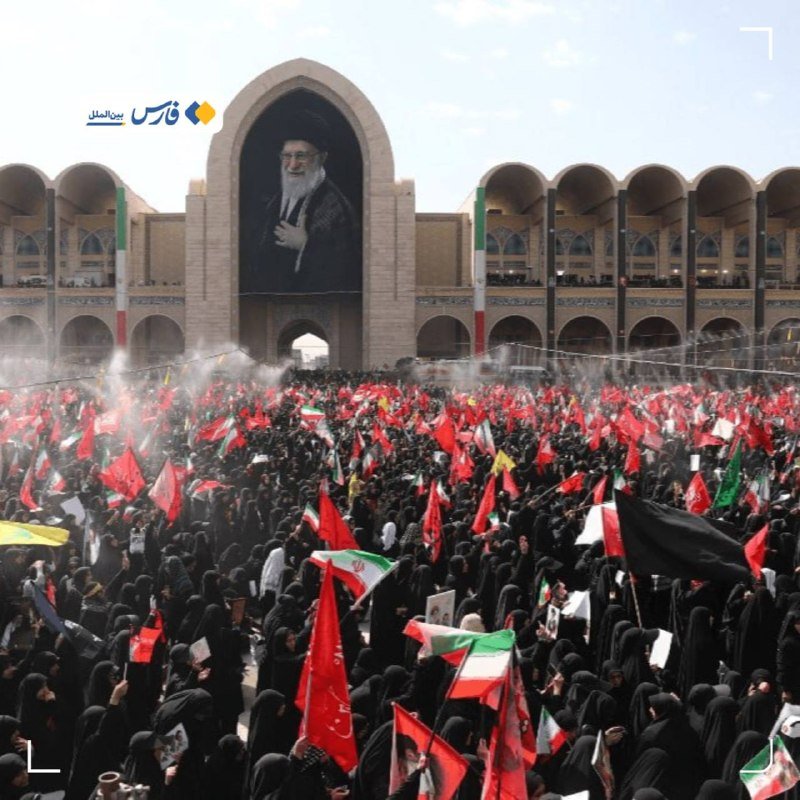
A funeral is, in most polities, an exercise in closure. The scenes that Tasnim News has been broadcasting since 14:10 UTC on 4 July 2026 are something else: a coordinated display of public grief, stitched together with hashtags — #Badarqa_Aghai_Shahid_Iran, #must_rise — that read less like mourning than like a call sheet. Three home exhibition platforms moved in joint procession during the farewell ceremony for the 'martyred leader of the Revolution'. Chants of 'revenge' echoed across the gathering, according to the outlet's own coverage. The state's messaging arm is asking the country to read the pageantry as devotion, but the editorial choices suggest the audience it actually wants is overseas.
This publication is not the place to debate whether a deceased Iranian official merits the title Tasnim assigns him. The relevant question is simpler and more useful: what does a state-aligned newsroom accomplish by saturating its own feeds with funeral iconography at this moment, in this register, with these hashtags? The answer is worth spelling out, because the Western wire has largely treated the ceremony as a colour story and missed the work the imagery is being asked to do.
What the framing is doing
Tasnim's English-language Telegram channel has run four discrete items between 14:10 and 15:37 UTC on 4 July, each reinforcing the same scaffold: a leader described as 'martyred', mourners described as 'lovers', and a chant — 'revenge' — that Tasnim itself captions as an 'echo'. That word choice matters. Echoes, in Iranian state-aligned vocabulary, are not the residue of private grief; they are the resonance chamber through which a leadership decision is laundered into popular will. The platform is performing consensus, not reporting it.
The home exhibition platforms in joint procession are the visual punchline. Funerals in the Islamic Republic have a documented history of doubling as mobilisation rituals — the 2020 farewell to Qasem Soleimani was the model, with crowds framed by state media as a mandate for the subsequent ballistic-missile strike on Ain al-Asad. The grammar here is the same: coordinated movement, shared slogans, the vocabulary of martyrdom. A reader in London or Riyadh is supposed to draw the inference that the street has ratified whatever comes next.
The translation problem for Western readers
The wire coverage that exists treats the ceremony as a domestic event. Tasnim's English channel exists precisely to push it back outward. By hashtagging in English (#must_rise), captioning in English, and selecting footage that foregrounds crowd density and chant volume, the outlet is packaging a domestic ritual as a signal to foreign ministries, foreign desks, and foreign traders. The 'martyred leader' is the bait; the operational question — what Iran's leadership intends to do in the days that follow — is the catch.
Two cautions are worth keeping in view. First, Iranian state media is not a neutral observer of its own rituals; the crowd counts, the choreography, and the editorial framing are all inputs to a message the outlet wants delivered. Second, the vocabulary of martyrdom is doing more than grief-work inside Iran — it is also the legal-political predicate for retaliation under longstanding Iranian state doctrine, which frames certain killings of senior officials as casus belli. Western readers who only see the colour piece are missing the second-order signal.
What the sources disagree about
The sourcing here is, by construction, narrow. Tasnim's English channel is the primary feed for the scenes described; the wire services have not, as of the timestamps above, published independent verification of crowd size, the identity of the deceased, or the precise wording of the chants. Readers should treat the descriptive claims — procession scale, slogan content, the phrase 'martyred leader of the Revolution' — as the outlet's framing rather than as cross-corroborated fact. The structural argument does not depend on which leader is being mourned; it depends on what the state-aligned outlet is doing with the mourning.
The stakes
If the pattern holds — and the precedent of 2020 suggests it will — the next seventy-two hours matter more than the ceremony itself. Foreign ministries that read Tasnim's English feed as noise will be slower to price in the policy signal the outlet is broadcasting. Energy desks that treat the hashtags as colour will be slower to adjust exposure. The funeral is the headline; the order it is being used to communicate is the story.
Desk note: Tasnim is a state-aligned outlet, and its English-language feed is itself a piece of Iranian state communication. Monexus has reported the framing rather than the framing's claims — the editorial choices are the news, not the crowd count.
Wire provenance
This editorial synthesis draws on the following public wire/social posts:
- https://t.me/tasnimnews_en
- https://t.me/tasnimnews_en
- https://t.me/tasnimnews_en
- https://t.me/tasnimnews_en