Iran stages a farewell, and the framing writes itself
Tasnim's coverage of the farewell to a 'martyred leader' reads like liturgy, not journalism. That is the point, and it tells us what the Iranian state wants visible and what it wants invisible.
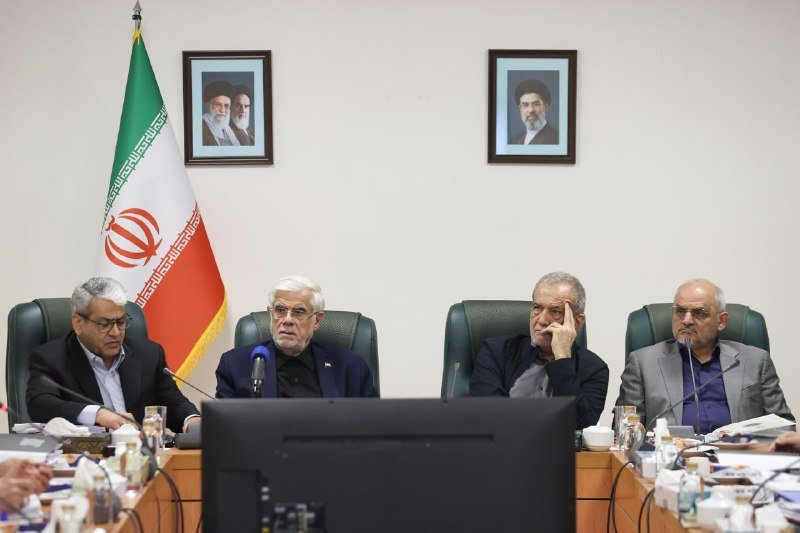
On the evening of 4 July 2026, Iran's Tasnim News Agency filled its English-language Telegram channel with the choreography of a national grief. A mother who travelled miles with her baby for a last meeting with a "martyred leader." A mourner who "portrayed grief" without speech or title. Mosque doors opened "due to the enthusiastic presence of people." A second mourner, quoted on the same channel: "I got to know Mr. Seyed Ali very late; I did not have time to love him; I am afraid that I love Mr. Seyed Mojtabi more than the martyred leader." The state-aligned outlet fixed an 8 p.m. funeral hour. Carriers of flags slept on prayer-stone "carpets," their pillows the bags they brought. The reporting reads less like news than like a script: liturgy turned into wire copy, grief managed into ceremony.
What is happening on Tasnim's English feed is not hard news in any conventional sense. It is a deliberate, hour-by-hour construction of a public mood. The point of the coverage is to make the political leadership legible as sacrifice and to make the public legible as devotion. The wire's job is to be visible doing that work.
The grammar of the farewell
Read the items together and the form reveals itself. Every Tasnim dispatch on 4 July performs the same structural gesture: a specific anonymous figure, an emotional register, and a ritual action. The mother with the baby. The unnamed man among the crowd. The doors of the mosque "opened" because the people came. There is no policy claim, no casualty figure, no institutional actor outside the family and the mosque. The English channel uses the Persian honorific "Aghai" rendered in transliteration and the hashtag #Badarqa_Aghai_Shahid_Iran, plus #must_rise. The hashtags themselves are a directive, not a description.
The framing rests on three moves that recur across the items. First, intimate access — a mother, an unnamed mourner, a man from "among the people" — to imply the event is felt rather than staged. Second, physical infrastructure responding to popular pressure — doors opened because bodies arrived — to imply the state is following, not leading. Third, spiritual vocabulary deployed at industrial scale: martyrdom, prayer stones, the beloved departed leader. Tasnim has institutional reasons to lift this language from Persian martyrdom culture into a register its English diaspora and foreign-policy audience can also parse.
What the framing leaves out
The same evening, the channel did not surface the questions a Western wire would lead with: what is the succession after the named dead figure, who controls the security institutions during the transition, what is the operational status of Iranian-aligned forces in Lebanon, Iraq, Yemen, or Syria, and what economic pressures are the sanctions regime imposing on ordinary households. The wire's silence on those questions is itself the story. A reader scrolling Tasnim English at 21:14 UTC, when the "man who portrayed grief" item was posted, would not learn whether the country is in mourning, in transition, or in controlled crisis.
Why the format works, and where it strains
This is an effective instrument for one job: producing an image of a country praying in unison. It is a less effective instrument for telling the world what comes next, because telling the world what comes next requires naming the institutions and factions that decide it. The English channel's avoidance of those names is consistent. It is also diagnostic. State-aligned outlets globally default to the same scarcity: plenty of feeling, little structure; plenty of faces, no offices. Tasnim is unusually disciplined about it.
Stakes
For a foreign reader, the practical take-away is blunt: the image of a nation that Tasnim presents is partly real and partly engineered, and the engineering is the part that travels furthest in English. Diaspora communities, foreign-policy desks, and political analysts who use Tasnim English as a window into the street should treat it as a speech act, not a survey. The community the wire is actually addressing is the regime's English-speaking present and future, and the message is that the grief is real, the leadership is ratified, and the next chapter is sealed before the doors close.
The remaining uncertainty is whether the same coverage pattern holds in the Persian-language channel, which the source items do not address. That gap is itself worth noting: the English feed is curated for export, and the domestic feed is the test of how much of this grief the state actually has to manufacture.
How Monexus framed this: against the Western wire's instinct to read state-aligned coverage as raw truth or raw deception, we read the items as artefacts — what they include is as informative as what they leave out.
Wire provenance
This editorial synthesis draws on the following public wire/social posts:
- https://t.me/tasnimnews_en
- https://t.me/tasnimnews_en/1
- https://t.me/tasnimnews_en/2
- https://t.me/tasnimnews_en/3
- https://t.me/tasnimnews_en/4
- https://t.me/tasnimnews_en/5