Khamenei's funeral and the choreography of Iranian statecraft
Delegations from China, Russia and across the Muslim world converged on Tehran as Iran's Supreme Leader was laid to rest, exposing the diplomatic geometry of who still shows up — and who stays away.
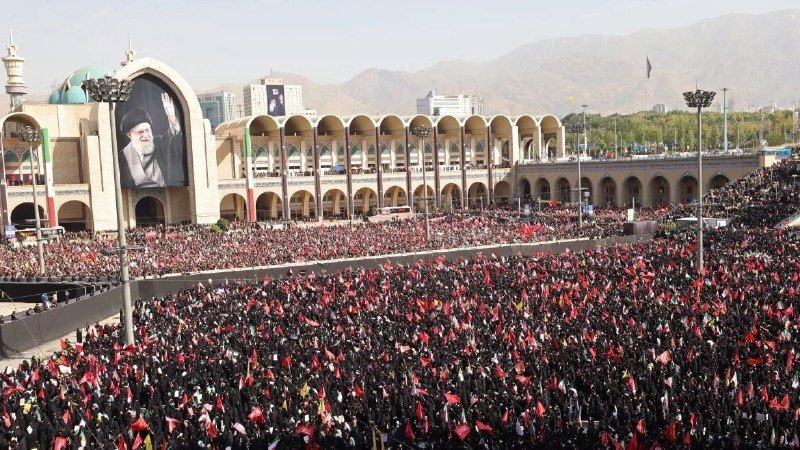
On 4 July 2026, Tehran opened the formal mourning rites for Ayatollah Ali Khamenei, the Supreme Leader of the Islamic Republic of Iran since 1989. Delegations began arriving in the capital overnight and through the morning, and the guest list read less like a condolence register than a map of Iran's diplomatic weather. According to The Indian Express's tally of official state representations, the delegations spanned the principal patrons of the Islamic Republic — China and Russia — alongside a wide arc of Muslim-majority states from South and Southeast Asia, the Gulf, North Africa and the wider Middle East. The same dispatch confirmed that no senior Western head of state was on the published list.
The choreography is the message. A funeral of this scale is, for any sitting Iranian leadership, a test of the coalition it has built under sanctions pressure and intermittent war. Tehran has had to maintain that coalition largely without the legitimacy props the Western order offers its members. The delegations on the ground in Tehran on 4 July — and the absences from Western capitals — answer a question about who that coalition now actually is.
Who came, who didn't
The Indian Express list is consistent with the pattern documented in recent years: Iran's diplomatic gravity tilts east and south. Beijing and Moscow have been the strategic backstops of the Islamic Republic through UN Security Council friction, sanctions architecture and the open conflict that broke out in mid-2025. Their presence at a funeral of this rank is procedural, but it is also a signal to the remaining Iranian negotiating class that the external scaffolding has not collapsed.
The wider guest list — Pakistan, India, Bangladesh, Iraq, Syria, Lebanon, Egypt, Algeria, Malaysia and Indonesia among others, per the same dispatch — illustrates a different point. Several of these governments maintain working relationships with both Iran and the Gulf monarchies, and some have restored or upgraded ties with Israel in recent years. By sending delegations to Khamenei's funeral they are signalling that proximity to Tehran does not require rupture with Washington or Tel Aviv. For India in particular, the calculus is delicate: a large energy dependence on Gulf states sits alongside a long-standing relationship with Iran, including the Chabahar corridor project. Attendance, in this context, is a form of diplomatic insurance rather than an endorsement.
The absences are equally informative. No G7 head of state features on the list. That is not because Western governments do not engage Iran — nuclear talks have produced intermittent framework agreements, and humanitarian channels have operated through the Swiss and Omani intermediaries — but because the symbolic vocabulary of the Iranian state and the Western liberal-democratic establishment are no longer compatible at the highest level. A Western prime minister standing at Khamenei's bier would be read in Tehran as subordination; in his own capital, as a surrender of human-rights language. So no one comes, and the silence is itself a datum.
What the funeral actually performs
Iranian state funerals are staged as theological-political events. The structure of the rites — Quranic recitation by designated clerics, supplication for the deceased, the participation of the Assembly of Experts, the visible presence of the senior military commanders of the Islamic Revolutionary Guard Corps — broadcasts continuity at the exact moment a regime is most vulnerable. The transition machinery matters because Khamenei held three nested offices simultaneously: Supreme Leader, custodian of the velayat-e faqih, and the jurist who, in the Iranian constitutional order, validates the legitimacy of every other office. The succession process is opaque by design.
That opacity is the second thing the funeral performs. A consolidated, certain transition would not need four days of public mourning, military parade, and continuous media coverage of foreign dignitaries. The ceremony is meant to demonstrate that the system is operating as written, while the political class around the casket is, in private, conducting the negotiation that the constitution never specifies. In that sense, the guest list is read twice — once publicly, as a show of coalition, and once privately, as a reading of which foreign principals are prepared to keep doing business with whatever Iranian leadership emerges from the process.
The Indian Express framing — a straightforward enumeration of who sent whom — also performs a service for readers outside the region. It treats the funeral as a normal diplomatic event with a guest list that happens to be unusual. That framing is itself a quiet rebuttal of the Western wire tendency to treat Iranian state occasions as either esoteric theocracy or pantomime. The delegations are real officials with real portfolios; the meetings they will hold on the margins are real bilateral business. Reading the funeral as theatre alone misses the policy content.
The structural frame
The deeper pattern is the reconstitution of a non-Western diplomatic sphere that operates on its own protocol. China's presence at Iranian state funerals is no longer exceptional; it is expected. Russia's is guaranteed by the partnership both states have signed into. Pakistan and Iraq attend because their internal politics and border politics make Iranian goodwill necessary. Egypt and Algeria attend because the post-2023 regional order has pushed several Arab capitals into a more transactional posture with Tehran. Malaysia and Indonesia attend because their domestic Muslim constituencies notice, and because neither government sees a cost.
What does not exist, structurally, is a return to the pre-2018 sanctions architecture. Even if a future nuclear framework produces partial relief, the financial plumbing, the shipping insurance market, the secondary-sanctions enforcement capacity and the diplomatic habits built up over more than a decade have produced a durable realignment. Iran's trade is rerouted through Chinese and Russian clearing, its energy flows are denominated in yuan and rupees alongside the dollar, and its diplomatic centre of gravity has shifted from Geneva and Vienna to Beijing and Moscow, with Ankara and Doha as adjuncts. The funeral guest list of 4 July 2026 is a snapshot of that rerouting.
Stakes and what remains uncertain
For the Iranian public, the immediate stakes are the succession itself — who, from inside the Assembly of Experts, is positioned to inherit the office, and what that person's posture will be on nuclear policy, on the镇压 of the post-Mahsa Amini protest cycle, and on the IRGC's economic empire. The Indian Express and other wires do not yet name a frontrunner; the sources do not specify. The diplomatic choreography is running ahead of a political settlement that has not been disclosed.
For the wider region, the stakes are continuity of the alignment pattern. If Beijing and Moscow are prepared to be visibly present at a moment of Iranian institutional vulnerability, that presence is a down-payment on the relationship under the next Supreme Leader. If Pakistan and India both send delegations, South Asia's two largest states have signalled that they will manage their bilateral differences without allowing either to dictate Iran policy. If no Western capital sends a senior figure, the diplomatic firewall between the Islamic Republic and the Western-led order is, for now, intact.
What remains genuinely uncertain is whether the coalition on display in Tehran on 4 July 2026 translates into coordinated action on any of the open files — nuclear, regional proxy posture, sanctions circumvention — once the mourning period closes. Delegations at a funeral are not treaties. They are, however, the necessary precondition for the conversations that produce treaties. The next few weeks will tell whether the choreography of 4 July converts into policy, or whether it remains, as some Western readers will be tempted to conclude, an orientalist tableau.
How Monexus framed this: the wire led with the names and titles; this piece reads the guest list as evidence of a realigned diplomatic sphere, without treating either Iranian statehood or Western absence as self-explanatory.