Medvedev's Hormuz Warning Meets a Funeral in Tehran
A Moscow heavyweight calls the Strait of Hormuz a weapon on par with nuclear arms, hours before mourners filled Tehran. The juxtaposition says something both governments would rather the world not hear.
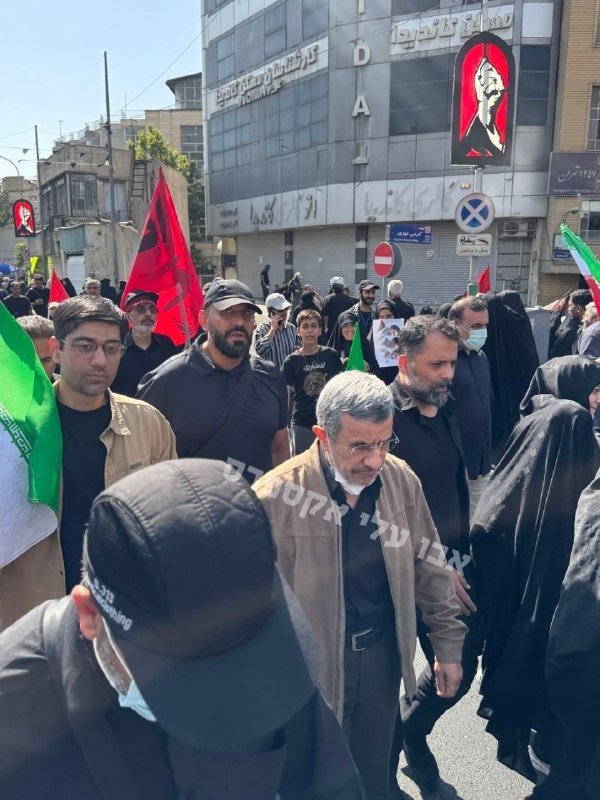
Two signals crossed on 4 July 2026. In Moscow, former president and current senior Security Council figure Dmitry Medvedev, fresh from what state-aligned X accounts described as a farewell ceremony for Ayatollah Ali Khamenei, declared the Strait of Hormuz a weapon for Iran "no less powerful than nuclear weapons." In Tehran, PressTV broadcast hours of footage showing what it called hundreds of thousands of mourners packing the capital's Grand Mosalla to mark the end of formal mourning for the Supreme Leader. The two messages reinforce each other, and that is the point — even if neither capital will say so plainly.
The Medvedev line is the one Western energy desks should be reading most carefully. A senior Russian official publicly ranking a chokepoint on par with a nuclear deterrent is not idle commentary. It is pricing information. It tells oil traders, tanker insurers, and the planners in Washington, Riyadh, and Brussels what Moscow believes the next phase of Middle East brinksmanship looks like — and what it expects the rest of the world to underwrite.
What Medvedev actually said
According to the X account @sprinterpress, Medvedev emerged from the Tehran farewell on 4 July 2026 with the line that the Strait of Hormuz has become a weapon for Iran "no less powerful than nuclear weapons" and that Tehran "also has a 'thermonuclear [weapon].'" The truncated framing is characteristic of Medvedev's social media style — half-sentence, half-taunt — but the underlying arithmetic is straightforward. Somewhere between a fifth and a third of seaborne oil moves through the strait in a normal week. Tehran has spent three decades building the asymmetric tools to make that flow interruptible on short notice: fast attack craft, mines, coastal anti-ship missiles, and the submarine capacity to complicate any close-in sweep. The first half of his claim is, in plain terms, accurate.
The second half is the one that should worry ministries. A "thermonuclear" weapon, in Medvedev's formulation, is shorthand for a non-military instrument with system-wide effect. For Iran, the closest analog is the diaspora-finance networks, the ballistic-missile inventory, and the proxy architecture built over four decades — the asymmetric retaliatory stack that any successor to Khamenei will inherit more or less intact. Medvedev is telling an outside audience that the deterrent Iran now possesses is not the deterrent of 2015, and that Western planners who still price the strait on the assumption of free transit are pricing risk with the wrong model.
The choreography in Tehran
The funeral footage served a different but compatible purpose. PressTV, the Iranian state English-language outlet, framed the Grand Mosalla gathering as a popular coronation of the transition rather than an ending. The visual register — mass crowds, slow banners, formal religious choreography — is designed to project continuity at the precise moment when succession questions most threaten regime cohesion. The Medvedev endorsement travels alongside it: Russia visibly on the Iranian side at the moment a new Supreme Leader takes up the mantle, before domestic rivals can settle scores, before Gulf negotiators can probe for weakness.
This is the part Western commentary tends to under-read. Succession in the Islamic Republic is not just an Iranian event. It is a moment when the country's external deterrent depends almost entirely on credibility signals from partners. Moscow is signalling. Beijing's silence, conversely, is its own data point — China has more at stake in the strait than any single foreign ministry, and quietness from Beijing at moments of Iranian vulnerability is the more reliable tell.
Counter-read — why the warmaking line is also a sales pitch
The alternate explanation is uglier and probably closer to true. Medvedev's bombast also functions as a sales pitch to two domestic audiences. First, Russian arms buyers who watched the war in Ukraine expose real limits in Russian defence industry: a louder Medvedev line on Iranian weapons reassures buyers from Hanoi to Algiers that the Russian-Iranian complex still produces strategic effects. Second, Russian oil and gas exporters who want a sustained risk premium priced into Gulf transit — and therefore into competing Russian deliveries to Asia. A world that believes Hormuz is a permanent hostage is a world that pays more for non-Gulf barrels.
The Western analytical community is right to be sceptical of the threat inflation. Iranian coastlines have been threatened with closure before. The 2019 Limpet mine incidents and the 2024 shadow-tanker seizures lowered throughput but did not chokepoint it. The structural argument here is older than the Islamic Republic: a chokepoint whose blockade is deterred only by the blockader's own dependence on the same waterway is, in the long run, only as dangerous as the consensus to keep it open.
What the next ninety days look like
The headlines to watch are not the eulogies. They are the appointments, the first-100-days Supreme Leader statements, and the way the IRGC handles its own internal succession. Whoever emerges as Supreme Leader will inherit not just Khamenei's title but his deterrence stack, and the Medvedev endorsement suggests Moscow intends for that stack to be quietly underwritten through the transition. Energy desks should price accordingly. Defence planners should read the Medvedev text twice — once as rhetoric and once as the Russian government's estimate of what comes next. The two readings point in roughly the same direction, which is what makes the moment uncomfortable.
What the sources do not yet disclose is the identity of the new Supreme Leader, the specific text of Medvedev's full statement beyond the truncated X excerpts, or the posture of the IRGC in the immediate post-transition window. On those data points, the next seventy-two hours will be louder than the last seventy-two hours have been.
How Monexus framed this vs the wire: where mainstream outlets will treat the Tehran funeral as a grief and transition story, Monexus treats it as a deterrence-and-pricing story — the Medvedev quote is the operative fact, not the visual at the Grand Mosalla.
Wire provenance
This editorial synthesis draws on the following public wire/social posts:
- https://t.me/sprinterpress
- https://t.me/presstv