A Telegram channel in mourning tells us something about Iran's information order
Tasnim's overnight farewell coverage reads less like journalism than liturgy. The real story is what that tells us about how Iran's official channel earns its audience.
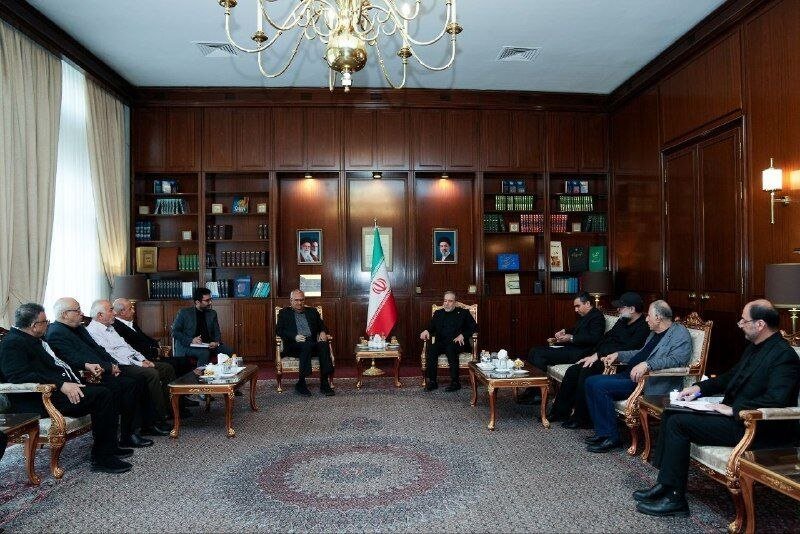
Between roughly 20:47 UTC and 22:25 UTC on 4 July 2026, the English-language Telegram feed of Iran's Tasnim News Agency ran seven posts in under two hours. None of them carried breaking-news structure. None of them led with a dateline, a casualty figure, or a named official's quote. They carried poetry, a mother's journey, an unnamed man "from among the people" whose grief was enough to make him the protagonist of a wire item, and an instruction — delivered in the second person — to weep standing up, because the departed was too great for seated tears.
That is the news story. Not a single event, but a sustained register: a state-aligned outlet converting a farewell ceremony into devotional copy, in English, on a platform where the audience is presumed to be the diaspora, the curious foreign correspondent, and the open-source analyst scraping Telegram for sentiment. The framing matters more than the facts Tasnim chooses to disclose, because the framing is the disclosure.
What Tasnim actually published
The thread opens at 20:47 UTC with a logistics note: new doors of the mosque have been opened because of the "enthusiastic presence of people" bidding farewell to a figure Tasnim tags with the hashtag #Badarqa_Aghai_Shahid_Iran and #must_rise. By 21:14 UTC the wire is profiling a mourner — neither a speaker nor a "well-known figure," the post insists, but a man whose sorrow alone was sufficient material for a news item. At 21:45 UTC a mother is featured, traveling miles with her baby for a last meeting. At 21:50 UTC a spokesperson named Attarzadeh, identified as the voice of the farewell and burial headquarters, announces that the ceremony will run through the night prayer and resume in the morning.
By 22:13 UTC the prose has slipped entirely out of the news register into something closer to elegy. By 22:21 UTC Tasnim is reflecting on the difficulty of writing news at all — "a frame that should not have been recorded, a pen that should not have written this news." By 22:25 UTC the instruction arrives directly: "You should cry while standing."
No named official outside Attarzadeh is quoted in the seven items. No specific casualty or operational detail appears. The English copy is smoothed into a register that few wire services in any language would consider publishable, and that is the point worth sitting with.
The counter-read: this is not journalism, it is liturgy
Western readers will default to a familiar frame: state media speaking in the voice of state media, propagandistic, therefore uninformative. That frame is not wrong, but it is shallow. Tasnim is not pretending to be Reuters. It is performing a different job. The English Telegram feed is not the primary product; the Persian wire and the Farsi-language broadcast are. What the English channel offers the regime is a mood export — a curated affect, aimed at the diaspora and the outside observer, intended to communicate that grief inside Iran is authentic, distributed, and bottom-up rather than choreographed.
The careful placement of "a man from among the people" in the 21:14 UTC post is the giveaway. The story exists to make the case that the mourners are not stage-managed. That case, made in English, on Telegram, where it can be screenshot and forwarded, is itself a piece of governance work. The Western wire dismissal — "Iranian state media says X" — flattens the technique and misses what it is actually doing.
What this tells us about the information order
The Tasnim Telegram channel is part of a broader pattern that has hardened across the past decade. State-aligned outlets in Iran, Russia, China and across the Gulf no longer compete on the same axis as Reuters or AFP. They do not try to be faster on confirmed facts. They compete on register — on providing an audience with a coherent emotional and moral frame in which events already make sense. The English-language feed is not aimed at people who want to know what happened. It is aimed at people who already know what happened and want to feel, in a sanctioned way, how to feel about it.
That shift has consequences for open-source analysts, sanctions investigators, and journalists who scrape these feeds. The traditional extraction problem — pull facts from propaganda, discard the framing — does not work when the framing is the entire payload. The relevant question is no longer "what did Tasnim report" but "what register is Tasnim performing, and for whom." Once you ask that, the seven posts in two hours stop looking like sloppy editing and start looking like a deliberate cadence: logistics, the ordinary mourner, the devoted mother, the official schedule, the elegy, the meta-reflection, the instruction. That is a sequence. It has a shape.
Stakes, and what we don't know
The short-term stakes are reputational and domestic. Inside Iran, a successfully performed national grief cements the standing of the departed and, by extension, of the apparatus that managed the farewell. Outside Iran, the English feed is a low-cost way to project a particular image of Iranian society — unified, devout, aggrieved on terms the regime approves.
The medium-term stakes are analytical. Every Western desk that treats Tasnim's English channel as a residual propaganda source to be ignored is conceding the register war by default. If the channel is shaping diaspora sentiment and shaping how open-source researchers describe "what Iranians believe," it is doing work whether or not anyone at a Western outlet cites it. The interesting move is to read the seven posts together as a single document, the way one would read a press release or a party communiqué, rather than as seven failed attempts at journalism.
What we don't know, and what the seven posts do not let us resolve: who exactly is in the mosque, how many, and whether the crowd is the size the ceremony's organisers claim. The source material is the organising committee's own feed, and on the questions that matter for any independent reconstruction of the day's events, it is silent. That silence is also a kind of answer.
Desk note: Monexus treats Tasnim's English Telegram channel as a primary source on how the Iranian state wishes to be perceived abroad. We do not treat it as a neutral factual wire. The seven posts above are cited in full as evidence of register, not as confirmation of crowd size, casualty figures, or operational detail, none of which the source contains.
Wire provenance
This editorial synthesis draws on the following public wire/social posts:
- https://t.me/tasnimnews_en
- https://t.me/tasnimnews_en/1421
- https://t.me/tasnimnews_en/1427
- https://t.me/tasnimnews_en/1433
- https://t.me/tasnimnews_en/1435