Tehran's farewell, and the silence around what comes next
Crowds fill a Tehran mosque for the farewell to a 'martyred leader' as named by Iranian state media. What the pageantry does not yet say is who fills the void, or on what terms.
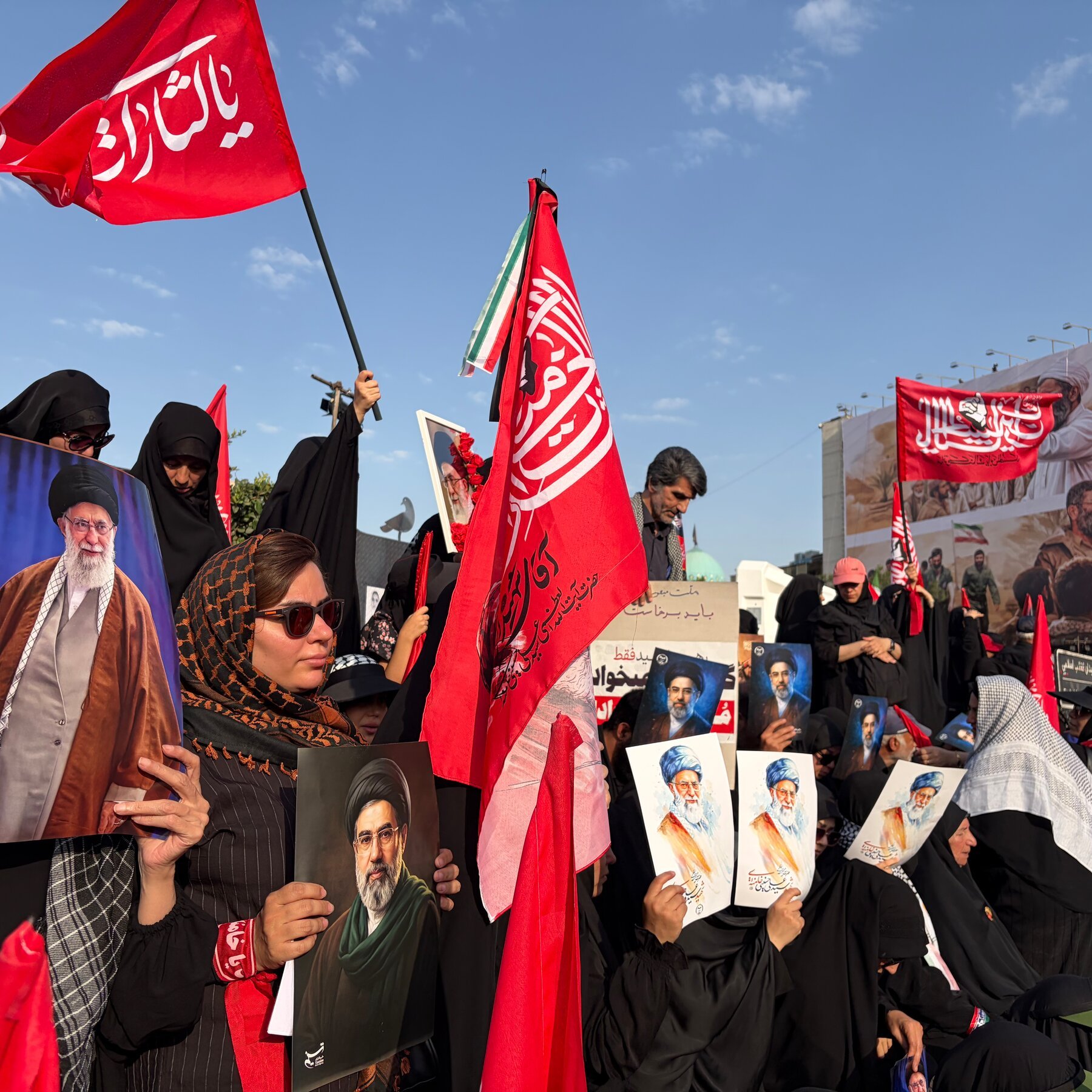
On the evening of 4 July 2026, the great mosque of central Tehran — Mosalla — was filling fast. State media framed it as a farewell to a "martyred leader of the Revolution," with mourners arriving in continuous waves from late afternoon into the night. The Tehran fire department's spokesperson told Tasnim News that the first night of the ceremony had passed without incident. By 21:22 UTC, the agency reported, the crowd had thickened still further.
For a system that has long understood ceremony as architecture, the staging is the news. What the visible choreography says, and what it pointedly does not, will shape Iran's internal trajectory in the weeks ahead.
What Tehran is showing
Iranian state outlets have converged on a single vocabulary: "martyred leader," "farewell ceremony," "the leader of the nation." The framing matters because it does work. It tells the public that the dead figure is being received as sacred, not merely senior — a placement well above ordinary politics, in the register of cause-and-blood that the Islamic Republic has used for four decades to anchor legitimacy in moments of institutional stress. The geographic choice of Mosalla, the capital's largest prayer complex, signals scale; the late-evening window signals reach. Tasnim also dispatched a softer register, profiling a grief-stricken mourner drawn from the crowd itself — a "man from among the people," neither speaker nor notable — as a way of demonstrating that the emotion was broad rather than orchestrated. The combined effect is to broadcast unity without yet conceding any specific succession outcome.
What the pageantry is not yet saying
State media's coverage has been meticulous about who came, how they came, and how many — and conspicuously thin on the substance of the handover. The Telegram feed reviewed here names no successor, no formal transfer of authority, no institutional venue for the next decision. That silence is itself a data point. When a movement's succession is settled behind closed doors, it tends to name the inheritor quickly and route grief through that continuity. When it is unsettled, the pageant absorbs attention instead. The flood of footage, eyewitness accounts and logistical reassurance from emergency services is filling a space that, for now, neither the establishment press nor its opponents inside Iran appear ready to define.
This pattern — ceremony expanding to fill the analytical vacuum — is the moment the foreign correspondents in Tehran tend to mistake for clarity. The wire tone abroad often reads the funeral choreography as resolution. The choreography is, more accurately, a substitute.
How the coverage is being managed
Three signals stand out from the official feed. First, the political framing: every Tasnim dispatch carries the hashtags #Badarqa_Aghai_Shahid and #must_rise, a deliberate pairing of martyrdom with continuity-of-mission that fuses the deceased into the order itself rather than the individual. Second, the safety framing: the fire-department interview was placed early and given prominence, a standard pre-emptive against the criticism that mass state ceremonies invite tragedy. Third, the sympathetic framing: by foregrounding an "ordinary" mourner and ambient crowd texture rather than only the VIP dais, state media is constructing an emotional commons and pre-empting the charge that grief is manufactured from the top. None of this is unique to Tehran — every modern state manages bereavement in public — but the layering is unusually disciplined, and the disciplines usually precede a contested decision the public is not yet ready to absorb.
The reading that holds, and the one that doesn't
The plausible reading is that Iranian institutions are buying time. The Revolutionary establishment needs a window in which grief, rather than factional arithmetic, is the dominant public mood — and in which rivalries within the security services and the clerical hierarchy can be resolved without the optic of a contest. The implausible reading is that the question is essentially settled and merely awaits announcement; the available evidence, drawn entirely from the official feed itself, supports the former more than the latter.
It is worth being honest about what is not visible. The foreign press has had limited access to Mosalla; the oppositional press inside Iran is dispersed and censored; diaspora outlets will fill the analytical gap with their own framings, some credible, some weaponised. A definitive institutional verdict on what follows the ceremony will not be discernible from a single Telegram channel, however disciplined its cadence. The honest stance is patient — and watchful for which name, if any, begins to recur alongside the funeral coverage in the days ahead.
Stakes
If the succession resolves quickly and to the satisfaction of the security services, Iran underwrites its recent posture — calibrated confrontation abroad, managed coercion at home — with renewed internal mandate. If it does not, the same choreography that is currently absorbing attention becomes the scaffolding for an intra-regime contest that the pageant was meant to defer. Either way, the foreign-policy conduct of the next quarter — the nuclear file, the regional corridor battles, the management of allied militias — is downstream of the question Tehran's state media is currently declining to answer.
Desk note: Monexus is reporting here from Iranian state outlets alone; Western wire access to the ceremony has been constrained, and Monexus has declined to import speculative framing from either the Iranian opposition or the foreign-commentary ecosystem until a second, independent source can be matched against Tasnim's timeline.
Sources
- Tasnim News — "The farewell ceremony for the martyred leader is being held without any incident" — 4 July 2026, 21:07 UTC — https://t.me/tasnimnews_en
- Tasnim News — "Tehran is ready to hold prayers for the leader of the nation" — 4 July 2026, 19:21 UTC — https://t.me/tasnimnews_en
- Tasnim News — "Tehran mosque is getting more crowded by the minute" — 4 July 2026, 20:10 UTC — https://t.me/tasnimnews_en
Wire provenance
This editorial synthesis draws on the following public wire/social posts:
- https://t.me/tasnimnews_en
- https://t.me/tasnimnews_en
- https://t.me/tasnimnews_en