Tehran's farewell and the choreography of state martyrdom
Tasnim's farewell coverage at Imam Khomeini's mosque reveals less about grief than about the curated performance the Islamic Republic has built around the death of its leaders.
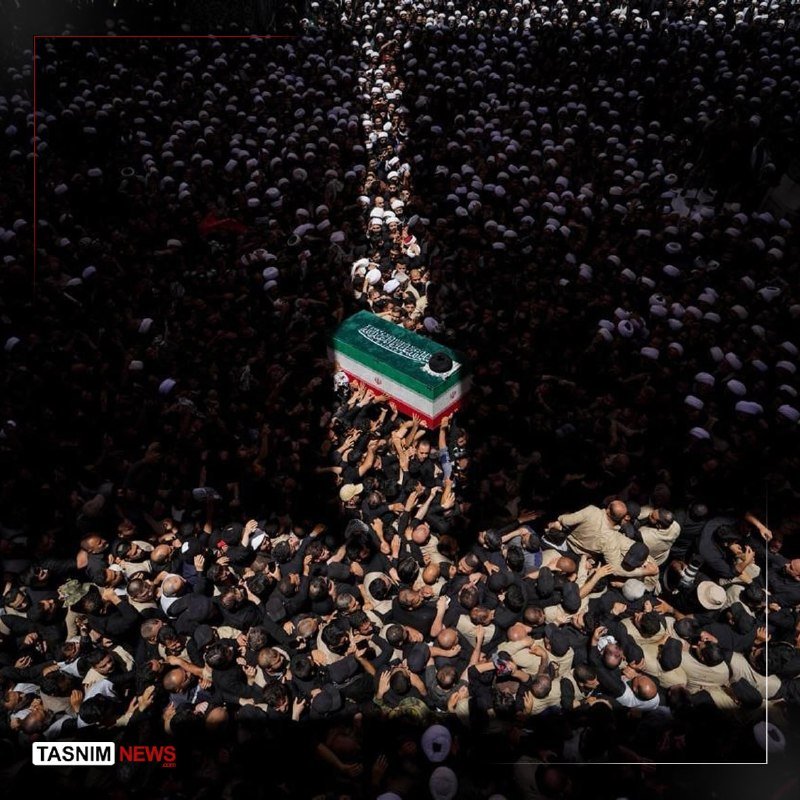
The script is unmistakable. On the afternoon of 4 July 2026, the English-language channel of Iran's Tasnim News Agency published five short video posts in a span of roughly thirty-two minutes — at 19:09, 19:23, and three more clustered at 19:41 UTC — each one a carefully framed vignette from a single farewell ceremony at Imam Khomeini's mosque in Tehran. The mourner is not named in the captions. The deceased is not named either. He is referred to, repeatedly and with consistent reverence, as "Mr. Martyr of Iran."
That phrase is the editorial payload of the entire feed. It is not a translation of how mourners actually speak; it is the line the state outlet has chosen to print, and it tells the reader almost everything worth knowing about who owns this moment.
The choreography of a curated farewell
Read the five posts in sequence and a production emerges. First comes a poem by Mohammad Biabani, published at 19:09 UTC, framing the night as one of "Hajran" — separation, longing — with imagery of a "terrible heat" breaking the call to prayer. Fourteen minutes later, at 19:23 UTC, Nariman Panahi recites the Karbala prayer at the same venue. By 19:41 UTC, three posts drop inside the same minute: Mohammad Ebrahimi Asl's lamentation, a second poetry reading by Mohammad Ali Biabani, and Haj Mohammad Hossein Poyanfar's lamentation invoking the idea that "the one we didn't die for, finally sacrificed his head for us."
That last phrase is the moral claim of the entire ceremony. It is a direct quotation from Tasnim's own caption, and it does two things at once: it absorbs the dead man into the Karbala paradigm of redemptive suffering, and it assigns to the living a duty of reciprocal sacrifice. The grammar is theological before it is political.
The pieces chosen for publication are not random. Lamentation, prayer, and verse alternate, and the order matters — grief, then intercession, then testimony. The repeated use of the honorific "Sir" in one of the captions ("Sir, you are the founder of this holy place") elevates the deceased from public official to foundational figure. Tasnim's editorial team has done its job: the mourners did the feeling, but the platform did the framing.
Who "Mr. Martyr of Iran" is, and why the indirection
The Tasnim captions withhold the deceased's name. Western readers reliant on the English feed will struggle to identify him from these posts alone. This is itself a journalistic choice. By circulating the honorific without the proper noun, the agency lets the title do the propaganda work while preserving a fig leaf of editorial distance — the speaker is a mourner, the journalist is only the cameraman.
The structural effect is familiar to anyone who has watched state-aligned outlets handle senior departures. Naming the dead invites scrutiny of his record; the title invites veneration of his office. The phrase "Mr. Martyr of Iran" is portable precisely because it can be slotted onto almost any senior figure the Republic has chosen to canonise, and because the English feed serves a foreign audience that the agency wants to feel the weight of the grief without necessarily being able to weigh the man.
The Karbala frame, plain
Iran's state media does not need to argue its case in secular language. It speaks in a register that fuses Shi'a memory with contemporary politics, and it does so in translations that preserve the register intact. The Karbala reference is not decorative. It situates the dead man inside the central moral drama of Shi'a Islam — the martyrdom of Hussein at Karbala — and asks the audience, in effect, to read the funeral as a continuation of that drama in modern Iranian form.
A reader unfamiliar with that grammar might dismiss the ceremony as another autocratic pageant. That reading is not wrong, but it is incomplete. The pageant works precisely because it draws on a vocabulary of grief that is older than the Republic, and that gives it a reach the regime's institutions could not manufacture from scratch. State media's job is to graft that vocabulary onto a current figure, and the Tasnim feed on 4 July performs that graft with notable economy.
What the sources do not settle
Five posts in half an hour is a heavy push, and a foreign editor should treat the volume as a signal rather than as confirmation. The English feed does not name the deceased, does not give a date of death, does not specify when the funeral took place, and does not link the ceremony to any official announcement from the Iranian government. The mourners are named; the central figure is not. The strongest claim in the feed — Poyanfar's line about sacrifice — is a caption paraphrase, not a verified transcript of what was said on the mosque floor.
A responsible read holds two facts together. The ceremony, as Tasnim filmed it, is real. The editorial product Tasnim has built around it is curated. Neither fact discredits the other; both are what a state-aligned outlet is for. The remaining question — who the man actually was, what he did, and what his death means for Iran's politics — cannot be settled from these posts alone, and this publication will return to it when primary reporting from non-aligned outlets is on the record.
Desk note: Monexus read Tasnim's English feed as a propaganda artefact first, and as a source on facts second. The five posts establish a mood and a vocabulary; they do not, on their own, establish a biography.
Wire provenance
This editorial synthesis draws on the following public wire/social posts:
- https://t.me/tasnimnews_en
- https://t.me/tasnimnews_en
- https://t.me/tasnimnews_en
- https://t.me/tasnimnews_en
- https://t.me/tasnimnews_en