The Tehran farewell the Western cameras didn't show
Western networks treated the Khamenei succession as a security file. Iranian state media showed something else: a choreographed popular mandate, broadcast as proof that the Islamic Republic outlasts the man who built it.
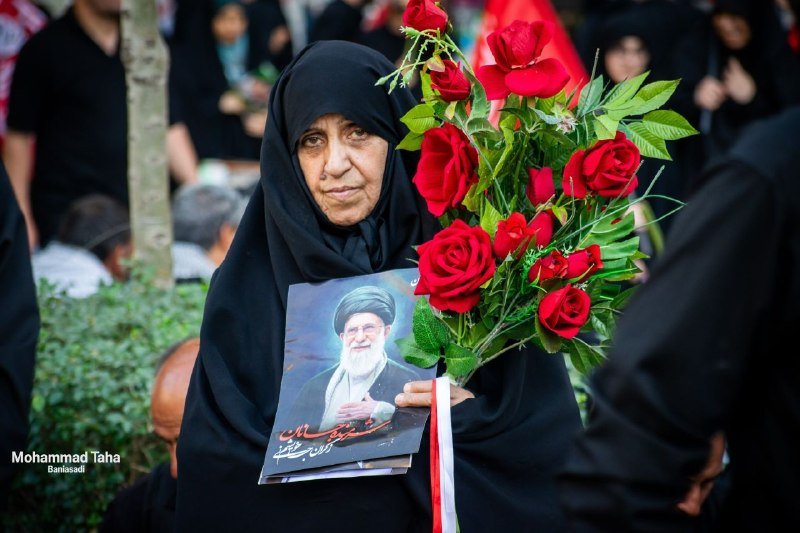
Crowds filled Tehran's Grand Mosalla on 4 July 2026 for the farewell to Ayatollah Seyyed Ali Khamenei. PressTV broadcast the ceremony live, framing Iran's Minister of Science, Research and Technology Hossein Simaee Sarraf as he helped serve meals to the mourners, and ran a separate feed of the pledge of allegiance to Ayatollah Seyyed Mojtaba Khamenei. Western newsrooms were thinner on the same images.
The scenes were choreographed for export, but the choreography is the news. The Islamic Republic's principal outside-the-bubble broadcaster sold an explicitly religious, explicitly dynastic transfer of power to an audience the Western press had already written off as inaccessible. The implicit argument: Iran's leadership transition is not the brittle, feared event the think-tank files predicted. It is a planned, televised ritual of mass consent.
What the cameras in Tehran actually showed
The PressTV footage makes two claims that travel further than either Western wire chose to package. First, scale: hundreds of thousands at the Grand Mosalla on a hot Tehran summer day, organised, fed and cleared on a single cycle. Second, continuity: the pledge-of-allegiance segment names Mojtaba Khamenei in his father's religious-political title, framing the successor less as an heir and more as a designated incumbent.
The point is not that Iranian state media is reliable by default. It plainly is not, particularly on operational military claims. The point is narrower and more useful: Western coverage of Iranian succession has defaulted to the framework of fragility — sanctions, succession uncertainty, regional isolation — while Iranian coverage of the same succession has defaulted to the framework of ritual continuity. Both framings are selective. Only one of them was on the airwaves all day.
The Western framing gap
The throughline in the BBC's, Reuters's and the Guardian's recent Iran coverage has been succession risk: who runs the country after the supreme leader, what the Revolutionary Guards will tolerate, whether the nuclear file reopens on hostile terms. That is a legitimate lens. It is not, however, the only lens, and the editorial logic of leading every Iran item with it has a quiet cost. It treats the regime's religious and political machinery as backdrop — a stage on which the real story, succession infighting, plays out — when for tens of millions of Iranian viewers that machinery is the story.
This is the media-framing point in unvarnished form. When a Western reader sees Iran, the visual kit is sanctions, hidden centrifuges, and satellite dishes taped to walls. When an Iranian viewer sees the same week, the visual kit is the Grand Mosalla, Sarraf serving tea, the son taking the oath. Both kits exist. Western desks have spent a decade choosing one of them, then marveling that Iranian state media reaches the audiences it does.
The structural read
Press coverage of a theocratic succession is structurally a question about institutional durability. The Mosalla ceremony suggests the durability question has been answered, at least for now, in the affirmative, and answered with a religious-affective mobilisation that Western secular reporting has no clean vocabulary for. The crowds at the farewell are not, in this reading, a stage-managed crowd. They are the answer the regime has been working toward for thirty years: a popular mandate large enough to make any external attempt to destabilise the succession look illegitimate.
That is the uncomfortable corollary for Western policy desks that have treated Iran's isolation as a near-terminal condition. The Islamic Republic's external isolation and its domestic legitimacy are related but not identical; they can move in opposite directions over a single news cycle. The 4 July coverage is a vivid case in point.
What remains genuinely uncertain
The footage the Western networks did not show is also evidence. PressTV shows the choreographed. It does not show the unchoreographed — the working-class Tehran neighbourhoods that were quietly absent from the broadcast, the diaspora opposition that organises outside its frame, the Bazaaris whose price signals tell a different story than the ceremonial one. The sources published on 4 July do not quantify the silent share; they only describe the loud one.
What this publication has not been able to corroborate: independent confirmation of the turnout figures, the role of coerced attendance in producing them, or whether Mojtaba Khamenei's pledge includes the full constitutional powers of his father. Iranian state media has an obvious interest in eliding each of those questions, and Western networks have an obvious interest in framing the successor's rise without addressing them on air. The truth will sit somewhere the cameras were not pointed.
Desk note: Monexus framed this through the lens of which audiences see which Iran — a question about media infrastructure and what survives translation between coverage ecosystems — rather than as a pure succession-risk analysis, which is the angle Western wires have run into the ground.
Wire provenance
This editorial synthesis draws on the following public wire/social posts:
- https://t.me/presstv/2861
- https://t.me/presstv/2860
- https://t.me/presstv/2858