Tehran's Mosalla fills as Iran buries its 'martyred leader' — and the cameras do the rest
Crowds at Tehran's Mosalla mark a farewell ceremony the regime is choreographing for an audience far beyond Iran's borders. What the mourning tells us, and what it leaves out.
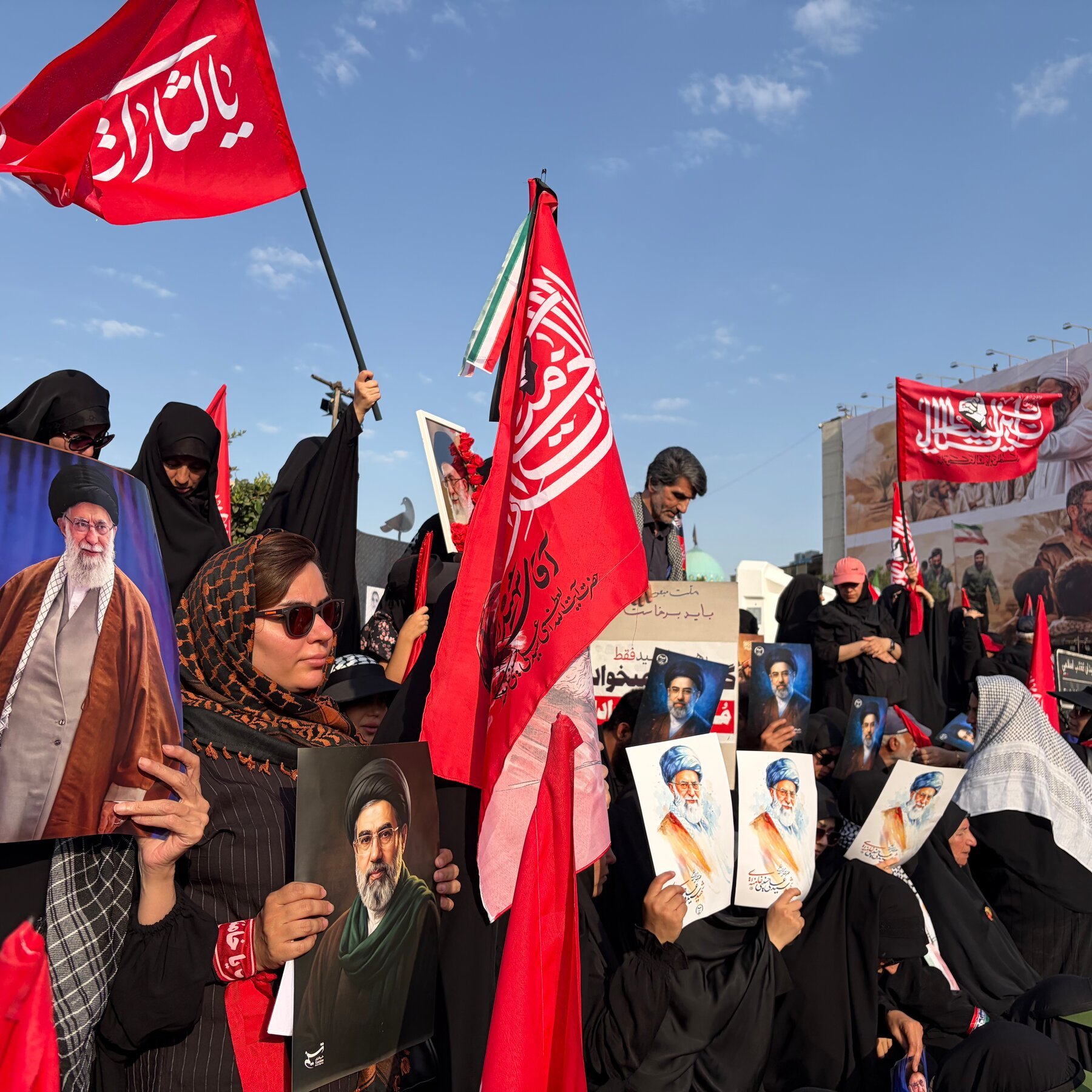
By the time the afternoon light over central Tehran had begun to soften, the Mosalla — the great prayer hall built to host assemblies the size of a small city — was, by every Iranian state account on 4 July 2026, full to the point of standing-room only. Crowds continued to thicken past 20:11 UTC, the English-language @Middle_East_Spectator account reporting from the hall, while the official @TasnimNews feed tracked the same arc minute by minute: the space prepared for prayers ("Tehran is ready to hold prayers for the leader of the nation"), the faithful arriving, the chests struck in mourning, the hands clapped, the hashtags deployed. The framing is uniform: a martyr, a nation, a send-off.
A farewell ceremony is, by definition, a stage-managed event — but the staging here is doing more than grief-work. It is a piece of political theatre being performed for an audience that includes the Iranian street, the country's fractious rivals, and a regional order being recalibrated in real time. The cameras are not incidental.
What the state cameras are showing
Iranian state media is broadcasting a single, disciplined image: a sea of mourners inside the Mosalla, with no space left for "even a needle," as one Tasnim dispatch put it at 18:14 UTC on 4 July 2026. The recurring motifs across the Tasnim feed — prayers at 19:06 UTC, mourners' chests at 18:52 UTC, the clapping of hands at 18:51 UTC — are less reportage than liturgy. The hashtags pinned to every post — #Badarqa_Aghai_Shahid_Iran, #must_rise — are not commentary on the event; they are the event's instructions for how to read it. Even the spelling of "Mosli" in early Tasnim captions (later corrected to Mosalla) is a reminder that on a day like this, the platform itself is doing editorial work.
The point of the production is not subtle. A leadership succession, or the consolidation of one, requires visible mass legitimacy, and visible mass legitimacy in 2026 is a function of how many phone cameras, livestreams and Telegram forwards can be made to point in the same direction at the same hour. The Mosalla is filling on a clock; the feeds are running on the same clock.
What the cameras are pointed away from
The choreography is also an act of concealment — not of the death itself, which is universally acknowledged, but of the questions the death provokes. Iranian state outlets do not on this feed name the cause, the date of death, or the specific office being vacated and refilled. The Telegram thread references a "martyred leader of the Revolution" and a "leader of the nation" interchangeably; it does not specify which institutional seat is in transition, who the presumed successor is, or what the line of command looks like in the days between event and inauguration. Western wire reporting on the political mechanics is not present in this thread; the absence is itself the message.
That selective framing is the structural point. Coverage that defers to official language tends to inherit official silences. The state cameras show grief in long, slow takes; they do not show the bazaar, the universities, or the periphery. For readers relying on Iranian state media alone, the country on 4 July 2026 looks like the Mosalla, and only the Mosalla.
The regional audience
Outside Iran, the ceremony is being received as a different kind of signal — one about posture, cohesion and resolve. The neighbours with the most to lose from a misread, Israel and the Gulf states, will be parsing the footage for any glimpse of who is on the podium beside the family, who is missing, and which IRGC commanders are being given camera-time. Western intelligence services will be doing the same, only with better optics.
The deeper risk is that a leaderless interval in Tehran, however brief, is exactly the kind of window in which regional escalation becomes thinkable — through proxies, through a miscalculated strike, through a provocation designed to test the new command. The Mosalla images are intended to close that window before it opens, by depicting a polity already consolidated around a successor narrative. Whether the depiction and the reality match is the question the next forty-eight hours will answer.
What we are watching
There is a temptation, on a day of tightly produced mourning, to read either too much or too little into the images. The honest read is that we are watching a regime performing legitimacy at scale, on a platform it controls, in a language it has refined over four decades. The performance does not need to be believed inside the Mosalla to be useful outside it. Its function is to make a contested succession look like a coronation, and to do so before any rival framing can take hold.
The unresolved questions are the ones the cameras are not pointed at: how the office of the leader is constituted under Iranian law in the days ahead, who commands the security services during the interregnum, and whether the regional actors who have spent years calibrating their posture to a known counterpart will accept the calibration being silently redrawn. Until those questions are answered in more than hashtags, the Mosalla footage is best read as a preface, not a conclusion.
Desk note: This piece leans on Iranian state-media framing because that is what the available wire is broadcasting; we have flagged rather than reproduced the silences around the cause of death and the succession procedure. A fuller picture will require Western and Gulf-based reporting in the hours ahead.
Wire provenance
This editorial synthesis draws on the following public wire/social posts:
- https://t.me/Middle_East_Spectator
- https://t.me/tasnimnews_en
- https://t.me/tasnimnews_en
- https://t.me/tasnimnews_en
- https://t.me/tasnimnews_en