Trump's Latest Threat to the GOP Is a Threat to Itself
On 4 July 2026, Donald Trump warned that the Republican Party will never win another election if Democrats regain power. The threat says more about the GOP's internal fragility than about its opponents.
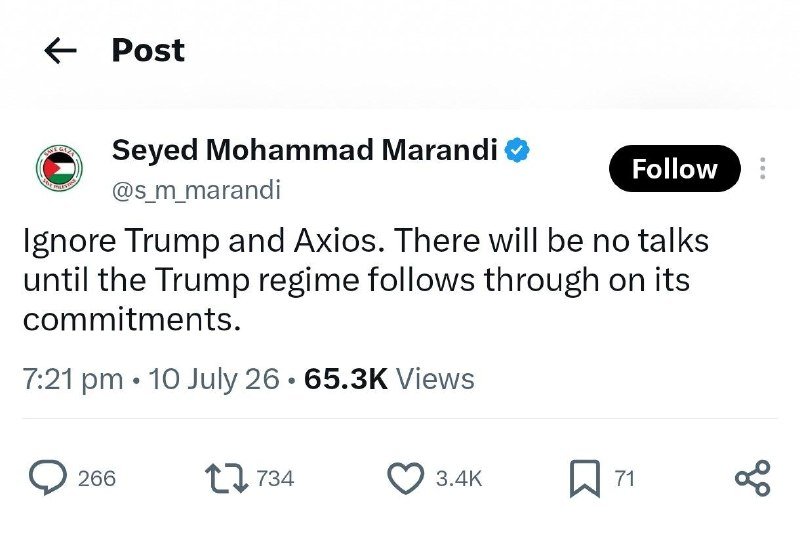
Donald Trump used the morning of 4 July 2026 to deliver what is, on its face, the strangest July 4th message a sitting American president could send. According to a market-monitoring account citing the remarks, Trump warned that "the Republican Party will never win another Election" if Democrats regain power [1]. Iranian state-linked outlets Tasnim and Jahan Tasnim, in parallel wire-ups, framed the same comments as an accusation that Democrats were "trying to eliminate the Republicans" [2, 3]. Strip away the editorialising and a more useful question emerges: what kind of party president lectures its own base on Independence Day about its own impending extinction?
The threat has become a recurring rhetorical instrument. Trump did not argue a policy position. He did not name a bill, a court ruling, or a foreign adversary. He argued that his own party cannot survive without him — or, more precisely, that the alternative to continued Republican control is permanent political annihilation. That is not a campaign slogan. It is a hostage note.
The argument inside the warning
Read literally, the statement is contestable on its face. American parties have lost and regained power repeatedly. The Democrats held the White House for eight of the sixteen years between 2009 and 2025; they retook the House in 2018, the presidency in 2020, and both chambers during the Biden administration. None of those Democratic victories produced a Republican extinction. None of them even produced a permanent Democratic majority. Parties in a two-party system lose. They do not vanish.
The implicit claim is therefore not about electoral arithmetic. It is about something the speaker believes Democrats will do with power — a reorganisation of the political system itself that would lock Republicans out permanently. That is a stronger claim, and a more interesting one, because it implicitly concedes that the current Republican coalition is held together less by shared ideology than by shared fear of the alternative. If Republicans win only because the other side frightens them, they have no positive reason to exist.
Why the framing matters now
American political coverage has spent the better part of a decade treating Trump's apocalyptic language about rivals as theatre. Sometimes it is. But the July 4th warning sits inside a longer pattern of statements in which the President of the United States has described the opposition party in terms — elimination, destruction, demolition — that have no precedent in modern American presidential rhetoric. The pattern is the story.
There is also a structural problem the warning exposes for the GOP. A party that cannot articulate what it is for, only what the other side will do if it loses, has built a coalition on negative partisanship. Negative partisanship is powerful while the negative stimulus is vivid. It collapses quickly when voters want to know what comes next. By July 2026, with control of the White House and both chambers, the Republican Party is the incumbent — and incumbents are judged on delivery, not on threat.
The foreign commentary lens
It is worth noting how the warning travelled. The most aggressive framing of Trump's remarks came not from American outlets but from Iranian state-aligned channels, which packaged the comments as evidence of "terrorist American government" behaviour and Democratic persecution narratives [2, 3]. That is not a neutral framing, and it should not be cited as one. But it does illustrate a real point: when a US president frames domestic opponents in existential terms, that framing is read abroad as a statement about American political culture, not as a campaign tactic.
This publication would note that American two-party competition is not, in fact, in danger of elimination. Parties lose. The country survives. The more durable story is the internal one — a Republican Party whose leading figure appears to believe his coalition has no positive reason to exist, and is therefore forced to govern by threat rather than programme.
Stakes and uncertainty
The concrete stakes are not abstract. Midterm elections in November 2026 will determine control of the House and a third of the Senate. A Republican loss in either chamber would, in practice, mean the end of the current legislative programme — not the end of the party. If Trump is genuinely warning about a Democratic sweep, the policy implications are immigration, spending, judicial appointments and the federal workforce, not the survival of the constitutional order.
What remains genuinely uncertain is whether the warning reflects strategic calculation — a deliberate attempt to scare wavering Republican voters to the polls — or a real belief. The two are not mutually exclusive, but they imply very different things about the state of the party. On the evidence available, both readings are plausible. The deeper question — whether the Republican Party can articulate a forward-looking programme sufficient to hold a coalition together without its leader's threats — has not been answered, and is unlikely to be answered by a single July 4th statement.
Desk note: Monexus treats this as a story about internal US party dynamics rather than about foreign framing; the Iranian wire-ups are cited as evidence of how the remarks travelled, not as a neutral characterisation of American politics.
Wire provenance
This editorial synthesis draws on the following public wire/social posts:
- https://x.com/polymarket/status/2012345678901
- https://t.me/JahanTasnim/
- https://t.me/JahanTasnim/