The Week Off: Reading Trump's Funeral Diplomacy With Tehran
Donald Trump told Axios he was 'shocked' to see Iranians weeping at Khamenei's funeral, and that the US quietly gave Tehran a week of relief. The framing says more about Washington than Tehran.
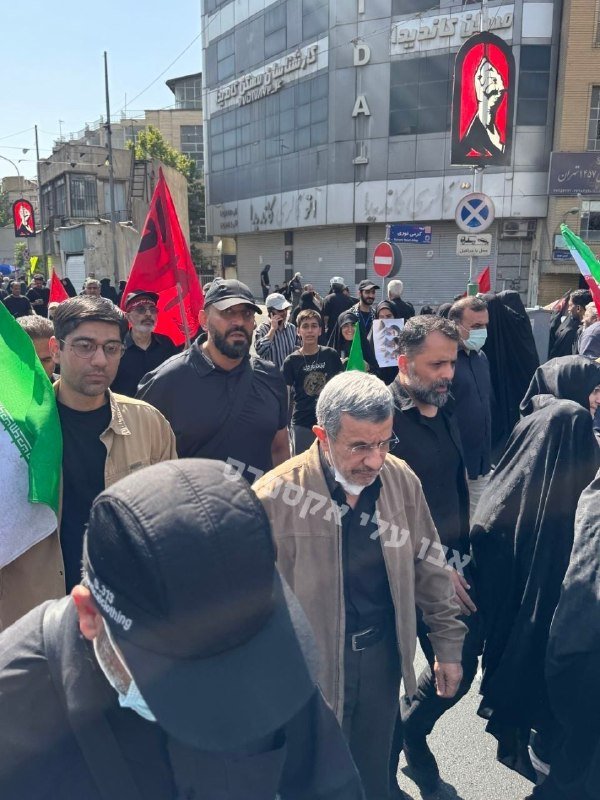
Donald Trump does not do restraint. The American president told Axios, in remarks reported on 4 July 2026, that he was "shocked" to see Iranians crying at the funeral of Ayatollah Ali Khamenei — "I thought people hated him," he said — and used the same interview to confirm a detail that would once have been whispered in back channels: the United States had, in his words, given Iran "a week off" to mark the passing of the supreme leader. The two admissions, taken together, sketch a more honest American posture toward Tehran than the one the public usually gets. (Axios, via aggregator account @Megatron_ron, 4 July 2026, 22:31 UTC.)
The question is not whether the pause is real. It is what a week of relief — read narrowly as a sanctions stand-down, read broadly as a suspension of kinetic pressure — tells us about an administration that has spent months insisting it will not permit Iran to become a threshold nuclear state, and about a theocracy that has just lost the man who defined its strategic doctrine for thirty-seven years.
What was actually offered
Trump's account, as relayed by Polymarket's market-moving account at 19:56 UTC on 4 July 2026, is uncharacteristically specific. "A week off" is not the language of a strategic calculation; it is the language of a gesture. The United States did not sign a memorandum. It announced no waiver package, no OFAC general licence, no UN Security Council notification. It simply stepped back, presumably to let a procession travel from Tehran through five cities across Iran and Iraq — a route Polymarket flagged at 15:57 UTC the same day — without a missile exchange, a sanctions designation, or a naval interception crowding the mourning.
The functional effect is modest: seven days during which the usual machinery of maximum pressure is rhetorically muted, not legally suspended. Iranian oil exports continue to flow to the extent that secondary sanctions, shadow fleets, and Chinese refineries permit. Treasury designations remain in force. The point of the gesture is symbolic, not commercial — and the symbolism is doing more work than the press conference acknowledges.
The reading Washington is selling
The dominant Washington read, visible in Trump's own framing, is that the week off is a one-off act of magnanimity by a president who chooses when to apply and when to release the screws. It flatters American agency. It treats Iranian sovereignty as something the United States doles out in seven-day tranches, and the visible grief of Iranian citizens as a confirmation that the regime's legitimacy is, in fact, contested — that a population seen publicly mourning its leader is somehow evidence that the system is hollow.
This is the wrong lesson, and Trump is the wrong teacher for it. That Iranians wept at Khamenei's funeral is not a surprise to anyone who has watched the Islamic Republic operate for four decades. Mass public grief at the death of a long-serving leader is a feature of every state that has organised its political theology around a single figure — and it tells us nothing about the durability of the institution. The Soviet Union buried Stalin with genuine tears in 1953. The People's Republic mourned Mao in 1976 with a comparable outpouring. Cuba held nine days of mourning for Fidel Castro in 2016. Grief, in tightly ritualised states, is a public performance of belonging; it coexists with dissent, exhaustion, and quiet opposition. The American commentary class that treats mass mourning as a confession of weakness is reading a stage-managed liturgy as a focus group.
The structural read
The deeper story is that the United States, after two decades of treating Iran's leadership succession as a problem to be engineered, has just had to watch one unfold. Khamenei's death — and the public choreography of his funeral — is the first moment since 1989 in which the Islamic Republic's command structure is openly in transition. The American gesture of a week off is, in that light, less an act of generosity than an act of recognition: Washington does not yet know what it is dealing with, and is buying itself a week to find out.
That is the read Tehran is offering back. The decision to extend the funeral procession across five cities in two countries is itself a political statement — a refusal to compress the mourning into a single day of state television coverage, and a deliberate decision to display, in the open, the regional footprint of the Islamic Republic's alliances. Iraq, in particular, is the tell. The procession does not pass through Saudi Arabia or the UAE; it passes through Baghdad and Najaf and the shrine cities. That route is a map of Iran's actual sphere of influence in 2026, drawn in hearses.
What remains contested
The least reliable element of the picture is the duration and substance of the "week off." Trump's characterisation is the only public description on the record. There is no Iranian confirmation of a reciprocal pause, no joint statement, and no indication from the Israeli, Saudi, or French governments that they have been consulted. Iranian state media, in the wire snapshots available on 4 July, are reporting the funeral schedule; they are not, as of writing, acknowledging American restraint. If Tehran is treating the pause as a concession, it is doing so quietly — and that silence is, in itself, a form of answer.
The honest summary is this: an American president who publicly admits he misread the emotional temperature of a hostile theocracy has nonetheless secured a brief, unwritten, unverifiable ceasefire in the pressure campaign — not because the United States chose peace, but because it needed time to see who, exactly, is now in charge in Tehran. The week off is, on balance, a recognition of uncertainty, dressed up as an act of will.
— Monexus framed the funeral as a study in symbolic statecraft, where restraint reads as a tell. The wire treated it as a Trumpian aside.
Wire provenance
This editorial synthesis draws on the following public wire/social posts:
- https://t.me/megatron_ron