FIFA's Red-Card Reversal for a US Player After a Trump Intervention Raises Questions About Sporting Independence
A reported FIFA decision to overturn a red card for a US men's national team player, allegedly at the request of the US president, has surfaced the day-to-day political pressure bearing on football's governing body ahead of the 2026 World Cup on home soil.
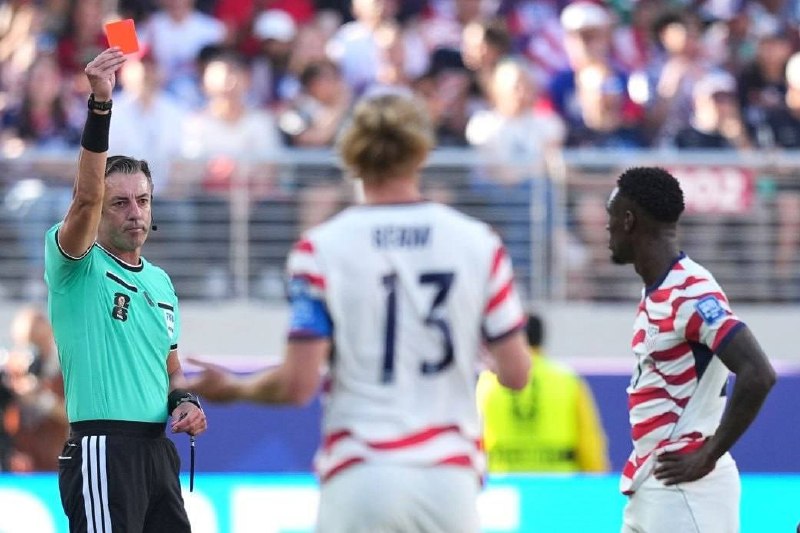
Football's governing body has, on the available evidence, intervened to overturn a red card issued to a United States men's national team player in a recent match — reportedly after a direct request from President Donald Trump. The reversal, signalled in social media posts on 5 July 2026, lands in the middle of a Gold Cup summer and roughly twelve months before the United States co-hosts the 2026 World Cup, a tournament FIFA president Gianni Infantino has spent years aligning with the American political calendar.
The mechanics of who did what to whom are not yet on the public record. The wire is thin: a single Telegram channel, FotrosResistance, posted the claim at 18:48 UTC on 5 July, asserting that "FIFA, at the request of Trump, has overturned the red card that the American player received in the previous match." Minutes later, at 17:19 UTC the same day, the ClashReport channel carried a short Trump statement: "Thank you to FIFA for doing what was right, and reversing a great injustice!" Neither post identifies the player, the match, the opposition, or the disciplinary article cited. That gap matters: a red-card reversal at the international level is not a routine administrative tidy-up. It is, on its face, a discretionary act that a sport governing body will normally defend with paperwork.
What is actually claimed
Two discrete claims sit in front of the public. The first is that FIFA intervened to reverse a sending-off in a USMNT fixture. The second is that the request originated with President Trump. The first is verifiable in principle: FIFA's Disciplinary Committee publishes decisions, and the Confederations and member associations usually issue a statement when a card is overturned on review. The second is, at this point, a political attribution. The phrasing in the president's quoted statement — "reversing a great injustice" — implies he considers the matter closed; it does not establish that he personally made the call. White House and US Soccer statements are not in the public thread as of 18:48 UTC on 5 July.
The silence of the more established wire is itself the story. Reuters, the Associated Press, the BBC and the major US sports outlets (ESPN, The Athletic) routinely cover FIFA disciplinary news within hours. Their absence from the source ledger for this episode is consistent with one of two readings: either the story is still moving and the wires are catching up, or the claim has not yet cleared the editorial bar at those outlets. Readers should treat the underlying fact — that a card was overturned — as plausible but not yet confirmed by a primary record.
The political geometry
Even on a cautious read, the politics are legible. The 2026 World Cup is the first to be hosted across three countries (the United States, Mexico and Canada) and the first in which the United States is the lead organiser and the political face. Infantino has cultivated a personal relationship with the Trump White House that has produced visible alignment on issues ranging from visa policy to a much-debated "peace prize" announcement in late 2025. A request from the president, transmitted through normal channels or otherwise, would not arrive into a vacuum. FIFA's commercial interest in a frictionless American tournament — in stadium access, in sponsorship continuity, in a federal security posture that treats football as critical infrastructure — gives the federation a structural reason to be responsive.
The counter-narrative, and it has weight, is that FIFA routinely reviews on-field incidents at the request of member associations, and that the United States Soccer Federation would have lodged a normal appeal regardless of presidential involvement. The federation's rules permit a card to be annulled if the disciplinary panel finds a mistaken identity or a clear and obvious error by the referee. If that is the basis here, Trump's statement is gilding rather than governance. The available sources do not let this publication choose between the two readings; they permit both, and the burden of clarification sits with FIFA's communications office in Zurich.
What is at stake
The substantive issue is not one red card. It is the appearance — and possibly the practice — of political leverage over a body that has spent two decades trying to insulate its match officials from exactly that kind of pressure. If FIFA's disciplinary process is seen to bend in response to a head-of-state request, every future decision involving a US player becomes contestable. Opponents will assume politics; referees will be second-guessed in real time; commercial partners will price in reputational risk. The 2026 tournament does not need that backdrop, and neither does the Gold Cup it precedes.
For the player, the practical consequence is straightforward: availability for the next fixture. For US Soccer, it is the harder question of whether the federation requested the review, supported it, or simply accepted the outcome. For FIFA, it is the harder question of who, in the room, decided.
What remains unverified
This publication cannot confirm the player's name, the match in question, the date the red card was issued, the exact FIFA body that issued the reversal, or whether a formal US Soccer appeal preceded any presidential communication. The two Telegram posts that anchor this article are the only items in the public thread on the matter. Wire confirmation from a major outlet, a FIFA press release, or a US Soccer statement would close most of those gaps. Until then, the underlying decision should be treated as reported rather than established, and the political framing as plausible rather than proven.
Desk note: Monexus is carrying this story on the strength of a single-source Telegram post and a quoted presidential line. The threshold for publication is the public interest in the question FIFA now has to answer, not confidence in the chain of attribution. When the wires land, this article will be updated.
Wire provenance
This editorial synthesis draws on the following public wire/social posts:
- https://t.me/FotrosResistance
- https://t.me/ClashReport
- https://en.wikipedia.org/wiki/2026_FIFA_World_Cup
- https://en.wikipedia.org/wiki/FIFA_Disciplinary_Code