Iran's quiet Khuzestan tribute, and the choreography of a state funeral
State-aligned coverage of coffins travelling 800km from Ahvaz to Tehran offers a window onto how Iran's ruling order stages grief at scale — and what the staging leaves out.
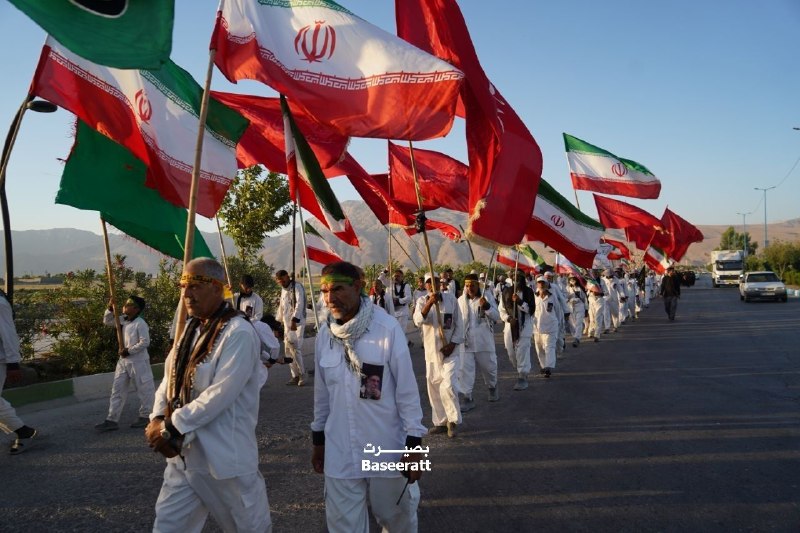
On 5 July 2026, Iran's state-aligned outlets carried a single, coordinated message across multiple Telegram channels: coffins wrapped in Khuzestani shrouds had been travelling the roughly 800 kilometres from Ahvaz to Tehran for a farewell ceremony at a central mosque. Posts branded with the hashtag #Badarqa_Aghai_Shahid_Iran and the rallying cry #must_rise appeared within minutes of each other, each piece of footage framed as one continuous procession. The choreography is visible in the timestamps: at 16:41 UTC, Tasnim reports shrouds en route; at 17:36 UTC, Tasnim shows the illuminated Tehran mosque receiving the body; at 17:48 UTC, Tasnim poses the question of what a 800-kilometre journey is for. The framework is unmistakable — regional loyalty, religious staging, and a capital-city farewell rolled into a single narrative arc.
The point of the pageantry is not the destination. It is the demonstration that mourning can be administered from above, and that the provinces consent to it.
The route itself is the story
The 800-kilometre corridor between Ahvaz and Tehran is one of the most politically charged stretches of road in Iran. Khuzestan is the country's oil heartland — home to the Arab-speaking minority, the site of the 1979 revolution's most combustible street battles, and the population whose grievances over water, air, and employment have repeatedly forced the central government onto the defensive. When state-aligned media treats a body or a symbol of sacrifice as travelling from Ahvaz to Tehran, it is repeating a long-practised formula: the periphery confers legitimacy on the centre.
The tagged hashtag accompanying Tasnim's coverage — #Badarqa_Aghai_Shahid_Iran — frames the dead as martyrs of the Iranian state ("shahid" meaning martyr), a status that carries both religious and political weight in the Islamic Republic's vocabulary. Posts refer to the figure honoured with the honorific "Aghai," signalling formal respect. Coverage of a state funeral is, by design, never neutral about who deserves it.
A unified push across channels
What is unusual is the density of the rollout. Three posts in roughly seventy minutes from a single outlet, all carrying footage and identical hashtag framing, is consistent with a coordinated communications plan rather than organic news. The order matters: first the journey, then the arrival, then the question that converts the viewer into an interpreter.
The final Tasnim item, captioned with the rhetorical question "What is the purpose of traveling 800 km from Ahvaz to Tehran?", does the heaviest lift. It invites the audience to complete the meaning themselves. In the grammar of state-aligned coverage, the answer is meant to be obvious: pilgrimage, loyalty, sacrifice. The viewer is positioned not as a spectator but as a participant in a shared act of recognition. The hash-flag #must_rise reinforces a mobilisation register that is as much political as devotional.
The frame that the staging leaves out
Khuzestan has been the site of recurring protest and severe repression — most notably during the 2019 demonstrations that swept the province after a fuel-price decision, and again during the broader 2022 unrest that followed the death in custody of Mahsa Amini. None of those episodes have been absent from Iranian provinces' political memory, even if they have been expunged from official broadcast.
Reporting on a state funeral is thus never only a question of honouring the dead. It is a question of whose grief is permitted, and on whose terms. The 800-kilometre journey the cameras record is also a reminder that travel in Iran flows through checkpoints, that mourning can be granted or withheld, and that the symbols the capital chooses to illuminate are not neutral. Where there are coffins draped in Khuzestani cloth at a central Tehran mosque, there is, by omission, a quieter set of coffins the same cameras do not visit.
What the coverage tells us
For outside readers, the useful takeaway is procedural rather than sentimental. When Iranian state media array multiple platforms around a single iconography in a tight window, with rhetorical questions meant to be answered by the audience, they are running a familiar operation: manufacture unity through ceremony, and use the provinces as the path that legitimises the route.
The information the sources do not disclose is significant. The thread context includes no identification of the deceased, no institutional affiliation, no cause of death, no biographical detail beyond the honorific — none of which is incidental. State funerals whose subjects are unnamed in English-language coverage tend to be the ones whose politics is most local. The choreography of grief is doing the talking.
Monexus frames this as a study in how Iranian state-aligned media choreographs regional loyalty, not as a profile of the deceased. Where Western wires are silent, Tasnim's English-language wire is the primary record — read with that asymmetry in mind.
Wire provenance
This editorial synthesis draws on the following public wire/social posts:
- https://t.me/tasnimnews_en
- https://t.me/tasnimnews_en
- https://t.me/tasnimnews_en
- https://en.wikipedia.org/wiki/Khuzestan_province