Iran's resistance message goes on tour — the western press doesn't get a ticket
Tehran stages memorials in Berlin and across the diaspora while a coordinated tribute rolls across state media — and the silence in the western press tells its own story.
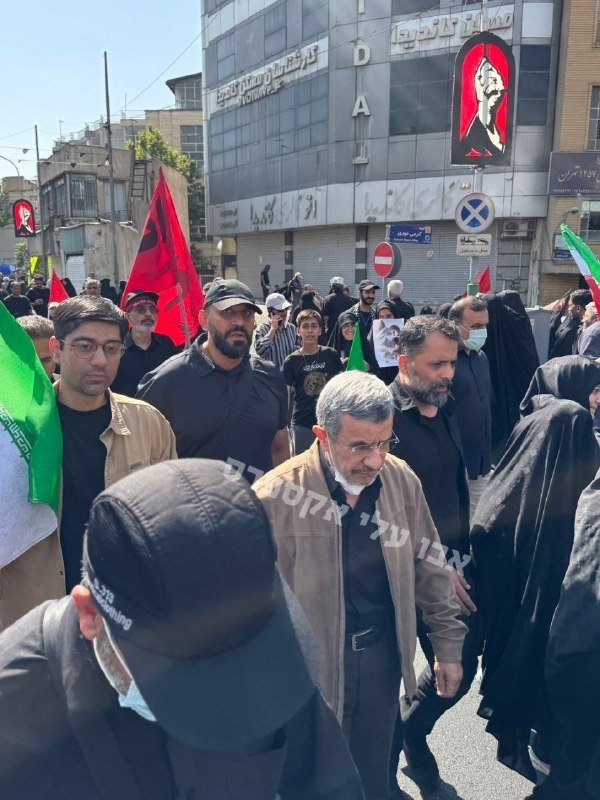
The machinery is working. On 5 July 2026, PressTV's English-language feed carried a rolling tribute: a Berlin memorial for Ayatollah Seyyed Ali Khamenei, framed as the "martyred Leader of the Islamic Revolution"; a statement from analyst Calla Walsh declaring his message of resistance "truly universal"; a packaged biographical segment on a leader who, in the network's own framing, "stood firm for his principles and gave his life for them." The hashtags, the visuals, the cadence — they were produced to a template that has been refined over four decades of Iranian state broadcasting. What is unusual is the venue on this particular day: not Tehran, but Berlin.
That geography matters. A diaspora memorial held in a Nato capital, and covered in English as if for a global audience, is a soft-power staging that sits awkwardly beside the wire-service reporting on Iran's actual regional posture. The two registers — Tehran's curated image-management and the western press's near-total non-coverage of this specific commemorative cycle — tell a more honest story about information asymmetry than either does alone.
The wire silence, and what it costs
Western wire services have spent the past several weeks running familiar frames on Iran: nuclear-file brinkmanship, proxy calibration across the Levant, sanctions enforcement theatre, the occasional IAEA inspection yarn. None of those threads mentions a memorial in Berlin, or a Walsh-byline tribute on Iranian state television, or the production choices — grief aesthetic, slow zoom, orchestral underscore — that accompany them. The omissions are not accidental. The events being omitted are politically inconvenient to a coverage consensus that has, for years, treated the Islamic Republic as a unitary object of analysis rather than as a regime that also runs a sophisticated multilingual media operation aimed at sympathetic western audiences.
What that consensus misses is straightforward. When a state-aligned outlet can place its commemorative programming in front of an English-speaking analyst willing to declare a martyred-leader message "universal," and the only countervailing coverage is silence, the information vacuum fills itself. Diaspora communities in Europe — Iranian, but also Iraqi, Lebanese, Yemeni — see one version of the day. Western general-readership audiences see nothing.
The counter-narrative the consensus cannot say out loud
The case for engaging with the commemorative frame on its own terms is not endorsement. It is recognition that the framing exists, that it is being deliberately exported, and that ignoring it does not make it stop. Three structural points deserve airtime the consensus tends to skip.
First, Iranian state media's English offerings have improved markedly in production value over the past five years. PressTV's on-screen graphics, English-language captions, and interview pacing now compete credibly with mid-tier cable news. That is a measurable shift, not a stylistic preference. Audiences that would once have written off the channel as crude Kremlin-style agitprop now find themselves, against expectation, watching a competent broadcast product.
Second, the diaspora-memorial format is a deliberate choice. Holding a remembrance in Berlin rather than Tehran creates a specific audience geometry: European officials, journalists on assignment, Iranian expatriates, and sympathetic Arab-world observers can all credibly attend or amplify the coverage without crossing into Iranian territory. It is a piece of staged normativity — a claim, by visual evidence, that the regime's narrative has purchase outside its borders.
Third, the commemorative idiom being deployed — "martyr," "resistance," "universal message" — is a vocabulary that travels. It reads cleanly across Arabic, Farsi, Turkish, Urdu, and Malay feeds. For western audiences it reads as alien; for the audiences the network is actually optimising for, it is legible. The structural mismatch between the intended audience and the reporting audience is the gap to name.
Why the western press finds itself here
The structural problem is not bias in any simple sense. It is the steady narrowing of what counts as newsworthy inside a coverage consensus that has consolidated around nuclear-and-proxy reporting on Iran. Anything that does not fit that frame — religious ceremony, ideological pedagogy, the slow export of a particular martyrology — falls outside the editorial aperture. Outlet budgets in western newsrooms have thinned; foreign-desk desks have shrunk; the cost of assigning a reporter to a Berlin memorial attended mostly by Iranian diaspora figures is, by newsroom arithmetic, harder to justify than another IAEA file story.
The arithmetic has consequences. When an entire information domain — the cultural, religious, diasporic, and symbolic life of a regime's projection of itself — goes uncovered, the coverage becomes functionally incomplete. Western readers end up with a picture of Iran as a sanctions docket and a nuclear site. The Iranian state, watching that gap, fills it.
The stakes, plainly stated
The stakes are not that anyone reading PressTV is suddenly converted. The stakes are subtler and worse. They are that the languages, the symbols, and the commemorative forms an authoritarian state uses to knit together its transnational constituency are now allowed to develop in an informational environment free of competing coverage. Diaspora identity is constructed as much by what is reported about a memorial in Berlin as by what is not. Over a five-to-ten-year horizon, the gap between how Iranian state media describes its own leaders and how western wire services describe them widens into something difficult to close. A younger European-Iranian reader who encounters only the martyrology has no comparable counter-narrative drawn from the same kind of direct, attentive reporting. The vacuum belongs to whoever shows up.
What remains genuinely uncertain is whether any western outlet intends to fill that gap. The current consensus treats the answer as self-evident; the tributes continue regardless. The lesson of 5 July 2026 is not that a Berlin memorial changes geopolitics. It is that the absence of a competing report from the same city, the same day, in the same language, has become the story.
How Monexus framed this: where the wire cycle saw nothing to cover, this publication reads the silence as itself the subject — and treats the regime's commemorative operation as a piece of media power to be analysed, rather than ignored.
Wire provenance
This editorial synthesis draws on the following public wire/social posts:
- https://t.me/presstv/1
- https://t.me/presstv/2
- https://t.me/presstv/3