Iran stages a choreographed farewell — and the streets do the rest
Convoys from Zanjan, Khuzestan and Shahrekord converge on Tehran as state media broadcasts a national choreography of grief — a performance that says as much about authority as it does about mourning.
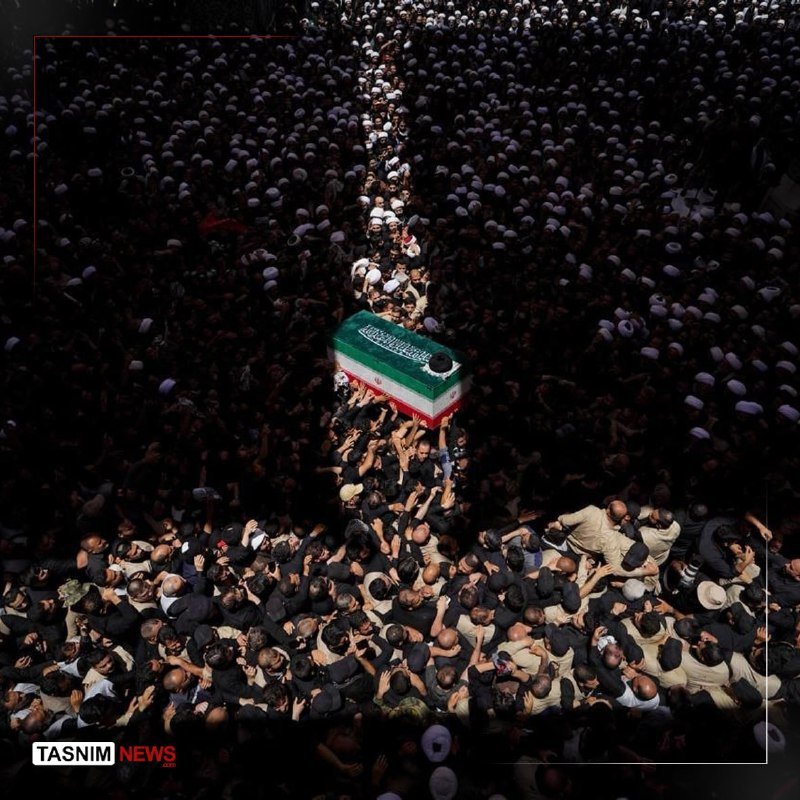
On 5 July 2026, Iran is mourning not in private rooms but in sequenced tableaux. By 16:40 UTC, Iranian state outlet Tasnim is circulating footage of what it calls the "caravan of devotion" — a procession from Shahrekord bound for the Mossali mausoleum in southern Tehran — under the persistent hashtags #Badarqa_Aghai_Shahid_Iran and #must_rise. Within the hour, two further dispatches land from the same feed: a caravan from Zanjan declaring, in the language state media has chosen for them, that "fatigue has no meaning for us," and one from Khuzestan insisting that "this unity of the nation makes enemies unable to do wrong." Tasnim's third posting of the afternoon, at 16:41 UTC, captures "the mood of Tehran's Mausoleum in the last hours of the passing away of the martyred leader." The word martyred, applied to a serving supreme leader, is itself the story: it places the succession inside the register of sacred sacrifice rather than ordinary political death.
The broadcast machinery is doing two things at once. It is recording grief, and it is shaping grief into a pattern. The geography is the argument — Zanjan in the north-west, Khuzestan in the south-west, Shahrekord in the central Zagros — describing a country that is mobilising, province by province, around a single point in Tehran. The lexicon is the second argument. References to Badarqa, a mourning invocation drawn from Shia commemorative practice, sit next to a political slogan (#must_rise) that converts lament into mobilisation. When the state news apparatus publishes on this cadence, on this scale, it is rarely performing only grief. It is performing legitimacy.
A scripted sorrow, with margins of spontaneity
The Iranian state's relationship with public mourning has long been one of authorship rather than observation. Hashemi Rafsanjani's funeral in 2017 and Qasem Soleimani's in January 2020 produced the template: choreographed processions, repeated hashtagged slogans, footage timed to the news cycle, and a hard editorial insistence on a single authorised emotional register. Tasnim's three near-simultaneous postings on the afternoon of 5 July fit that template almost perfectly. What is less standard is the explicit framing of the supreme leader as a martyr. That rhetorical move collapses the distance between clerical authority and the martyrdom tradition that has anchored the Islamic Republic's identity since its founding.
The phone videos and short messages Tasnim is republishing, however, also carry traces of a register the state cannot fully script — exhaustion, devotion, defiance braided together in the same sentence. The Zanjan dispatch's claim that "fatigue has no meaning" is, in its own way, an admission that fatigue has been raised. The Khuzestan dispatch's claim that national unity has the effect of neutralising "enemies" makes the political stakes explicit. None of this can be read as spontaneous, and none of it can be read as fully contained.
What the protest register is missing
The version of the country Tasnim is publishing has no counter-image. There is no feed from the bazaars, no fragments from the universities, no audio from the neighbourhoods where the official narrative meets friction. Iran's domestic information environment has been shaped for decades by a combination of official media dominance and selective filtering. Coverage of succession moments is shaped even more tightly. After the death of President Ebrahim Raisi in May 2024, for instance, the state apparatus coordinated the framing of grief and continuity almost without interruption; dissenting voices surfaced on diaspora outlets rather than inside Iran. The same asymmetry is structurally present today. A reader who relies only on Tasnim's three Sunday afternoon posts would see a country in unbreakable unison. Whether that picture matches what is happening inside the mausoleum precincts — let alone the streets beyond them — is the question neither the state broadcaster nor the opposition diaspora is incentivised to answer honestly.
The structural frame, in plain terms
A regime that has spent four decades institutionalising clerical rule treats the death of its supreme leader as an organisational problem before it is an emotional one. The choreography of mourning — processions disciplined by route, slogans selected by editorial room, hashtags chosen for their dual liturgical and political resonance — is the production of legitimacy at the precise moment that legitimacy is most exposed. In a system where the supreme leader is the integrating node, succession is the operation that proves whether the node can be replaced without the system decoupling. Public grief, performed at scale, is one of the instruments of that decoupling test. The other instruments sit behind closed doors: the Assembly of Experts convened to confirm a successor, the security services ensuring that the streets broadcast the version of the moment the state requires. What Tasnim is publishing on this Sunday afternoon is the visible half of that work. The invisible half is where the real decisions are being made.
What remains uncertain
Even from a single-state-media vantage, several things are not yet knowable. The identity of the successor has not been announced in the items circulated by Tasnim on 5 July. The institutional choreography around the funeral — which institutions participate, which clergy officiate, which foreign delegations are received — has not yet been detailed. The diaspora press has not, as of this writing, produced verifiable reporting on the temperature inside Tehran beyond the mausoleum. The pieces of the picture available today describe a regime performing unity with unusual discipline. They do not, on their own, prove that the unity is real, or that the discipline will hold once the cameras move on.
Desk note: Monexus is reading the public performance of mourning on its own terms, against the historical template of Iranian state choreography in succession moments. Future reporting will widen the source base beyond state media to diaspora outlets, neighbour-state coverage, and independent OSINT inside Iranian-language social media.
Wire provenance
This editorial synthesis draws on the following public wire/social posts:
- https://t.me/tasnimnews_en/66645
- https://t.me/tasnimnews_en/66644
- https://t.me/tasnimnews_en/66643
- https://t.me/tasnimnews_en/66642