A Funeral Pause, and the Geometry of De-escalation
Washington reportedly granted Tehran a ceremonial ceasefire window for Ayatollah Khamenei's funeral. The optics matter more than the substance — for now.
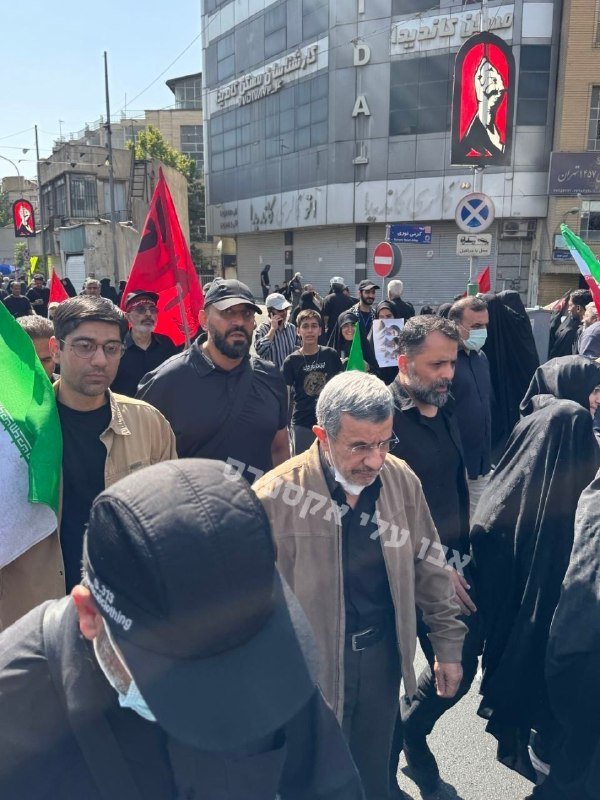
On 5 July 2026, the United States and the Islamic Republic of Iran are operating, by apparent mutual agreement, inside a one-week de-escalation window bracketed by a funeral procession. President Donald Trump disclosed on 4 July that Washington had extended Iran "a week off" for the mourning of Ayatollah Ali Khamenei, the late Supreme Leader, whose funeral prayer and inter-regional procession have become the organising event of the week in Tehran and beyond (Polymarket wire, 2026-07-04T19:56 UTC).
The framing matters because it concedes, in plain language, two things American administrations rarely concede on the record: that Washington calibrates the tempo of its pressure campaign around Iranian political theatre, and that Khamenei — whatever his precise status in the post-Khamenei order now taking shape — was treated, even in death, as a figure whose passage warranted diplomatic accommodation.
The optics are not the same as the substance. But the optics are the news.
What is actually being paused
The Iranian state-aligned channel IRIran_Military announced on 5 July that the funeral prayer for Khamenei would proceed and invited public participation through a registration portal, LetUsRise.net (Telegram: IRIran_Military, 2026-07-05T13:03 UTC). A separate Polymarket wire bulletin on 4 July confirmed that the funeral procession would travel through five cities across Iran and Iraq, a logistical detail that implicitly confirms the regional dimension of the mourning operation (Polymarket wire, 2026-07-04T15:57 UTC). Taken together, the two messages define the geometry of the week: a multi-city ceremonial movement, a US-acknowledged pause, and a closing window of roughly seven days.
It is the second component — Trump's disclosure — that introduces the political content. A "week off" is not a ceasefire, not a sanctions waiver, and not a negotiating track. It is, in the language of pressure campaigns, a deliberate pause in the cadence of coercive signalling: no new designations, no public ultimata, no strikes. The strategic effect is to allow Tehran to manage its internal transition without simultaneously managing an external escalation clock. Whether that is generosity or calculation depends on what comes after the week ends.
What the framing elides
Western wire coverage of an Iranian state funeral tends to flatten the event into a single image: a theocracy in mourning, an opportunity for the outside world to read the succession. That framing misses two things.
The first is agency. The decision to hold a five-city procession that crosses into Iraqi territory is itself a sovereign communicative act — a deliberate demonstration that the post-Khamenei order retains ritual reach across a border the United States would prefer to treat as a zone of managed containment. Iraqi participation, whatever its precise form, is not incidental; it is signal. The second thing the framing misses is the asymmetry of the pause. A US-acknowledged "week off" concedes that Washington's posture is the variable. Iran, by contrast, is conducting a funeral it would have held regardless of American preferences. The pause does not bind Tehran; it binds Washington.
That asymmetry has historically been the harder truth for US administrations to speak aloud. The Trump disclosure, casual in tone, may be the most candid American articulation of the constraint in years.
The structural read
A pause framed as deference to a funeral is, in plain terms, an acknowledgement that the United States does not currently possess — or does not currently wish to deploy — the instruments that would make a sustained pressure campaign on Iran costless. Coercive pressure on a state of Iran's institutional depth works only if it can be maintained continuously and credibly. Any visible accommodation, even a one-week ceremonial one, lets Tehran argue to its own elite audience that American pressure is intermittent and therefore negotiable.
This is not a new problem. It is the recurring geometry of pressure without resolution: a sanctions architecture that is real, a military option that is salient, and a negotiating position that has not yet been formalised into a deal. The funeral week does not change any of those variables. It does, however, convert them into a public countdown. When the week ends, the question on the table will be the same one that was on the table before the pause began.
The wider pattern here is older than this news cycle. Where a hegemonic power's leverage depends on tempo, any pause the adversary can name becomes leverage in the other direction. Funerals, in this sense, are not just rituals. They are deadlines that the other side gets to write.
Stakes, and what the week does not settle
If the trajectory holds, the funeral procession closes in the second week of July 2026 and the de-escalation window closes with it. Tehran's internal transition will then resume under whatever external conditions the United States chooses to set. For Washington's regional partners — Israel, the Gulf monarchies, the Iraqi government hosting a leg of the procession — the week is a buffer during which public positioning is constrained. For Iran's negotiating class, the week is a window in which to consolidate, signal, and prepare the terms under which they will re-engage.
What the sources do not yet specify is the precise content of any post-pause American posture: whether the week ends in renewed sanctions activity, a renewed negotiating track, or a return to the previous cadence without comment. Polymarket's bulletin records Trump's disclosure and the procession route, not the substance of any diplomatic exchange behind it. The Telegram announcement from IRIran_Military records the funeral programme and the public registration portal, not Iran's internal deliberations about succession. What is verifiable from the open sources is narrower than what the framing implies.
That gap is itself the news. A pause named in public is a pause whose duration both sides will be expected to honour, and whose end both sides will be expected to negotiate. The funeral is the deadline. The diplomacy has not yet begun.
This publication treats the Polymarket wire bulletins as a market-information feed rather than as editorial sourcing; the underlying claim of a US-acknowledged pause is taken from the bulletin text on its face, and the funeral logistics from the Iranian state-affiliated Telegram channel, with the latter's institutional position noted where it bears on the framing.
Wire provenance
This editorial synthesis draws on the following public wire/social posts:
- https://t.me/IRIran_Military