Macron Heads to Damascus: What a French Presidential Visit to Syria Actually Signals
Syria's presidency says Emmanuel Macron will travel to Damascus for high-level talks — a routine diplomatic move on its face, and anything but routine underneath.
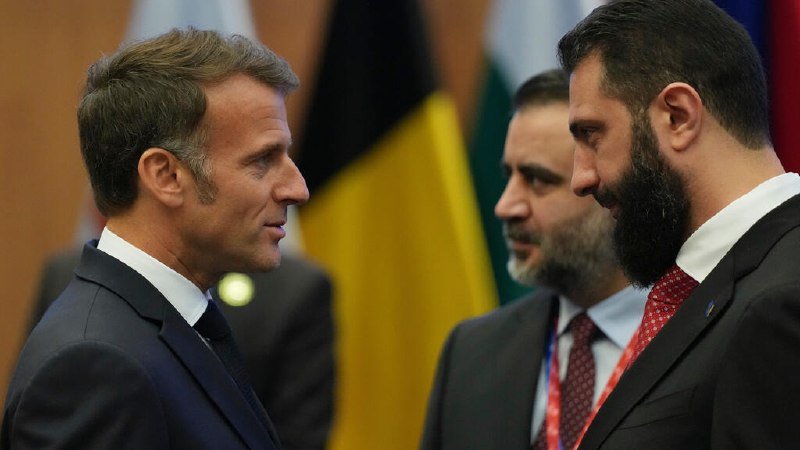
On Sunday 5 July 2026, Syria's presidential office said French President Emmanuel Macron will travel to Damascus for high-level discussions on the bilateral relationship. The announcement was carried by the Syrian Presidency's own media directorate and amplified through Telegram channels with ties to the Syrian state — including Jahan Tasnim and the pro-Damascus geopolitical desk GeoPWatch, both posting within the same hour. No date for the visit, no agenda, no delegation list, and no readout from the Élysée had been published at the time of writing.
A French president in Damascus is not a routine diplomatic stop. France broke with Syria more than a decade before the regional earthquake of late 2024, and the trip, when it happens, will be the first of its kind in years. The substance of the visit — what Paris recognises, what it conditions, and what it leaves quietly off the table — will say more about the European posture toward Syria than any communique that has run out of Paris in the last twelve months.
The announcement itself, and what it does not say
Two facts sit inside the wire. First, that the Syrian Presidency is the entity putting the visit into the public domain, not the Élysée. Second, that the framing — "high-level discussions regarding bilateral relations" — is conspicuously thin. There is no joint communique language, no signed framework, no announced working group. For a presidential visit, that silence is its own kind of statement: it lets Damascus own the optics at home while leaving Paris the room to define substance later.
The Telegram-sourced reporting from Jahan Tasnim and GeoPWatch on 5 July 2026 carries the wording the Syrian Presidency itself used. Neither channel characterised the visit beyond what Damascus released. That matters: the absence of editorial framing from either outlet suggests the announcement is being held deliberately narrow while it travels.
Why now, and why Paris
Europe is the diplomatic leg of Syria's reintegration problem. Gulf money and the Syrian state's regional patrons have already moved — capital, reconstruction contracts, reconstruction-adjacent visas. Europe lags because European policy is filtered through three further layers: sanctions architecture still technically in force in several jurisdictions, refugee-return politics back home, and the slow grind of conditional recognition that treats Damascus as a partner only on issues it can be made to deliver on.
France in particular carries weight in this file. Paris has historically been the European capital most willing to engage Damascus across changes of government — and the one that has most often redrawn its red lines when the regional picture shifted. A Macron visit, if it lands, would harden the European position's pro-engagement wing at precisely the moment some member states are still weighing whether engagement rewards reconstruction or merely legitimises the prevailing order on the ground.
The structural frame, without the theorist
This is a hegemonic transition in working clothes. The Syrian state is being recalibrated into a regional order in which the Gulf pulls the diplomatic capital, Türkiye holds the security perimeter, Russia carries residual influence, and Europe is being asked to underwrite the trade and reconstruction bill. Paris showing up in Damascus is Europe accepting the seat it has been offered at that table — not the seat Europe would have designed five years ago, but the seat that is on offer now.
The underlying deal is already visible in energy, port, and reconstruction-adjacent flows. The politics of recognition follow the politics of capital. A Macron visit converts a quiet realignment into an image that European publics will see on evening news — and that is itself part of the transaction.
Counter-read
The most plausible alternative read: the visit is theatre, not a realignment. Macron is heading into the back end of his mandate, the European sanctions file is still partially intact, and France has its own refugee politics to manage. The counter-story is that a presidential trip costs Paris almost nothing — a photograph, a joint statement, a working lunch — and buys the appearance of engagement without committing to the economic opening that would actually matter.
That read holds if the trip produces no commercial or sanctions-side deliverables. It collapses the moment a French concession appears on the wire — a banking channel reopened, a refugee-return mechanism signed, a delegation-level working group with a published calendar. The question to watch is which side of that line the eventual readout lands on.
Stakes
If the visit lands as engagement-without-substance, Damascus collects the photo and Europe keeps its options open. If the visit lands as the opening of a real bilateral track — banking, energy, consular services, refugee cooperation — then every European capital that has been sitting on its hands gets pushed off the fence.
For Syrian refugees, the trip's outcome is more material than symbolic. A real bilateral channel is what makes voluntary returns discussable on terms more dignified than the ones on offer today. For European taxpayers, the same channel is what determines whether reconstruction aid runs through multilateral plumbing or through the corridors of the regional actors already on the ground. The next seven to ten days will tell.
Desk note
Telegram-sourced announcements from the Syrian Presidency tend to be narrow on first publication, then filled in by wire reporting once Paris confirms. Monexus is treating the 5 July 2026 announcement as confirmed by Damascus and pending confirmation from the Élysée; we will update this piece once an official French readout, agenda, or delegation list appears on the wire.
Wire provenance
This editorial synthesis draws on the following public wire/social posts:
- https://t.me/JahanTasnim
- https://t.me/GeoPWatch