Pyongyang's naval power play: what two destroyers in a week actually means
A second Choe Hyon-class destroyer is undergoing sea trials within days of the first being commissioned, signalling an unusually rapid pace for Pyongyang's shipyards and raising fresh questions about the regime's strategic intent.
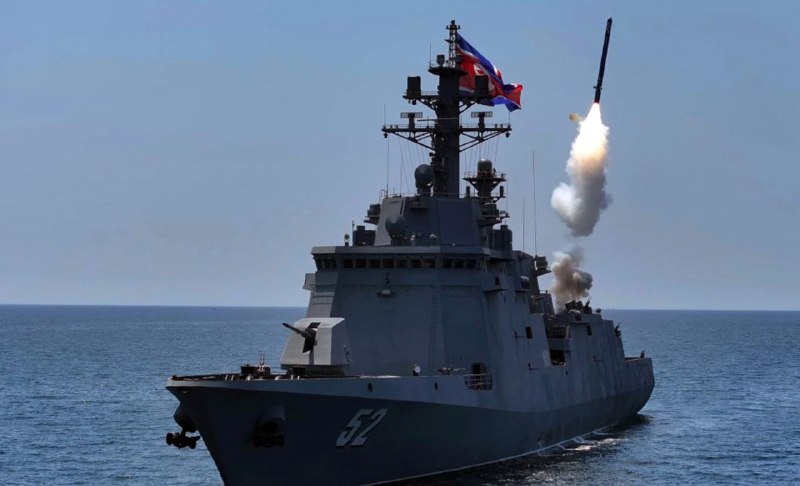
Within the span of a single week, North Korea has commissioned one destroyer and put a second through sea trials — a pace that, on the evidence available so far, has no recent precedent for the country's shipyards. The first vessel, the lead ship of the Choe Hyon class, was formally adopted by the Korean People's Navy in the days leading up to 5 July 2026. The second hull was photographed under tow and then under own power during trials on the east coast, according to the Russian-aligned military Telegram channel Rybar, which has been tracking the construction cycle since the lead ship was launched at Nampo in April 2025.
The headline number is two ships in a week, but the more telling figure is the gap between them. North Korea's previous naval expansion cycle measured hulls in years, not days. A programme that until recently produced a frigate every three to five years is now producing 5,000-ton destroyers at a tempo that suggests either genuine industrial acceleration, parallel-yard construction, or both. Each of those explanations carries a different policy implication for Seoul, Tokyo and Washington.
What is actually new
The Choe Hyon class is itself a recent invention. The first hull was publicly unveiled in April 2025, when Kim Jong Un attended a launch ceremony at the Nampo west shipyard and declared the vessel a step toward "building a powerful navy." The ship displaces roughly 5,000 tons and is visibly configured to carry vertical launch cells, suggesting a cruise-missile or short-range ballistic missile armament rather than the older gun-and-torpedo loadout typical of DPRK surface combatants. That configuration is the point of the programme: a navy optimised not for sea control against the ROK or US fleets, but for coastal denial and land-attack strike.
The second hull, now under trials, is reportedly being built at a different yard — the Rajin shipyard on the east coast, which has historically been used for cargo and auxiliary construction rather than major combatants. If confirmed by independent satellite imagery, that would be the more significant story: it would suggest the regime is treating the Choe Hyon line as a serial production run, not a one-off prestige project, and that it has quietly developed a second facility capable of cutting steel for hulls of this size.
The Russian read
Coverage of North Korean naval modernisation has, until recently, flowed almost entirely through Western wire services and South Korean defence briefs. The Rybar channel's reporting on the second destroyer — sourced to photographs and video circulating on DPRK state media and to its own observers on the Russian side of the Tumen — is one of the few places where the build-up is being tracked in near real time outside Seoul's intelligence cycle. Russian military commentators have framed the Choe Hyon class as part of a broader alignment between Pyongyang and Moscow, noting that North Korean munitions and personnel have flowed toward the Russian war effort in Ukraine and that naval cooperation could plausibly be reciprocated with technical assistance.
That framing is not the dominant one in Western capitals, where the destroyer programme is read primarily through a sanctions-enforcement lens: another hull means another vector for evading the UN cap on weapons of mass destruction-related technology, and another test bed for indigenous propulsion and launch systems. Both readings can be true. The interesting question is which one survives contact with the next round of imagery.
Structural stakes
A serial-production destroyer line matters less for what the ships can do in isolation than for what they signal about the regime's industrial priorities. North Korea has, for two decades, spent the bulk of its defence budget on ballistic missiles and artillery — weapons optimised for a land war on the peninsula. A sustained naval build-up implies that Pyongyang is preparing for a contingency in which the maritime dimension matters more: an extended blockade scenario, a strike campaign against US and ROK naval bases in the rear, or the protection of sea lines of communication for sanctioned trade.
It also implies something about resource allocation that the official media is unlikely to acknowledge. Steel, precision machine tools, marine-grade turbines and VLS engineering do not appear from nowhere. If the Choe Hyon line is genuinely a production run rather than a propaganda showcase, the regime is diverting scarce industrial capacity from the missile programme that has, until now, eaten the lion's share of the defence budget.
What the evidence does not yet show
The two hulls visible in this week's photographs are not, on their own, proof of a production run. A regime that builds two ships in a year has not necessarily built two shipyards, and a destroyer on trials has not necessarily cleared sea acceptance. The armaments fit is unknown. The propulsion arrangement — gas turbine, diesel, or steam — is unknown. The crew complement and the operational doctrine that would govern a five-thousand-ton surface combatant in the Korean People's Navy are, as of 5 July 2026, not in the public record.
What is in the public record is the tempo. One hull commissioned, one hull on trials, within a week. That is the fact to watch. Everything else — the Russian alignment thesis, the sanctions-evasion thesis, the industrial-acceleration thesis — is scaffolding around that observation. The next independent satellite pass over Nampo and Rajin will tell us which scaffolding holds.
This publication has tracked the Choe Hyon programme since the lead hull's April 2025 launch at Nampo. Where Western wires have focused on sanctions implications, the Telegram-channel evidence base tracks the construction cycle in closer to real time, and the structural read here leans on that operational detail rather than on policy framing from either Seoul or Washington.
Wire provenance
This editorial synthesis draws on the following public wire/social posts:
- https://t.me/rybar_in_english
- https://t.me/rybar