Tehran's farewell and the architecture of succession
Iran buries Ayatollah Khamenei as a movement, not just a man — and the question of who inherits the chair is now a question of who inherits the resistance project he built.
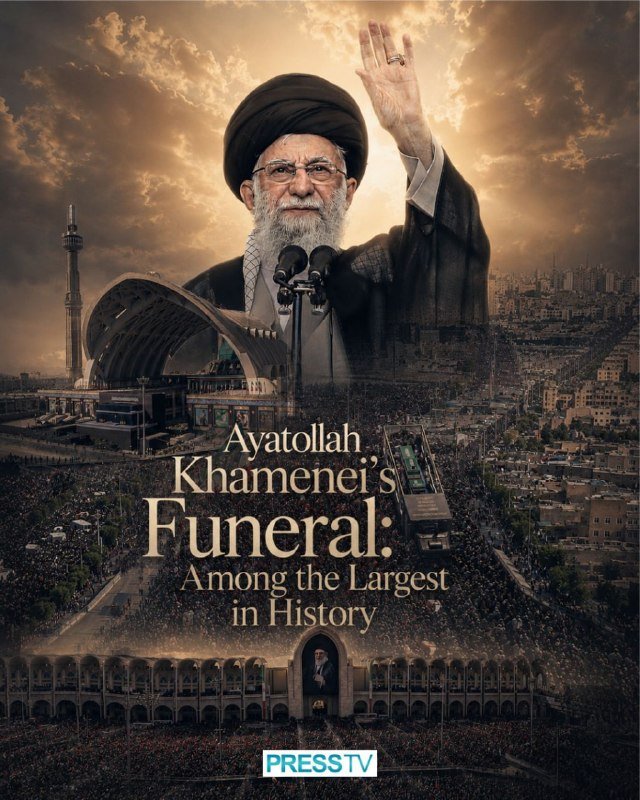
The crowds that filled central Tehran on Sunday did not gather to bury a head of state in the ordinary sense. They gathered to bury the architect of a project — the institutionalisation of resistance to what Iranian state media repeatedly, and without embarrassment, calls Western hegemony. State-aligned coverage describes the funeral of Ayatollah Seyed Ali Khamenei as a national farewell and, simultaneously, as a coronation of the line he leaves behind. The two framings are not in tension; in Tehran's telling, they are the same event.
The succession question is therefore not a personnel question. It is a question about whether the resistance project survives its principal organiser intact, or whether it fragments into a coalition of causes that no longer answers to a single capital.
What the funeral was, and what it was meant to be
Funeral proceedings unfolded through the day of 5 July 2026, with the formal prayer at the body of the martyred Leader drawing densely compact rows of mourners into central Tehran, according to material published on the Khamenei-related Telegram channel. Press TV's Zeinab Zakaria carried the ceremonial details in real time from the same thread of state-aligned coverage. The framing throughout was explicitly religious-national: the Leader was honoured as the Leader of the Islamic Revolution, with the word shaheed — martyr — applied to a man who died in office rather than on a battlefield. That choice of vocabulary matters. It places Khamenei inside the same semantic register as the paramilitary commanders and Hezbollah field officers the Iranian state has spent four decades lauding. The funeral is being staged as a continuation of the war by other means.
A short, telling item in the same Press TV thread is the headline that frames Khamenei's "defining legacy" as the institutionalising of resistance to Western hegemony. Note the verb. Not the waging of resistance, not the rhetorical defence of resistance — the institutionalising of it. That is a claim about an organisational inheritance: training pipelines, militia supply chains, ideological curricula, satellite broadcasting, and diplomatic cover. It is also a claim about the unfinished business of building those institutions deep enough to outlive any single figure.
The Axis reads itself through the funeral
The clearest signal of what is at stake came from outside Iran. The spokesperson for Palestinian Islamic Jihad used the occasion to attribute the "strength of the Resistance" to Khamenei's "lifelong sacrifices," in remarks carried by Press TV on 5 July. That is a movement telling its own members, and its rivals in the wider network, that the source of legitimacy runs through Tehran and will continue to do so. Similar messaging has, over the years, come from Hezbollah's Beirut operations room, from Houthi media in Sanaa, and from a constellation of Iraqi militias. The 5 July coverage gives the family of movements a single, dated occasion to perform unity at a moment when unity is no longer automatic.
The honest read is that the Axis of Resistance is not a unified command. It is a patronage network stitched together by training, payment, theological cover and political airtime. Khamenei was the patron of last resort. Whether his successor sits in the same office with the same authority, or whether the office itself is recut — perhaps into a collective leadership, perhaps into something closer to a junta of clerics and IRGC commanders — will determine whether the network holds together or frays into a set of regional insurgencies that increasingly answer to local sponsors.
What the succession is actually about
Western commentary tends to read Iranian leadership transitions through the prism of factional intrigue: reformists versus hardliners, principlists versus the Islamic Revolution Guards Corps, Khamenei's inner office versus the bonyads. That framing is not wrong; it is just incomplete. The deeper contest is over who gets to define what resistance means in a post-Khamenei Iran, and over the institutional levers — the Supreme National Security Council, the IRGC, the state broadcasters, the bonyads' patronage networks — that decide which definition gets funded and which gets starved.
Two readings are plausible. The first is that the office of Supreme Leader survives in form and that a continuity figure — likely from the same clerical establishment that produced Khamenei — occupies it, preserving the Axis's command architecture for another generation. The second is that the office is hollowed out, with real power migrating to the IRGC and to a shura-style collective, and that the Axis of Resistance becomes a brand rather than a chain of command. The sources currently available do not let us choose between these outcomes. They do tell us which one Tehran's official communicators prefer to project, and the answer is unambiguously the first.
Stakes, and what we do not yet know
If continuity holds, the practical consequence is the continuation of Iranian backing — financial, training, ballistic — for Hezbollah, for Palestinian Islamic Jihad, for the Houthis, and for the Iraqi Shia militias that have shaped the region's last two decades. The sanctions architecture built around Iran's nuclear file and around its regional proxies will continue to face an organised counterparty. If the office fragments, the Axis's external operations become a competition between sponsors — and competition among sponsors, in this region, has historically produced escalation as often as restraint.
What remains uncertain, even after Sunday's carefully staged performance of unity, is the order of battle behind the curtain. The state-aligned coverage on 5 July documents what the regime wants the world to see. It does not document the deliberations of the Assembly of Experts, nor the public statements of senior IRGC commanders, nor the private diplomacy that will shape the next six months. Those threads will have to be followed through independent reporting — wire services, analysts with deep Iran files, the regional embassies that maintain contact with all sides of the succession debate. Monexus will be reading those threads as they develop.
What is already legible is the strategic intent of the funeral itself: to make sure the world sees continuity, not transition, and to give the Axis of Resistance a single image to rally around in the period before the harder institutional questions answer themselves.
Desk note: this publication reads the 5 July coverage as a managed performance of continuity rather than a spontaneous outpouring, and treats Iranian state-aligned channels as primary-source material about Tehran's framing of itself — not as neutral description. Independent verification of succession mechanics remains pending.
Wire provenance
This editorial synthesis draws on the following public wire/social posts:
- https://t.me/Khamenei_es
- https://t.me/presstv
- https://t.me/presstv
- https://t.me/presstv