A succession crisis in Tehran, and the choreography of grief
Within hours of Ayatollah Ali Khamenei's reported death, state-aligned channels choreographed a vast public outpouring in Tehran — and a quieter conversation began about who actually inherits the Islamic Republic.
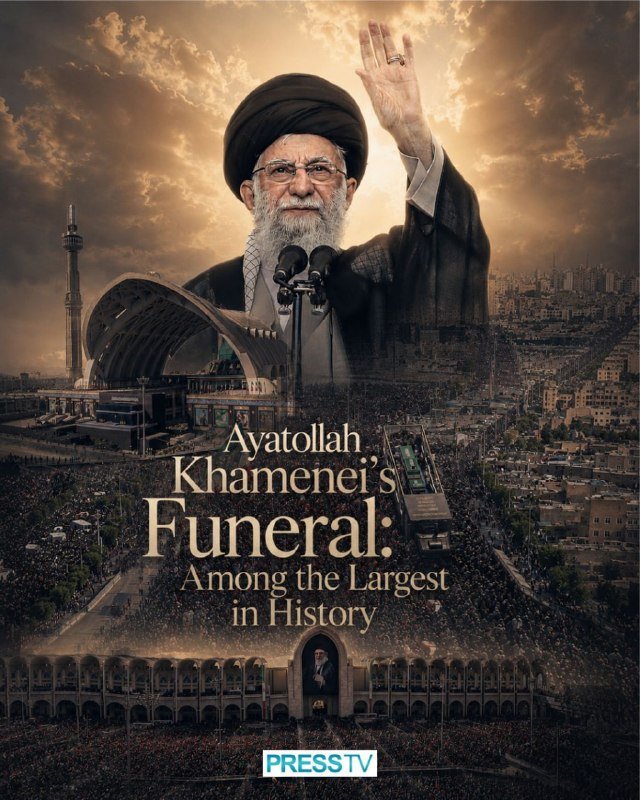
Inside the first twenty-four hours of a leadership vacuum, the visual record tends to matter more than the communiqués. By 20:00 local time on 5 July 2026, the Mosala prayer hall in central Tehran was, according to the Fotros Resistance channel on Telegram, still packed with mourners chanting "Ya Hussein" — a refrain with deep roots in Shia commemorative ritual — twelve hours after the gates had first been opened. The same channel described a turnout in the millions, with the surrounding streets of the capital full and overflow crowds unable to reach the hall itself. The man being mourned is Ayatollah Ali Khamenei, the Islamic Republic's second supreme leader, whose death the channel characterised as martyrdom.
The choreography of grief in a theocratic republic is not incidental — it is policy. Within hours, the public square was being mobilised in a form that fuses liturgical mourning with regime legitimacy. The same channel that reported the turnout also reported the political claim, putting forward Khamenei's son, Ayatollah Mojtaba Khamenei, as a fait accompli: "Ayatollah Khamenei has left us, he gifted us Ayatollah Khamenei Jr." The shorthand matters. It frames succession as inheritance rather than as a contested selection process.
What is actually being claimed
The reports should be read as claims, not as confirmed facts. Fotros Resistance is a Persian-language opposition channel; its coverage of the Iranian state is oppositional in framing, and it routinely uses terms — martyred leader, martyrdom — that echo the religious register of the Islamic Republic itself, though deployed for a different political end. The phrase "10 million attendees" is its own estimate of scale rather than a verified attendance figure. No wire service or international outlet has, in the material available to this publication, corroborated either the cause of Khamenei's reported death or the size of the gathering, and the Iranian state has, in the snippets captured, not been independently reached for confirmation.
That epistemic gap is the story behind the story. In a system where the Assembly of Experts is the formal selector of the supreme leader, and where that body has, in living memory, produced exactly one succession, the question of who now sits at the top of the Iranian state is not a detail. It is the question on which the Republic's foreign policy, nuclear posture, regional alliances, and domestic repression architecture all turn. Reporting that names a successor before that body has spoken — as the Fotros Resistance channel is doing with Mojtaba Khamenei — is not neutral observation. It is an attempt to fix, in advance, what is formally an open question.
The counter-frame: grief as governance
There is a plausible alternative read of the photographs, and a serious one. The state-aligned framing — that Iranians have turned out in their millions to honour a martyred leader — is, on the face of it, a piece of authoritarian stagecraft. The Mosala is a venue designed for mass political-religious gatherings; the regime's habit of filling it, and of mobilising bussing from provincial bases, is well documented in the international press. A crowd of millions, on this reading, is not evidence of organic devotion but of an apparatus that knows how to manufacture the appearance of consensus at precisely the moment the regime most needs it.
That reading is not, however, the only one. Crowds at Shia commemorations across the region genuinely do swell in ways that are neither fully spontaneous nor fully coerced. The mourning cycles of Muharram produce some of the largest sustained public gatherings on earth, and the latmiyya dirge tradition makes "Ya Hussein" a refrain that is learnt in childhood rather than imposed at checkpoint. A serious analysis has to hold both possibilities at once: the gathering is being instrumentalised by the state, and the grief expressed in it is, for many participants, real. Confusing the two is a category error that the opposition press can be as prone to as the state press, just in the opposite direction.
The structural picture
Strip away the slogans and the structural question is straightforward. Iran is, in the immediate term, a one-leader state. Every institutional check on the supreme leader — the presidency, the parliament, the judiciary, the Guardian Council, the Expediency Council, the Assembly of Experts, the Islamic Revolutionary Guard Corps — is structurally subordinate. That architecture was deliberately built to be activated, not by routine, but by succession. When a supreme leader dies, the system is meant to function through a specific, legally specified mechanism: a transitional council operates until the Assembly of Experts chooses a successor. Whether that mechanism has actually been activated, has been bypassed, or is being shadowed by an informal pre-selection, is the most consequential political fact in the Middle East this week, and is precisely the fact that the available reporting cannot yet confirm.
The reports from opposition channels are useful as a temperature reading of the Persian-language conversation, but they are not a substitute for verification. The Iranian state's eventual official announcement of the supreme leader's death — the date, the cause, the order of succession — will be the load-bearing fact, and the international wire services will rightly treat it as the primary source for it. Until that announcement, the gap between what is being claimed inside Iran and what is being verified from outside it is itself the news.
The stakes
Who inherits the Islamic Republic will determine, over a five-to-ten-year horizon, whether the nuclear file reopens, whether the axis of resistance in Lebanon, Iraq, Yemen and Syria is held together or allowed to fray, and whether the domestic repression apparatus hardens further or, in the chaos of a contested succession, cracks. A hereditary succession — even one dressed in clerical robes — would consolidate one faction of the security state and alienate another, with consequences that flow well beyond Tehran. A contested succession inside the clerical establishment would do the opposite. The crowd at the Mosala, real and manufactured at the same time, is the visible surface of an event whose real consequences will be settled in rooms no camera has entered.
Desk note: Monexus has reported this from opposition-channel testimony and from the visual record, and has not relied on state-aligned framing. The piece is deliberately written to hold the verifiability of claims lightly until wire confirmation of the underlying event — the supreme leader's death, and the identity of any successor — is on the record.
Wire provenance
This editorial synthesis draws on the following public wire/social posts:
- https://t.me/FotrosResistancee
- https://t.me/FotrosResistancee
- https://t.me/FotrosResistancee